
When a Trust Doesn’t Feel Right: What You Need to Know
Contesting a trust is the legal process of challenging whether a trust — or specific provisions within it — is valid in court.
Here’s a quick overview of what it involves:
- Who can contest: Beneficiaries, heirs, and other interested parties with a financial stake in the outcome
- Valid grounds: Lack of mental capacity, undue influence, fraud, forgery, improper execution, or mistake
- How to start: File a petition or civil complaint in probate court
- Time limits: Vary by state — as short as 120 days from receiving trustee notice in some states
- Cost range: A few thousand dollars to $100,000 or more, depending on complexity
- Key risk: No-contest clauses may cause you to forfeit your inheritance if you lose
When a loved one dies and their trust doesn’t reflect what you believed their true wishes to be, the feeling can be devastating. Maybe a new caregiver appeared out of nowhere. Maybe the trust was changed just weeks before death. Maybe a sibling who handled all the finances ended up with nearly everything.
These situations don’t always mean something went wrong legally — but sometimes they do.
The problem is that simply feeling shortchanged isn’t enough to win a trust contest. Courts start with a strong presumption that the trust document reflects what the settlor actually wanted. Overturning that requires solid legal grounds and compelling evidence.
This guide walks you through exactly how the process works, what it costs, and what your realistic chances are — so you can make a smart, informed decision before taking any action.
Must-know Contesting a trust terms:
Understanding the Legal Framework of Contesting a trust
To navigate the waters of trust litigation in April 2026, we first need to understand the terminology and the environment of the Probate Court. A trust isn’t just a piece of paper; it is a legal entity. When we talk about Contesting a trust, we are essentially asking a judge to look at the Trust Instrument (the document itself) and declare it void, either in part or in its entirety.

The primary players in this drama are the Settlor (the person who created the trust and put their assets into it), the Trustee (the person or entity currently managing those assets), and the Beneficiary (the person meant to receive the assets). In our experience at National Probate Partners, disputes often arise when the Trustee is accused of failing in their fiduciary duty–the legal obligation to act solely in the best interest of the beneficiaries.
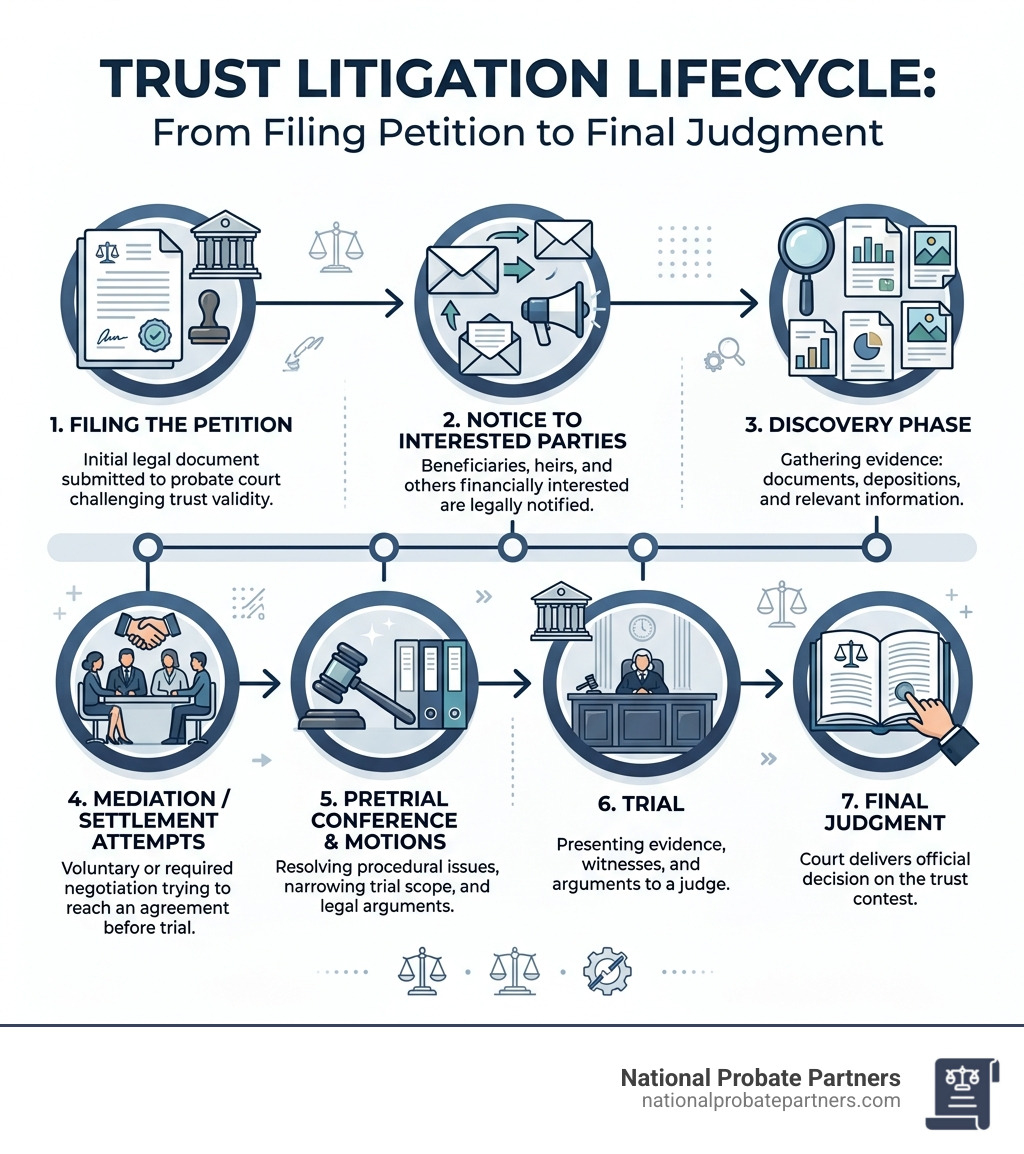
Unlike a will, which must go through a public probate process, trusts are often handled privately. However, when a dispute arises, it moves into the public sphere. We initiate the process by filing a Civil Complaint or a petition in the probate court. This starts a formal litigation lifecycle that includes discovery, mediation, and potentially a trial. It is important to remember that the court’s primary goal is to honor the Settlor’s intent. If the paperwork looks correct and the signatures are notarized, the court will assume everything is fine until we prove otherwise.
Determining Standing: Who Has the Right to Sue?
Not just anyone can walk into a court in Texas or Arizona and challenge a trust. You must have what we call Standing. In the legal world, standing means you are an Interested Party—someone who has a personal, financial stake in the outcome of the case.
Generally, the following people have standing to pursue Contesting a trust:
- Named Beneficiaries: If you are in the current trust but believe you were supposed to receive more, or if a recent amendment unfairly reduced your share.
- Heirs at Law: These are relatives (like children or spouses) who would legally inherit the assets under state “intestacy” laws if the trust were found to be completely invalid.
- Disinherited Heirs: If you were in a previous version of the trust but were suddenly removed in the final version, you have a Pecuniary Interest (a financial interest) in proving the new version is invalid.
- Successor Trustees: Sometimes the person next in line to manage the trust has standing if they believe the current trustee is unfit or the trust was amended illegally.
What about a “non-beneficiary”? Usually, if you aren’t a relative and weren’t named in any version of the trust, you don’t have the right to sue just because you think the Settlor made a bad choice. However, creditors who are owed money by the estate may sometimes have standing to ensure assets aren’t being hidden or mismanaged.
If you are unsure where you fit in this hierarchy, it helps to look beyond probate: the role of a trust administration lawyer to see how these roles interact during the management of an estate.
Valid Grounds and Necessary Evidence
Winning a trust contest requires more than a hunch; it requires proving specific legal “grounds.” You can’t just say, “Dad liked me more, so this trust must be wrong.” You have to prove the document itself is legally flawed.
Legal Grounds for Contesting a trust
There are several common reasons we see for a trust to be overturned:
- Undue Influence: This is the most common ground. It involves someone–often a caregiver or a “favorite” child–using excessive persuasion to overcome the Settlor’s free will. It’s not just nagging; it’s a level of influence that makes the trust reflect the influencer’s wishes, not the Settlor’s. Legal definitions of undue influence emphasize that the victim’s free agency must be destroyed.
- Lack of Mental Capacity: We must prove the Settlor didn’t understand what they were signing, who their family was, or the extent of their assets at the time of signing.
- Fraud in the Inducement: This happens when someone lies to the Settlor to get them to change the trust (e.g., “Your daughter stole money from you, you should cut her out”).
- Improper Execution: Every state has rules. If a trust required two witnesses and only had one, it might be invalid.
- Mistake of Fact: If the Settlor signed the document thinking it was something else entirely.
- Revocation: Proving that the Settlor actually cancelled the trust or created a newer one that replaces the old one.
While many people think an Irrevocable Trust cannot be touched, it can still be challenged on these same grounds if the fraud or lack of capacity occurred at the moment it was created. For more detail on these concepts, you can read Is That Will Valid? Exploring the Grounds for a Contest.
Essential Evidence for Contesting a trust
The Burden of Proof usually rests on the person bringing the challenge. To meet this burden, we need a mountain of evidence:
- Medical Records: These are vital for proving lack of capacity. We look for diagnoses of dementia, Alzheimer’s, or heavy medication use around the date the trust was signed.
- Expert Testimony: We often hire medical experts or handwriting analysts (to check for Forgery).
- Witness Statements: Friends, neighbors, and even the notary who signed the document can provide “contemporaneous notes” about the Settlor’s state of mind.
- Forensic Accounting: If we suspect a trustee has been dipping into the funds, we follow the money. This is often part of understanding breach of trust and how to protect your assets.
- Electronic Evidence: Emails, texts, and even social media posts can show a pattern of Undue Influence or reveal the Settlor’s true intentions.
Navigating No-Contest Clauses and Litigation Costs
One of the biggest “scare tactics” in a trust is the No-contest Clause. This is a provision that says, “If you challenge this trust and lose, you get absolutely nothing.”
In many states like Texas and Arizona, these clauses are enforceable, but they have Probable Cause Exceptions. This means if you have a really good, evidence-backed reason to challenge the trust (like a clear medical record of dementia), the court might not punish you even if you don’t ultimately win. However, if you’re just “fishing” for money, you risk losing whatever share you were originally given.
Then there is the matter of the bill. Contesting a trust is not cheap.
- Attorney Fees: Most trust litigators charge by the hour (ranging from $300 to $700+). Some may take cases on a contingency basis if the estate is very large and the evidence is overwhelming.
- Total Costs: A simple dispute might cost $10,000 to $50,000. A complex, multi-year battle over a multi-million dollar estate can easily exceed $250,000.
- Asset Freezing: During the contest, we often ask for Preliminary Injunctions to freeze the trust assets. This prevents the Trustee from spending all the money on their own legal defense or “disappearing” the funds before the judge rules.
To get a better sense of these battles, check out our guide on probate disputes: what you need to know from a probate lawyer.
Frequently Asked Questions about Trust Litigation
What are the chances of winning a trust contest?
The honest answer? It depends entirely on the strength of your evidence. Cases based purely on “it’s not fair” have a success rate near zero. However, cases with clear medical evidence of incapacity or documented proof of fraud have much higher success rates.
Interestingly, less than 2% of these cases actually go to a full trial. Most end in a Settlement Probability because litigation is so expensive and stressful that both sides eventually agree to meet in the middle. Judicial Deference is real—judges don’t like overturning trusts unless the evidence is “clear and convincing.”
Can you contest a trust while the grantor is still alive?
In April 2026, the law generally says you cannot contest a Revocable Trust while the Settlor is alive and mentally competent. Why? Because they can just change it back the next day!
However, there is a Legal Standing Shift if the Settlor becomes mentally incompetent. If a daughter discovers that a “new friend” has tricked her father (who has advanced dementia) into changing his trust, she may be able to challenge that amendment immediately to protect her father’s assets.
How can you prevent a trust from being contested?
If you are the one creating the trust, you can take steps to make it “bulletproof”:
- Clear Language: Don’t leave room for interpretation.
- Competency Exams: Have a doctor certify your mental state on the day you sign.
- Video Documentation: A video of you explaining why you are making certain choices can be powerful evidence of your intent.
- Disinterested Witnesses: Use witnesses who have no financial stake in your estate.
- Professional Drafting: Avoid DIY kits. A specialized attorney is your best defense.
Conclusion
Contesting a trust is a marathon, not a sprint. It requires a mix of legal strategy, emotional resilience, and financial investment. While the process can be daunting, it is often the only way to ensure that justice is served and a loved one’s true legacy is protected.
At National Probate Partners, we often find that Mediation and Settlement Agreements are the most effective ways to resolve these disputes without “losing your mind” or your entire inheritance to legal fees. Whether you are dealing with a complex estate in Scottsdale or a family dispute in Corpus Christi, understanding the nuances of trust vs probate: what’s the difference and why it matters is the first step toward a resolution.
If you believe a trust has been unfairly manipulated or improperly handled, don’t wait. Statutes of limitations are strict, and the sooner you act, the better your chances of preserving the assets. Contact an experienced probate lawyer today to discuss your options and protect your family’s future.