
When a Loved One’s Final Wishes Are in Doubt: What You Need to Know
Contested wills & probate lawyers are legal specialists who help you challenge or defend a will — or resolve broader estate disputes — when something about an inheritance doesn’t seem right.
Here’s a quick overview of when and how they can help:
| Situation | What a Contested Wills & Probate Lawyer Does |
|---|---|
| You suspect the will was signed under pressure | Investigates undue influence and gathers evidence |
| You believe the deceased lacked mental capacity | Obtains medical records and expert testimony |
| The will appears forged or improperly signed | Challenges validity in probate court |
| You were left out despite being a dependent | Files a claim under inheritance or family provision laws |
| Probate is moving forward on a suspicious will | Files a caveat to pause the process |
| Executor is mismanaging the estate | Pursues fiduciary litigation or removal |
Losing someone you love is hard enough. Discovering that their estate isn’t being handled the way they intended — or that you’ve been unexpectedly cut out — makes an already painful time even harder.
Maybe a caregiver was involved at the last minute. Maybe the will was changed suddenly during an illness. Maybe a family member is pushing through probate on a document that doesn’t reflect your loved one’s true wishes.
These situations are more common than most people realize. And the legal window to act is often shorter than you’d expect — sometimes as little as six months from the grant of probate for certain claims.
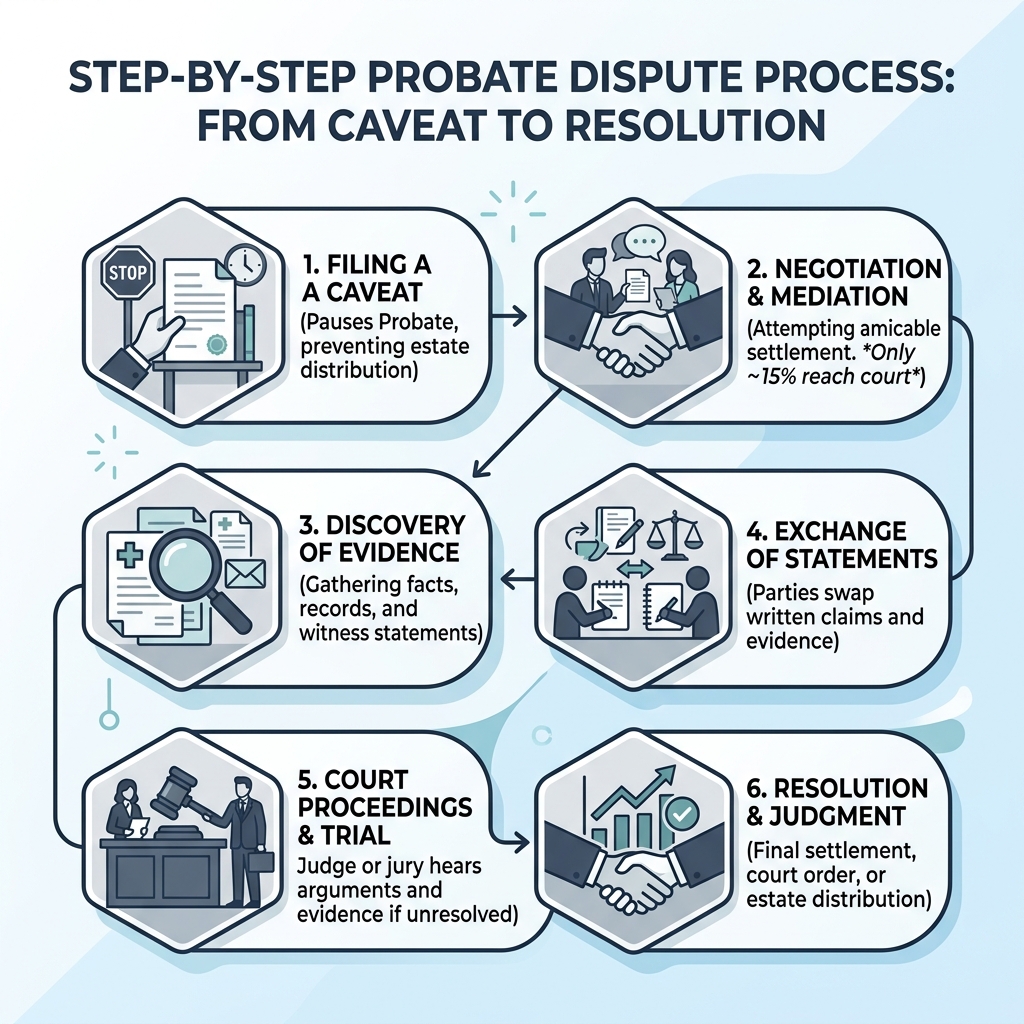
The good news? Most inheritance disputes never reach a courtroom. Research shows that only around 15% of disputes progress all the way to a final court hearing — meaning skilled legal guidance can often resolve things faster and with far less conflict than you might fear.
This guide walks you through exactly how the process works, what your options are, and how to protect your rights.
Contested wills & probate lawyers further reading:
Common Grounds for Challenging a Will

When we talk about challenging a will, it isn’t just about being unhappy with your share. To legally “contest” a will, you must have specific legal grounds. In our experience at National Probate Partners, most disputes boil down to a few core issues regarding the document’s validity.
According to section 55.001 of the Texas Estates Code, any person “interested in an estate” can challenge a will. But what are the actual reasons a judge might throw a will out?
- Lack of Testamentary Capacity: This is one of the most frequent claims. It means the person making the will (the testator) didn’t have the “sound mind” required to understand what they were doing. They must understand they are making a will, know the nature of their property, and recognize their “natural objects of bounty” (their family and heirs).
- Undue Influence: This occurs when someone exerts so much pressure on the testator that the will no longer reflects the testator’s true wishes, but rather the wishes of the influencer. We often see this in cases involving live-in caregivers or estranged relatives who suddenly reappear.
- Fraud or Forgery: If someone tricked the deceased into signing a document by telling them it was something else, or if the signature on the will isn’t actually theirs, the will is invalid.
- Improper Execution: Every state has strict rules for how a will must be signed. For example, in Texas, a will must be in writing, signed by the testator, and witnessed by at least two credible witnesses who are at least 14 years old. If these formalities aren’t met, the will can be contested.
- Insane Delusion: This is a specific type of incapacity where the testator holds a persistent, false belief that has no basis in reality, and that belief dictates how they distribute their assets.
For a deeper dive into these requirements, check out our guide on Is That Will Valid? Exploring the Grounds for a Contest.
Proving Lack of Capacity and Undue Influence
Proving these grounds isn’t always easy. It’s not enough to say, “Mom was forgetful.” You need concrete evidence. Contested wills & probate lawyers typically look for:
- Medical Records: Evidence of dementia, Alzheimer’s, or the use of heavy medications at the time the will was signed.
- Witness Testimony: Statements from friends, neighbors, or even the lawyer who drafted the will regarding the testator’s state of mind.
- Expert Evidence: We often work with medical experts who can review records and testify about cognitive decline.
- Evidence of Coercion: Showing that a beneficiary isolated the deceased from other family members or controlled their finances and communication.
Understanding these nuances is vital. You can learn more in our article on Probate Disputes: What You Need to Know from a Probate Lawyer.
The Legal Process: How Contested Wills & Probate Lawyers Navigate Disputes
The path to resolving an inheritance dispute is structured and highly technical. It begins with “standing.” You can’t just contest a neighbor’s will because you think they should have left you their classic car; you must have a personal and financial stake in the outcome.
In Texas, anyone with a financial stake in the outcome of the estate has the standing to challenge a will. This usually includes heirs-at-law (people who would inherit if there were no will) and beneficiaries named in a previous version of the will.
Once standing is established, the process typically follows these steps:
- Filing a Caveat or Objection: This is a formal notice to the court to pause the “grant of probate.” It prevents the executor from distributing assets while the dispute is active.
- The Discovery Phase: This is the “investigation” stage. We use this time to gather medical records, bank statements, and take depositions (sworn statements) from witnesses.
- Fiduciary Duty Review: We examine whether the executor is acting in the best interest of all beneficiaries. If they are self-dealing or hiding information, we may pursue fiduciary litigation.
The Role of Contested Wills & Probate Lawyers in Proving Standing
Proving you have the right to be in court is the first hurdle. We help identify your status as an “interested person.” Whether you are a disinherited child or a prior beneficiary, we ensure your right to be heard is protected. For more on this, see Do You Need a Probate Attorney? Unpacking Their Role.
Critical Deadlines and Statute of Limitations
Time is your biggest enemy in probate litigation. If you wait too long, you lose your right to claim forever.
- Texas: Generally, a will contest must be filed within two years from the date the will was admitted to probate. This is two years from the court’s admission, not the date of death.
- New Mexico: Personal representatives must respond to creditor claims within 60 days. If you are a creditor or have a claim, you must act fast. Check out more details via this New Mexico Contested Probate of Wills Lawyer resource.
- Inheritance Act Claims: In some jurisdictions, if you are claiming “reasonable financial provision” because you were a dependent, you may have as little as six months from the grant of probate to file.
Advanced Legal Claims: Inheritance Act and Proprietary Estoppel
Sometimes, the will is technically “valid,” but it is still fundamentally unfair under the law. This is where advanced legal claims come into play.
The Inheritance Act (and Family Provision): While specific laws vary by state and country, many jurisdictions (including those influenced by the Inheritance Act 1975) allow spouses and dependents to claim that a will did not make “reasonable financial provision” for them. In the U.S., states like New Mexico provide specific protections, such as a $30,000 family allowance and a $15,000 personal property allowance for eligible beneficiaries, regardless of what the will says.
In Texas, a surviving spouse has significant rights to “community property,” meaning they generally own half of all assets acquired during the marriage, even if the will tries to give them away to someone else. You can find more about beneficiary rights in The Named Beneficiary in a Will: Your Essential Guide.
Proprietary Estoppel and Broken Promises
Have you ever been told, “If you stay and take care of the family farm, it will be yours one day,” only to find out the will leaves it to a distant cousin? This is where proprietary estoppel comes in. To win this claim, we must prove:
- A promise was made to you.
- You relied on that promise (e.g., you worked for low wages or didn’t buy your own home).
- You suffered a “detriment” because the promise was broken.
This is a powerful tool for asset recovery when a written will doesn’t tell the whole story.
Why Specialized Contested Wills & Probate Lawyers Are Essential
Estate disputes often involve more than just a house and a bank account. We handle:
- Complex Business Structures: When a family business is at stake, the dispute involves corporate law and valuation.
- International Assets: Dealing with property in other countries requires knowledge of cross-border probate laws.
- Multi-jurisdictional Claims: If the deceased lived in Texas but had property in Arizona or Europe, things get complicated quickly.
If you’re unsure if your situation qualifies, read How Do I Know If I Need a Probate Lawyer?.
Managing Costs and Timelines with Contested Wills & Probate Lawyers
We know what you’re thinking: “Isn’t this going to cost a fortune?” While litigation can be expensive, there are many ways to manage costs.
| Feature | Mediation | Court Litigation |
|---|---|---|
| Cost | Usually lower; shared between parties | Higher; includes court fees and expert costs |
| Speed | Can be resolved in weeks or months | Can take 1–3 years |
| Privacy | Confidential | Public record |
| Control | Parties decide the outcome | Judge or Jury decides |
| Success Rate | Very high (about 85% of cases settle) | Only 15% of cases go to trial |
Funding Options:
- Hourly Rates: The traditional method where you pay for the time spent on the case.
- Contingency Fees: In some strong cases, we may work on a “no-win, no-fee” basis (or a percentage of the recovered amount).
- Legal Expenses Insurance: Some homeowners’ policies actually cover legal disputes over inheritances.
For more details on costs, see our Probate Lawyer FAQ: What You Need to Know When Hiring a Probate Lawyer.
Resolving Disputes Through Alternative Dispute Resolution
We always aim for family harmony and cost-effective solutions first. Mediation is a fantastic tool where a neutral third party helps both sides reach a compromise. Given that only 15% of cases ever see a judge, negotiation is usually the most efficient path. You can learn more about these strategies in The Ultimate Probate Lawyer FAQ – 2025 Edition | National Probate Partners.
Frequently Asked Questions about Contested Probate
Can a will be contested after probate has been granted?
Yes, but it is much harder. In Texas, you generally have a two-year window after the will is admitted to probate to file a contest. If you discover fraud or a later will after this period, there may be very limited “tolling exceptions,” but you should contact a lawyer immediately.
What happens if there is no will (intestacy)?
If there is no will, the state’s “intestacy laws” decide who gets what. This often leads to “heirship proceedings” where the court must officially determine who the legal heirs are. This can be just as contentious as a will dispute, especially in blended families.
How effective are ‘no-contest’ clauses in wills?
A “no-contest” clause (or in terrorem clause) says that if you challenge the will and lose, you forfeit whatever was left to you. However, these are not always enforceable. In many states, if you have “probable cause” and are acting in “good faith,” the court will not enforce the forfeiture, even if you lose the challenge.
Conclusion
At National Probate Partners, we understand that behind every legal file is a family grieving a loss. Whether you are in San Antonio, Scottsdale, or serving in the Armed Forces abroad, we provide compassionate, expert representation to ensure your loved one’s true wishes are honored.
Probate disputes are complex, but you don’t have to face them alone. From Texas probate expertise to nationwide service, we are here to help you navigate the storm.
If you have more questions, please visit our The Ultimate Probate Lawyer FAQ – 2025 Edition | National Probate Partners or Visit National Probate Partners to schedule a consultation. Let us help you fight for your fair share.