
When You Need a Guardianship Attorney Near You: What to Know First
Guardianship attorneys near me are legal professionals who help families protect loved ones — whether minor children or incapacitated adults — by navigating the court process to establish legal guardianship.
If you need a quick answer, here’s how to find and work with one:
- Search locally — Look for attorneys who specialize in guardianship, elder law, or estate planning in your state
- Check credentials — Look for board certifications, state bar membership, and experience with guardianship proceedings
- Schedule a consultation — Most guardianship attorneys offer an initial consultation to review your situation
- Understand your options — A good attorney will explain alternatives like powers of attorney or conservatorship before filing a petition
- Prepare your evidence — Courts require proof of incapacity, so gather medical or psychological evaluations early
When a loved one can no longer make decisions for themselves — due to age, illness, disability, or injury — the people who care about them are often left scrambling. Who has the legal authority to step in? Who can make medical decisions? Who protects their finances?
Many families are surprised to learn that being a spouse, parent, or adult child does not automatically give you legal authority over an incompetent adult. In many jurisdictions, you need a court to appoint you as a legal guardian first.
That’s a stressful realization — especially when you’re already dealing with an emotional family situation.
Guardianship law is complex. It varies significantly by state. And the stakes are high: you’re asking a court to grant someone authority over another person’s life, health, and finances.
Getting it right matters. That’s where a qualified guardianship attorney becomes essential.
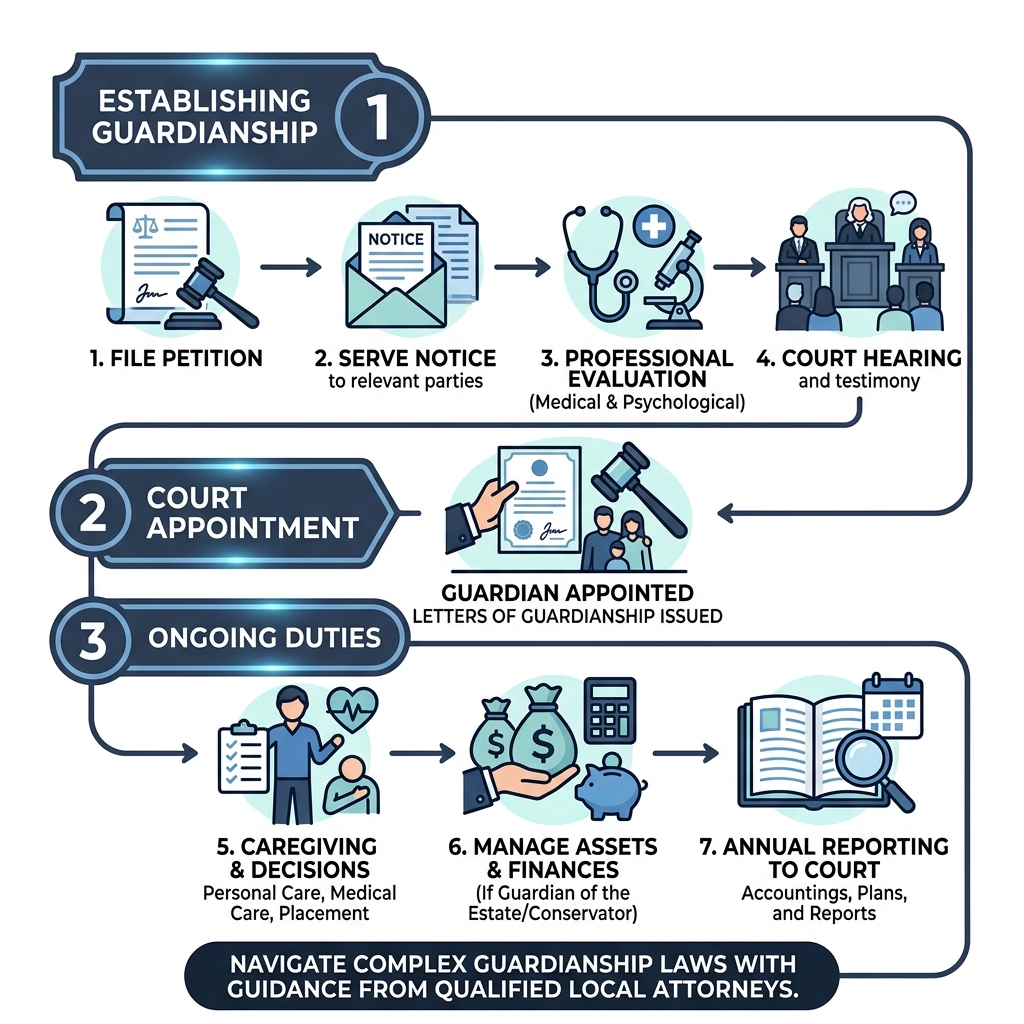
Easy guardianship attorneys near me word list:
Understanding the Role of Guardianship Attorneys Near Me
When you begin searching for guardianship attorneys near me, you are looking for more than just someone to fill out paperwork. You are seeking a guide through a process that fundamentally shifts legal rights from one person (the “ward”) to another (the “guardian”).
A guardianship attorney provides the legal authority necessary for a caretaker to manage the personal care and financial affairs of someone who cannot do so themselves. This might involve an aging parent with Alzheimer’s, a disabled child “aging out” of minority status, or an adult incapacitated by a sudden accident.
Navigating these waters requires a deep understanding of state-specific statutes. For instance, Navigating Elder Guardianship in Texas: A Compass for Caregivers highlights how Texas law treats the protection of seniors.

Guardianship vs. Conservatorship: A Quick Comparison
In many states, the court splits these responsibilities into two distinct roles. While some people use the terms interchangeably, they often have very different legal meanings.
| Feature | Guardianship (of the Person) | Conservatorship (of the Estate) |
|---|---|---|
| Primary Focus | Personal well-being and daily care | Financial management and assets |
| Decisions Made | Medical care, housing, food, clothing | Banking, investments, paying bills |
| Goal | Ensure the ward’s safety and health | Protect and preserve the ward’s estate |
| Reporting | Annual reports on the ward’s condition | Annual accounting of all financial transactions |
Personal Care vs. Financial Management
A Guardian of the Person is responsible for the ward’s “human” needs. This includes deciding where the ward lives (such as an assisted living facility or nursing home), ensuring they receive proper medical treatment, and overseeing their safety.
A Conservator (or Guardian of the Estate), on the other hand, handles the money. Their duties include protecting the ward’s assets, investing funds wisely, and ensuring all bills are paid. They are fiduciaries, meaning they must act in the ward’s best interest and are held to a high standard of accountability by the court. They must often provide a “bond” (a type of insurance) to protect the estate from mismanagement.
The Legal Process and Requirements for Appointment
The road to becoming a guardian is paved with legal requirements designed to protect the ward’s civil liberties. After all, the court is taking away a person’s right to make their own choices.
The process typically begins with a court petition. This is a formal document filed by an interested party (often a relative) alleging that the individual is incapacitated and needs a guardian.
Evidence and Evaluations
You can’t just tell a judge that your mom is “forgetful.” The court requires objective medical evidence. This usually involves a comprehensive psychological or medical evaluation from a licensed physician. In Texas, for example, a “Physician’s Certificate of Medical Examination” is a standard requirement.
The Role of the Guardian ad Litem
In many cases, the court will appoint a Guardian ad Litem (GAL). This is a neutral attorney whose job is to investigate the situation and report back to the judge. They interview the proposed ward, the petitioner, and relevant medical professionals to ensure the guardianship is truly necessary and that the proposed guardian is fit for the role.
For those in the military, specialized resources like Military Legal Assistance & Services can provide additional guidance on how service status affects these proceedings.
Who Can Be Appointed as a Guardian?
Courts generally follow a “priority of appointment” list. If the incapacitated person previously designated a preferred guardian in a legal document (like a Designation of Guardian), the court will usually honor that. If not, the priority typically flows as follows:
- The spouse
- Adult children
- Parents
- Siblings or other next of kin
- A professional fiduciary or public administrator (if no family is available)
To qualify, a person must usually be at least 18 years old and of sound mind.
Common Disqualifications for Guardianship
Not everyone is eligible to serve. Even if you are the closest relative, the court may disqualify you if you have:
- Felony convictions: Particularly those involving theft, violence, or sexual offenses.
- A history of abuse or neglect: Any record of mistreating children or elders is an immediate red flag.
- Incapacity: If you are struggling with your own health or cognitive issues, you cannot care for another.
- Conflict of Interest: If you owe the ward a significant amount of money or are involved in a lawsuit against them, the court may see this as a disqualifying conflict.
Navigating State Laws and State-Specific Requirements
Guardianship is governed by state law, not federal law. This means the rules in Texas are different from those in Arizona.
Choosing Experienced Guardianship Attorneys Near Me
When searching for guardianship attorneys near me, look for specialized credentials. In Texas, for example, there are over 100,000 licensed attorneys, but less than 50 are board-certified in Estate Planning and Probate while also being Certified Elder Law Attorneys (CELA).
Working with a board-certified attorney ensures they have met rigorous standards of experience and passed a difficult exam in this specific field. You should also check the Search Approved Guardianship Attorneys – State Bar of Texas to find lawyers who have completed the required training to represent parties in these cases.
State Variations in Guardianship Proceedings
- Texas: Known for having a robust probate court system. Texas requires attorneys to be “certified” to handle guardianship cases. The state emphasizes “least restrictive alternatives,” meaning the court won’t grant a full guardianship if a partial one (or a power of attorney) would suffice.
- Arizona: Often uses the term “Conservatorship” for financial matters and “Guardianship” for personal care. Arizona courts are very focused on protecting the rights of the ward and require regular, detailed reporting.
- Florida: Has specific residency requirements. Generally, a guardian must be a Florida resident, though certain non-resident relatives can serve.
- Wisconsin: Notably, Wisconsin law does not automatically allow next of kin to make decisions for incompetent adults. Without a Power of Attorney, a court-ordered guardianship is almost always required.
Alternatives to Guardianship and Related Legal Services
Guardianship is often called the “nuclear option” of estate planning because it strips a person of their rights. Before pursuing it, guardianship attorneys near me will often explore less restrictive alternatives.
Powers of Attorney (POA)
If a person is still of sound mind, they can sign a Durable Power of Attorney and a Medical Power of Attorney. This allows them to choose who will help them before they become incapacitated, avoiding the need for a court-supervised guardianship later.
Special Needs Trusts (SNT)
For families with disabled children, a Special Needs Trust can manage inherited assets without disqualifying the child from government benefits like SSI or Medicaid.
Professional Fiduciaries
Sometimes, family members are too busy or too emotional to handle the job. In these cases, a professional fiduciary can be hired to manage the ward’s affairs.
How Guardianship Attorneys Near Me Assist with Contested Cases
Not every guardianship is “uncontested.” Disputes often arise when:
- Siblings disagree on who should be the guardian.
- The proposed ward insists they are fine and don’t need help.
- There are allegations of financial elder abuse or “fraudulent” petitions.
In these “contested” cases, an attorney acts as a litigator, presenting evidence, cross-examining witnesses, and fighting for the best interest of the ward.
Related Services: Probate and Elder Law
Guardianship is often just one piece of the puzzle. Most guardianship attorneys near me also handle:
- Probate Administration: Managing an estate after someone passes away.
- Medicaid Planning: Helping seniors qualify for long-term care benefits.
- Will Contests: Resolving disputes over a deceased loved one’s final wishes.
Frequently Asked Questions about Local Guardianship
What is the difference between a guardian and a conservator?
A guardian typically manages the physical well-being and daily life of the ward (housing, medical care), while a conservator manages the ward’s financial assets and property. Some states use “Guardian of the Person” and “Guardian of the Estate” to make this distinction.
Who is disqualified from becoming a legal guardian?
Common disqualifications include having a felony conviction, a history of bankruptcy (for financial roles), a history of abuse or neglect, or being found incapacitated themselves. Judges also generally cannot serve as guardians unless they are related to the ward.
How much does it cost to establish a guardianship?
The cost varies based on whether the case is contested. Expenses include attorney fees, court filing fees, the cost of medical evaluations, and fees for the Guardian ad Litem. In a simple, uncontested case, costs may be a few thousand dollars; in a heated family battle, costs can escalate significantly.
Conclusion
Finding the right guardianship attorneys near me is about finding a partner who understands both the law and the heavy emotional weight your family is carrying. Whether you are in Texas, Arizona, or serving in the Armed Forces abroad, the goal is the same: protecting those who can no longer protect themselves.
At National Probate Partners, we specialize in providing compassionate, personalized legal strategies for families facing these challenges. We help you navigate the complexities of the court system so you can focus on what matters most—caring for your loved one.
If you’re ready to take the next step, read our guide on 5 Smart Ways to Find a Guardianship Attorney You’ll Wish You Knew Sooner to ensure you have the best representation possible.