
What Every Veteran and Military Family Needs to Know About Estate Planning
Veterans estate planning is the process of legally protecting your assets, benefits, and family’s future — and for the 22 million veterans in the United States, it carries unique weight that standard estate planning simply doesn’t address.
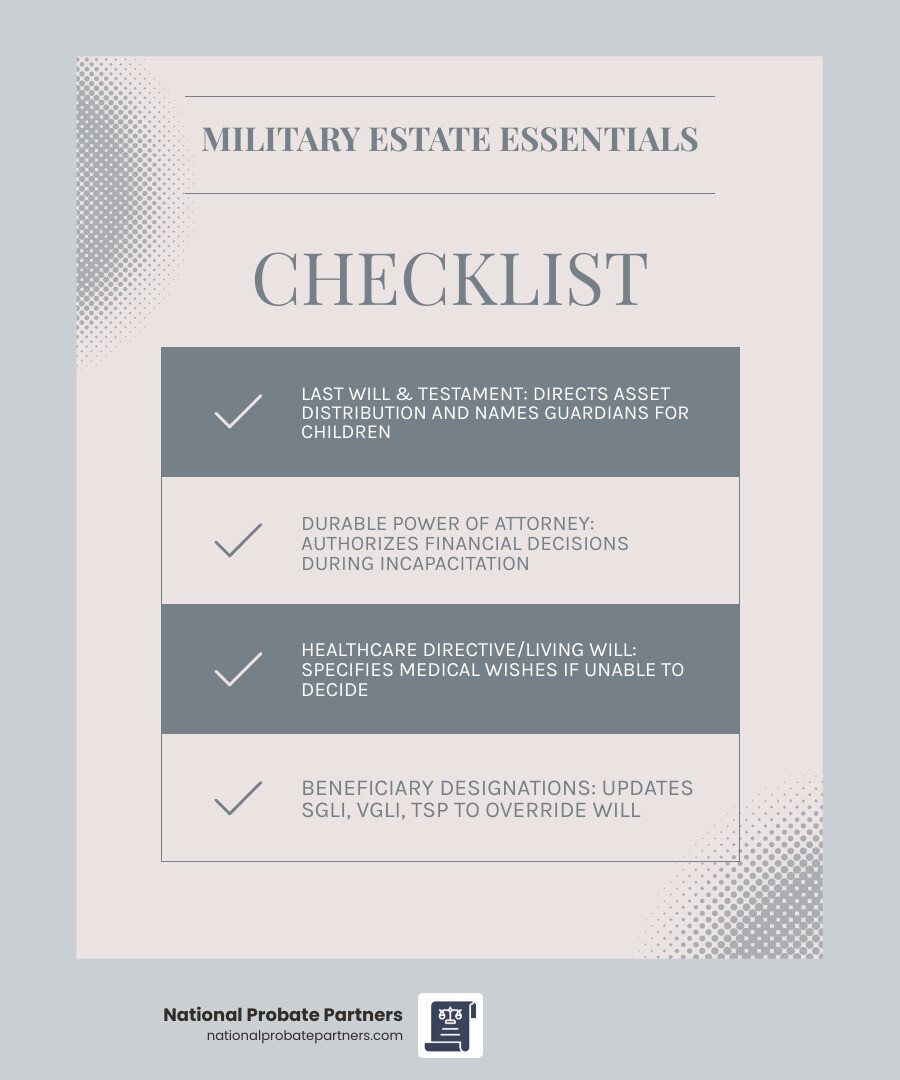
If you need a quick answer, here’s what a strong veteran’s estate plan includes:
- Last will and testament — directs who gets your property and who raises your children
- Durable power of attorney — names someone to handle finances if you’re incapacitated
- Healthcare directive / living will — documents your medical wishes
- Beneficiary designations — on SGLI, VGLI, TSP, and pension accounts (these override your will)
- Trust (if needed) — avoids probate and protects assets, including VA benefit eligibility
- Updated records — DD214, asset inventory, and death certificates stored safely
For most veterans and their families, getting these six things right is the difference between a smooth transfer of assets and a costly, painful legal battle.
The stakes are real. Military families face risks that most civilians don’t: sudden deployments, service-related injuries, frequent relocations across state lines, and complex benefit structures like Survivor Benefit Plans and VA pensions. Without a proper plan in place, state intestacy laws decide who inherits your property — and a judge, not you, decides who raises your children.
The good news? Veterans have access to free and low-cost legal resources that most people don’t know exist — from JAG offices on base to pro bono programs that have helped over 14,600 veterans secure their futures.
This guide walks you through everything you need to know.
Easy Veterans estate planning glossary:
Why Veterans Estate Planning is Essential in 2026
As we navigate through April 2026, the landscape for veterans has changed. With approximately 22 million veterans across the country, the need for specialized planning has never been higher. We often see families who assume that their military benefits will simply “take care of themselves.” Unfortunately, that’s a misconception that can lead to significant financial strain for those you leave behind.
For those of us who served, our lives weren’t “standard.” We moved every three years, deployed to combat zones, and dealt with service-connected disabilities that can change our needs as we age. Veterans estate planning isn’t just about who gets the house; it’s about ensuring that the unique benefits you earned through sacrifice are actually delivered to your family.
Whether you are in Scottsdale, Arizona, or Corpus Christi, Texas, the goal is the same: legacy security. You’ve been a guardian of your country; now it’s time to be the guardian of your family’s financial future. If you’re wondering where to start, it helps to first understand the estate and what it means for your legacy.
The Role of Wills and Trusts in Veterans Estate Planning
In our experience at National Probate Partners, the “Will vs. Trust” debate is one of the most common hurdles military families face. A Will is your voice from beyond, telling the court exactly how you want your assets distributed and who should be the legal guardian of your minor children. Without one, the state (whether it’s Texas or Arizona) uses a “one-size-fits-all” law to decide who gets your property.
However, a Will usually has to go through probate — a court-supervised process that can be slow and public. This is where a Trust comes in. For many veteran families, a Trust is preferable because it allows for an immediate transfer of assets. This is crucial if your family relies on your income and cannot afford to wait months for a probate judge to grant them access to bank accounts.
| Feature | Last Will and Testament | Living Trust |
|---|---|---|
| Probate Required? | Yes | No |
| Privacy | Public Record | Private |
| Guardianship | Can name guardians for kids | Cannot name guardians |
| Speed of Transfer | Months to Years | Weeks or Days |
| Cost | Cheaper upfront | More expensive upfront |
Choosing between these two depends on your specific assets and family goals. To dive deeper, check out our guide on Trust vs Probate: What’s the Difference and Why It Matters.
Healthcare Directives and Powers of Attorney
Incapacity is a difficult topic, but for veterans with service-related health issues, it’s a necessary conversation. A Power of Attorney (POA) allows you to designate a trusted person to make legal, financial, and medical decisions on your behalf if you become unable to do so yourself.
There are different types of POAs:
- Durable Power of Attorney: Stays in effect even if you become mentally incapacitated.
- Medical Power of Attorney: Specifically for healthcare decisions.
- Living Will: A directive that tells doctors what kind of life-sustaining treatment you want (or don’t want) if you are terminally ill or in a persistent vegetative state.
For active military members or those still in the reserves, a POA is also vital for handling affairs during deployments. According to Military OneSource, having these documents ready ensures that your spouse or partner can pay bills, sell property, or manage your TSP while you are away or unable to act.
Integrating Military Benefits into Your Legacy
One of the biggest mistakes we see in Veterans estate planning is failing to integrate military-specific benefits into the broader legal plan. Your SGLI (Servicemembers’ Group Life Insurance) or VGLI (Veterans’ Group Life Insurance) provides essential liquidity, but it’s just one piece of the puzzle.
You also have to consider the Survivor Benefit Plan (SBP). If you are a retiree, the SBP provides your spouse or children with a portion of your retirement pay after you pass. However, these benefits have strict election rules and can be impacted by divorce or remarriage.
When planning, we encourage you to look at the “big picture.” While DIY online forms are tempting, they often fail to account for the nuances of military benefits. You might save a few dollars now, but it could cost your family thousands later. For a reality check on costs, see Will Your Will Break the Bank? Comparing DIY vs Attorney Fees.
Beneficiary Designations for Veterans Estate Planning
This is the “Golden Rule” of estate planning: Beneficiary designations override your Will.
If your Will says your house goes to your son, but your SGLI or Thrift Savings Plan (TSP) still lists your ex-spouse as the beneficiary, that money is going to your ex. Period. The court will not “fix” this for you.
We recommend reviewing your designations every time you have a major life event:
- Marriage or divorce
- Birth or adoption of a child
- Death of a previously named beneficiary
- Significant changes in your military status (promotion or retirement)
Always name contingent beneficiaries. If your primary beneficiary passes away at the same time as you, having a backup prevents the asset from falling into probate.
Protecting Eligibility for Aid and Attendance
Many veterans rely on the VA Aid and Attendance benefit to help cover the costs of long-term care, assisted living, or in-home nursing. However, this benefit has strict income and asset limits.
If you have “too much” in assets, you might be disqualified. This is where specialized Veterans estate planning tools, like an Irrevocable Trust, come into play. By transferring assets into a trust, you may be able to protect your legacy for your heirs while still meeting the financial requirements for VA benefits. According to SmartAsset, structuring your income properly is key to maintaining eligibility for these vital healthcare supplements.
Strategies for Avoiding Probate and Protecting Assets
Probate can be a headache, especially in states like Texas where the process can be complex if not handled correctly. One of our primary goals at National Probate Partners is to help you avoid the courtroom entirely.
Common strategies to bypass probate include:
- Joint Ownership: Holding property as “Joint Tenants with Rights of Survivorship” means the asset passes automatically to the survivor.
- Transfer-on-Death (TOD) Deeds: Available in many states (including Texas and Arizona), these allow you to name a beneficiary for your real estate without needing a trust.
- Living Trusts: As mentioned, these keep assets out of the court’s hands.
While some states have high thresholds for probate, any veteran with real estate should consider a plan to keep that home out of the court system. If you’re currently facing a situation where a loved one has passed, you might be asking, Do You Really Need a Probate Lawyer? Contact Us for a Free Consultation!.
Impact of the Servicemembers Civil Relief Act (SCRA)
For those still serving or recently separated, the Servicemembers Civil Relief Act (SCRA) provides powerful protections. If you are deployed, the SCRA can allow for a “legal stay,” effectively hitting the pause button on civil court proceedings, including some estate litigation or foreclosures.
This is a double-edged sword in estate planning. It protects you while you’re away, but it also means your family might need specific legal authority (like a military POA) to act on your behalf regarding SCRA protections. If you’re unsure how your service status impacts your legal standing, it’s worth asking, How Do I Know If I Need a Probate Lawyer?.
Free Resources and Legal Assistance for Veterans
You don’t always have to pay a premium for basic legal help. The military community is supported by several fantastic programs:
- JAG Offices: Every major installation has a legal assistance office. They can help active duty, retirees, and their families draft basic Wills and Powers of Attorney for free.
- VA News Resources: The VA often highlights organizations that offer free or discounted services. You can find a list of 12 places that offer free wills or trusts for Veterans.
- Pro Bono Programs: Organizations like the ABA Veterans Legal Services and various state-level “Ask-A-Lawyer” clinics provide free counsel to low-income veterans.
If you do decide to hire a private firm for more complex needs (like protecting Aid and Attendance eligibility), make sure you know the right questions to ask. Our Probate Lawyer FAQ is a great starting point.
State-Specific Tools and Online Will Preparation
If you are a Texas veteran, you have access to specific resources like the Corpus Christi Veterans Ask-A-Lawyer Clinic. These clinics are invaluable for getting quick answers about local property laws and state-specific tax exemptions.
Additionally, for beneficiaries of SGLI or VGLI, the VA offers free online will preparation through “Financial Point Plus.” These documents are generally valid in all states, though they may not be enough for veterans with complex estates or those looking to avoid state estate taxes in high-net-worth scenarios.
Managing Life Changes and Sentimental Assets
Estate planning is not a “one-and-done” task. It’s a living document. We recommend a review every three to five years, or immediately following:
- Marriage or Divorce: In many states, divorce doesn’t automatically remove an ex-spouse from a life insurance policy.
- Birth of a Child: You need to name a guardian and potentially set up a trust for their inheritance.
- Relocation: Moving from Texas to Arizona (or vice-versa) means your documents should be reviewed to ensure they comply with local laws.
Don’t forget the sentimental assets. For veterans, things like service medals, uniforms, flags, and even old letters carry immense emotional value. We suggest including a “Memorandum of Tangible Personal Property.” This is a simple list where you specify who gets your Bronze Star or your grandfather’s dress sword. This prevents family arguments and ensures your military legacy is cherished.
For more on how to handle these unique challenges, our Ultimate Probate Lawyer FAQ: 2025 Edition covers many of these common family dynamics.
Frequently Asked Questions about Veterans Estate Planning
How often should I update my military estate plan?
You should review your plan at least every 3–5 years. However, you should update it immediately after any “Life Event” (marriage, divorce, birth, death) or a change in your military status, such as retirement or a major change in VA disability rating.
Can I protect my service medals and awards in a trust?
Yes! In fact, we recommend it. By placing sentimental items in a trust or mentioning them in a specific memorandum, you can ensure they stay in the family and are not sold off during a messy probate process. You can even include instructions on how you want them displayed or preserved.
What happens to my VA benefits if I die without a will?
VA benefits like the Survivor Benefit Plan (SBP) or Dependency and Indemnity Compensation (DIC) are governed by federal law and will go to your eligible surviving spouse or children regardless of a Will. However, your private assets (house, car, bank accounts) will be distributed according to state law, which may not align with your wishes.
Conclusion
At National Probate Partners, we are honored to serve those who served. Whether you are looking to set up a new plan or you are currently navigating the complexities of a loved one’s estate in Texas or Arizona, we are here to help. Veterans estate planning doesn’t have to be overwhelming. With a little preparation and the right team behind you, you can rest easy knowing your legacy is secure.
If you’re ready to take the next step, Schedule a Case Review with us today. We specialize in making the complex simple, ensuring your family is protected for generations to come.