
When Every Hour Counts: What Temporary Guardianship Attorneys Do and Why You Need One
Temporary guardianship attorneys help families get fast, court-backed legal authority to care for a child or incapacitated adult when a parent or primary caregiver suddenly cannot.
If you’re in a crisis right now, here’s what you need to know:
Who needs a temporary guardianship attorney?
- A family member whose loved one was just hospitalized
- A grandparent stepping in while a parent is deployed or incarcerated
- Anyone who needs legal authority to make medical or school decisions for a child — fast
What they can do for you:
| Situation | What an Attorney Helps With |
|---|---|
| Medical emergency | File for emergency guardianship within 24-48 hours |
| Military deployment | Set up standby or temporary guardianship before departure |
| Parental incapacity | Petition probate court for short-term legal authority |
| Risk to a vulnerable adult | Seek emergency protective orders to prevent exploitation or harm |
Life doesn’t send warnings. A diagnosis, a deployment, an accident — and suddenly someone you love needs care, but you have no legal authority to provide it.
Without that authority, schools may refuse to share records. Hospitals may delay treatment. Banks won’t talk to you. The gap between wanting to help and being legally allowed to help can feel impossibly wide.
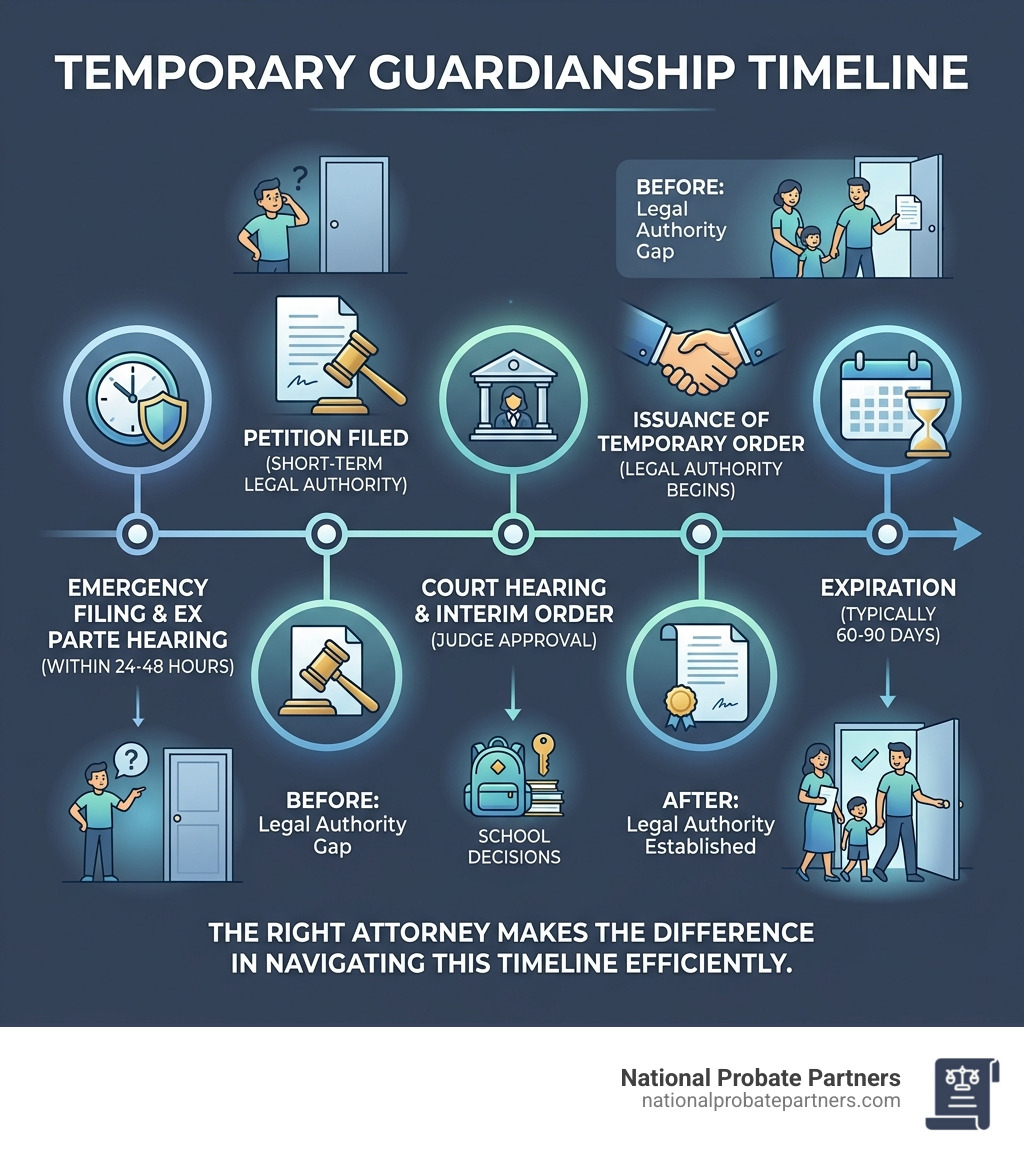
That’s exactly where temporary guardianship comes in. It’s a court-authorized arrangement — typically lasting 60 to 90 days — that gives a trusted adult the legal power to make decisions for someone who temporarily cannot be cared for by their parent or guardian. It does not end parental rights. It simply pauses them while life gets sorted out.
As of April 2026, approximately 1.3 million adults in the United States are under some form of guardianship — and countless more families rely on temporary arrangements each year to bridge urgent care gaps for both minors and adults.
The right attorney makes the difference between a petition approved in 24 hours and paperwork that stalls for weeks.
Temporary guardianship attorneys vocab explained:
Understanding Temporary vs. Permanent Guardianship

When we discuss guardianship, the first thing to clarify is the timeline. Many people fear that by stepping in to help, they are initiating a permanent legal battle that will strip a parent of their rights forever. This is a common misconception that temporary guardianship attorneys work hard to dispel.
The primary difference lies in the intent and the duration. Temporary Legal Guardianship is designed for short-term needs—think of it as a legal “bridge.” It allows someone to step into the shoes of a parent or caregiver for a specific period or until a specific event occurs (like a parent being discharged from a hospital).
Permanent guardianship, on the other hand, is a long-term commitment. While it doesn’t necessarily terminate parental rights in the same way adoption does, it is much harder to revoke and usually implies that the parents are unable to care for the child for the foreseeable future.
| Feature | Temporary Guardianship | Permanent Guardianship |
|---|---|---|
| Duration | Typically 60–90 days (can be extended) | Indefinite (until age 18 or court order) |
| Parental Rights | Suspended, not terminated | Often restricted or significantly limited |
| Purpose | Emergency or short-term unavailability | Long-term inability to provide care |
| Court Oversight | High (frequent check-ins/expirations) | Moderate (annual reporting) |
When to Consult Temporary Guardianship Attorneys
You don’t always need a judge to tell you how to care for your family, but there are specific “red alert” moments where legal authority is non-negotiable. We often see families reach out in the following scenarios:
- Medical Emergencies: If a parent is in a coma or undergoing long-term treatment and cannot consent to a child’s surgery or routine medical care.
- Military Deployment: Service members often need to designate a guardian for their children before heading overseas. Military Legal Assistance & Services can provide initial guidance, but a local attorney ensures the documents hold weight in state courts.
- Parental Travel or Incarceration: If a parent will be physically unreachable for an extended period.
- Sudden Illness or Incapacity: When an adult loved one suddenly loses the ability to manage their own safety or finances due to a stroke, dementia, or other health crisis.
Rights and Responsibilities of a Guardian
Being appointed as a temporary guardian is a major responsibility. You are essentially stepping into a “fiduciary” role, meaning you must act in the ward’s best interests at all times.
Your rights usually include:
- Healthcare Decisions: Choosing doctors and consenting to treatments.
- School Enrollment: Signing permission slips and accessing educational records.
- Daily Care: Providing food, shelter, and basic necessities.
- Financial Management: In cases of “guardianship of the estate,” you may be responsible for paying the ward’s bills and protecting their assets from exploitation.
For those caring for older adults, Navigating Elder Guardianship in Texas: A Compass for Caregivers offers a deeper look at the specific nuances of managing a senior’s affairs.
Legal Alternatives to Court-Ordered Guardianship

Believe it or not, we often tell clients that the best way to handle a temporary situation is to avoid court altogether if possible. If the parents are cooperative and have the mental capacity to sign documents, there are faster, cheaper ways to establish authority.
Establishing Authority Without a Judge
The most common tool is the Power of Attorney (POA) for a Minor Child. In many states, including those where we operate like Texas and Arizona, a parent can sign a document giving a relative the power to make medical and educational decisions.
However, there are “catches”:
- 6-Month Limits: In states like Michigan (and similar rules in Arizona), these POAs are often only valid for six months before they must be renewed.
- Revocable Status: A parent can revoke a POA at any time.
- Acceptance Issues: Some hospitals or school districts are “picky” and may refuse to honor a POA, insisting on a court order instead.
Understanding the Power of Attorney vs. Guardianship distinction is vital for choosing the right path for your family’s specific timeline.
State-Specific Variations in April 2026
While we provide services nationwide, we see significant differences in how states handle these cases:
- Texas: The probate code is very specific about “attorney ad litem” appointments to protect the ward.
- Arizona (Scottsdale/Phoenix): Courts often favor “limited guardianships” to preserve as much of the ward’s independence as possible.
- Nevada (Las Vegas): Nevada has unique “substituted judgment” rules that allow guardians to make estate planning changes for an incapacitated person.
- Florida: Often requires very specific medical affidavits before a temporary order is even considered.
Why You Need Experienced Temporary Guardianship Attorneys
You might be tempted to download a “free” form online. In our experience, this is where the trouble starts. A “sloppy” petition is the fastest way to get your case tossed out or delayed. Temporary guardianship attorneys provide a level of precision that DIY forms simply can’t match.
How Temporary Guardianship Attorneys Navigate Emergency Filings
In a true crisis, you don’t have 60 days to wait for a hearing. We specialize in Ex Parte orders. This is a legal term for a “one-sided” hearing where a judge can grant emergency authority within 24 to 48 hours without waiting for the other party to be served.
To win an emergency order, we have to prove imminent danger. This requires gathering evidence like:
- Police reports or Social Service records.
- Medical affidavits from treating physicians.
- Proof that the current environment is unsafe for the child or adult.
For more on these high-stakes procedures, you can review the Emergency Guardianship and Legal Procedures guidelines.
Protecting the Ward’s Best Interests
The court’s primary job is to protect the “ward” (the person who needs the guardian). To do this, they often appoint a Guardian ad Litem or an Attorney ad Litem. These are independent professionals who investigate the situation and report back to the judge.
An experienced attorney knows how to work with these court-appointed investigators to show that you are the best person for the job. We also assist with capacity evaluations, ensuring that the medical evidence clearly shows why the guardianship is necessary.
The Step-by-Step Process for Court-Ordered Protection
If an informal agreement isn’t enough, you’ll have to go through the probate court. Here is the general roadmap we follow:
- Filing the Petition: We submit a formal request to the probate court in the county where the ward lives.
- Notice Requirements: You must notify all “interested parties”—this includes parents, adult children, and sometimes siblings.
- The Investigation: A court visitor or investigator may interview you and the ward.
- The Hearing: You attend a hearing where the judge reviews the evidence.
- The Order: If approved, the judge signs “Letters of Guardianship,” which is your “golden ticket” to show to doctors and schools.
For a broader overview, see The Guardianship Court Process.
Duration and Termination of Orders
Temporary orders are not meant to last forever. In many jurisdictions, they expire automatically after 60 days. If the emergency hasn’t passed, we must file a petition for an extension before the expiration date.
Alternatively, if the parent recovers or the crisis ends, we can petition for early revocation. The goal is always to return the ward to their natural home or to their own independence as soon as it is safe.
Documentation and Notarization Requirements
Paperwork is the heartbeat of a guardianship case. We help you compile:
- Identity Docs: Birth certificates and Social Security cards.
- Medical Records: Physician affidavits proving incapacity.
- Proof of Service: Legal proof that you told everyone who needed to know.
- Bond Requirements: If you are managing money, the court may require you to post a “bond”—a type of insurance—to protect the ward’s assets.
Frequently Asked Questions about Temporary Guardianship
Does temporary guardianship terminate parental rights?
No. This is the most important thing to understand. It suspends rights. The parent is still the parent, but their authority is temporarily “paused” so you can provide care. Once the court order expires or is revoked, the parent can resume their authority, provided they are fit to do so.
How long does the temporary guardianship process take?
In an emergency, it can take less than 24 hours. For a standard, non-emergency temporary petition, expect a 10 to 30-day window to allow for proper notice to all family members.
Can temporary guardianship be established for an adult?
Absolutely. This is common for elderly parents who have been targeted by financial scams or who are neglecting their health. If we can prove medical necessity and that no Power of Attorney exists, the court can appoint a temporary guardian to ensure their safety.
Conclusion
At National Probate Partners, we know that when you’re looking for temporary guardianship attorneys, you’re likely in the middle of one of the most stressful weeks of your life. Our goal is to provide the legal expertise and “legal muscle” you need to protect your family, giving you back your peace of mind.
Whether you are in Scottsdale, Corpus Christi, or serving in the Armed Forces overseas, we can help you navigate these complex probate challenges efficiently. Don’t wait for the crisis to get worse—planning ahead is the best gift you can give your loved ones.
If you’re ready to take the next step, check out our guide on 5 Smart Ways to Find a Guardianship Attorney You’ll Wish You Knew Sooner to ensure you have the right advocate in your corner.