
What Do Estate Planning Costs Actually Look Like?
Estate planning costs typically range from $1,000 to $5,000+ for a complete plan done with an attorney. Here’s a quick breakdown of what you can expect to pay for individual documents:
| Document | Typical Cost (Attorney) |
|---|---|
| Last Will and Testament | $500 – $1,500 |
| Revocable Living Trust | $2,000+ |
| Power of Attorney | $150 – $450 |
| Advance Healthcare Directive | $300 – $600 |
| Full Plan (Individual) | $1,200 – $3,000+ |
| Full Plan (Couple) | $2,000 – $5,000+ |
Costs vary based on your location, the complexity of your estate, and whether you hire an attorney or use a DIY tool.
If you’ve recently lost a loved one — or you’re trying to get your own affairs in order — the last thing you want is a surprise bill. Estate planning feels complicated enough without having to decode attorney fee structures and figure out what you actually need.
The good news: most people pay far less than they expect for solid protection. And the cost of not planning? That can run into tens of thousands of dollars in probate fees alone — typically 3% to 7% of your estate’s total value.
This guide breaks down exactly what you’ll pay, document by document, so you can make a confident, informed decision.
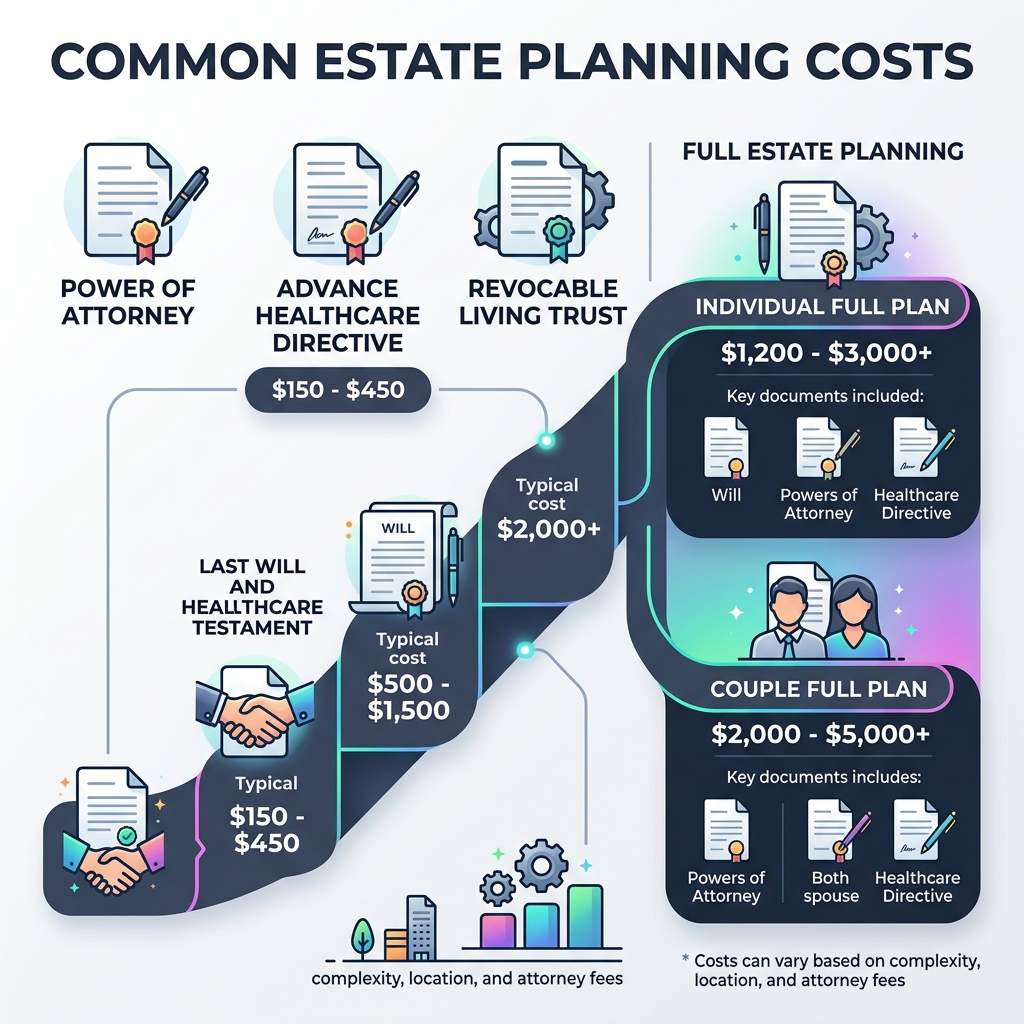
Average Estate Planning Costs for Essential Documents
When we talk about estate planning costs, it is helpful to view the plan as a collection of tools. Just as you wouldn’t buy a house without a roof or a front door, a solid estate plan requires a few essential pieces to function correctly.
At National Probate Partners, we see many clients who start with a single document and eventually realize they need a comprehensive package. While you can purchase documents “a la carte,” bundling them into a package is almost always more cost-effective. For example, a single will might cost $600, but a package including the will, powers of attorney, and healthcare directives might only be $1,200.
For individuals, these packages generally start around $1,200. For couples, the starting point is often closer to $2,000 because the attorney must draft two sets of documents that mirror or complement each other.
Typical Costs for a Last Will and Testament
The will is the bedrock of most estate plans. It is a legal document that communicates your “testamentary intent”—basically, who gets what when you pass away.
For a simple will drafted by an attorney, you can expect to pay between $500 and $1,500. The price shifts based on a few factors:
- Guardianship provisions: If you have minor children, your will must specify who will care for them.
- Beneficiary designations: Listing a few people is simple; creating complex “if/then” scenarios for twenty different relatives adds time and cost.
- Asset protection: If you want to include specific language to protect an inheritance from a beneficiary’s creditors, the complexity increases.
While a will is essential, a will alone does not avoid probate. It simply acts as a roadmap for the probate court to follow.
Average Pricing for Revocable Living Trusts
If your goal is probate avoidance, a trust is often the better vehicle. A revocable living trust allows you to maintain “grantor control” over your assets while you are alive, but upon your death, those assets transfer to your beneficiaries without the need for a judge’s permission.
Attorney-drafted trusts typically start at $2,000 and can climb to $5,000 or more for complex estates. Why the higher price tag?
- Privacy protection: Trusts are private documents, unlike wills, which become public record during probate.
- Asset management: Trusts provide detailed instructions on how assets should be managed if you become incapacitated.
- Complexity: Drafting a trust requires more sophisticated legal work to ensure it is structured correctly under state law.
Factors That Influence Your Total Legal Fees

Not all estate planning costs are created equal. If your life is a straight line—one marriage, two kids, one house, and a retirement account—your costs will stay on the lower end of the spectrum. However, life is rarely that simple.
Estate Complexity
Complexity is the biggest driver of fees. We often work with families who have:
- Blended families: Navigating inheritances when there are children from previous marriages requires careful legal balancing.
- Special needs: Creating a “Special Needs Trust” is vital to ensure a loved one doesn’t lose government benefits like Medicaid or SSI.
- Business ownership: If you own a company, your estate plan must include a succession plan, which involves more hours of legal work.
Attorney Experience
You are not just paying for paper; you are paying for the attorney’s ability to spot problems before they happen. An attorney with twenty years of experience in Texas probate law will likely charge more than a general practitioner who just graduated. However, that experience can save your family tens of thousands of dollars in taxes and litigation later.
How Location Impacts Pricing in Texas and Beyond
Where you live matters. National medians show that a revocable living trust costs about $2,475, but that number shifts based on local markets.
- Texas: In cities like Houston, Dallas, or Corpus Christi, you might find that basic packages for individuals start at $1,200. Texas has specific rules regarding “Independent Administration” in probate, and your estate plan should be drafted to take advantage of these unique laws.
- Arizona: In Scottsdale or Phoenix, a basic estate plan typically ranges from $1,000 to $3,000. Arizona’s filing requirements and state-specific laws for community property also influence how documents are drafted.
- Urban vs. Rural: Generally, attorneys in large metropolitan areas have higher overhead costs, which leads to higher hourly rates (often $300–$500+) compared to small-town lawyers who might charge $150–$250 per hour.
For our clients in the Armed Forces, it is important to note that military legal assistance offices often provide basic estate planning services for free or at a very low cost.
Understanding Attorney Fee Structures: Flat Fees vs. Hourly Rates
How an attorney bills you can be just as important as the total price. There are generally two ways we and other firms charge for our time.
Flat Fees
The vast majority of estate planning—about 94% of firms—now uses flat-fee pricing for standard documents. This is great for you because it provides cost predictability. You know exactly what the “Full Plan” costs before the first word is typed.
Flat fees encourage you to talk to your attorney without watching the clock. It fosters a better relationship because you aren’t worried that a five-minute phone call will result in a $50 bill.
Hourly Billing
Hourly billing is more common for “open-ended” work. If you are involved in a heated family dispute or have a highly complex business structure that requires dozens of meetings, an attorney might bill by the hour. Average hourly rates for lawyers typically range from $162 to $392, though specialists in high-cost areas can exceed $500.
Engagement Letters
Regardless of the structure, always get your fee in writing. A standard engagement letter should outline:
- The scope of work (what documents are being created).
- The total cost or hourly rate.
- Any additional costs like filing fees or notary charges.
The Benefits of Flat-Fee Estate Planning Packages
We highly recommend looking for flat-fee packages. These bundles usually include:
- A Last Will and Testament
- Durable Power of Attorney
- Healthcare Power of Attorney
- Living Will (Advance Directive)
- HIPAA Authorization
By bundling, you get “strategic alignment.” All your documents are designed by the same person to work together seamlessly. This “value-based billing” ensures you aren’t overpaying for individual components.
The Real Cost of DIY vs. Professional Estate Planning
It is tempting to look at a $1,500 attorney fee and then look at a $15 online template and think, “How hard can it be?”
Online Templates and DIY Tools
Online DIY platforms have made estate planning more accessible. A basic online will might cost $100 to $250. For a very simple estate with no minor children and few assets, these can work.
However, the risk of error is high. DIY tools often fail to account for state-specific requirements. For example, if your state requires two witnesses and a notary, but you only get it notarized, your will could be declared invalid.
Customization and Legal Validity
When you hire a local estate planning attorney, you aren’t just getting a form. You are getting:
- Legal advice: An online form can’t tell you if a trust is better than a will for your specific tax situation.
- Validity checks: We ensure every signature, witness, and notary seal is exactly where it needs to be to satisfy a judge.
- Updates: Life changes. An attorney can help you adjust your plan after a divorce, a birth, or a move to a new state.
When to Choose a Professional Attorney Over DIY Tools
As CBS News Business Analyst Jill Schlesinger notes, if there are any complications—like a second marriage, a special needs family member, or business ownership—you should use a qualified attorney. The peace of mind that your family is protected is worth the investment.
For more on why the structure of your plan matters, see our guide on Trust vs Probate: What’s the Difference and Why It Matters.
Hidden Expenses and the High Price of No Plan
The “sticker price” of an estate plan isn’t always the final number. There are small, often overlooked costs that can add up.
Hidden Costs to Consider
- Notary Fees: Most estate documents must be notarized. Depending on your state, this usually costs $5 to $15 per signature.
- Trust Funding: This is the most common mistake. A trust is like a suitcase; it only works if you put things inside it. “Funding” involves retitling your house, bank accounts, or cars into the name of the trust. Some attorneys include this in their fee; others charge an extra $500 to $1,500 to handle the paperwork for you.
- Document Updates: We recommend reviewing your plan every 3 to 5 years. A simple update might cost $500 to $1,500.
The Financial Burden of Dying Without an Estate Plan
If you think estate planning costs are high, wait until you see the bill for not having one. If you die “intestate” (without a plan), the state provides a default plan for you—and you probably won’t like it.
- Probate Costs: In many states, probate costs 3% to 7% of the estate’s value. On a $500,000 home, that is $15,000 to $35,000 gone.
- Asset Freezing: Without a power of attorney, if you become incapacitated, your family may have to go to court just to pay your mortgage with your own money.
- Family Litigation: Disputes over who should be the guardian of children or who gets the family home can lead to years of expensive legal battles.
To understand the full scope of these expenses, check out our article on How Much Does a Probate Lawyer Cost?.
Frequently Asked Questions and Final Thoughts
At National Probate Partners, we believe that everyone deserves a plan that fits their life and their budget. Whether you are in Texas, Arizona, or serving in the Armed Forces, understanding these costs is the first step toward security.
What is the average cost of a basic estate plan?
For a single individual, a basic attorney-led package (Will, POA, Healthcare Directive) usually costs between $1,200 and $2,000. For a couple, expect to pay between $2,000 and $3,500. If you add a trust, those numbers typically start at $2,500 for individuals and $4,000+ for couples.
How can I minimize my estate planning costs?
The best way to save money is to be prepared.
- Do your homework: Gather a list of all your assets (bank accounts, real estate, retirement plans) and debts before your first meeting.
- Choose flat fees: Ask for a package price to avoid hourly billing surprises.
- Consolidate: It is cheaper to do a full plan at once than to come back every six months for a new document.
- Ask about discounts: Some firms offer discounts for first responders, military members, or upfront payments.
Is a living trust worth the extra upfront cost?
In most cases, yes. While a trust might cost $2,000 more than a simple will today, it can save your family $20,000 in probate fees and six to twelve months of court delays later. It also offers immediate asset transfer and keeps your family’s financial business out of the public record.
Conclusion
Investing in an estate plan is not just about numbers; it is about legacy protection. It is the final gift you give your family—a clear, stress-free path forward during a difficult time. By understanding estate planning costs now, you can ensure your future security without overpaying.
If you are ready to protect your family’s future or need help navigating a current estate issue, we are here to provide compassionate, expert guidance. Contact a probate lawyer today to start your journey.