
When a Loved One Can No Longer Decide for Themselves: Elder Law and Guardianship Explained
Elder law and guardianship is a legal framework that protects older adults who can no longer make safe decisions about their health, finances, or daily care.
Here is a quick overview of what you need to know:
| Topic | Key Point |
|---|---|
| What is elder law? | A legal practice covering guardianship, benefits, estate planning, and long-term care for older adults |
| What is guardianship? | A court-appointed arrangement where a guardian makes decisions for an incapacitated person (the “ward”) |
| When is it needed? | When an adult cannot make or communicate decisions due to dementia, disability, or cognitive decline |
| Who can be a guardian? | A family member, friend, professional guardian, or public agency |
| Are there alternatives? | Yes — powers of attorney, advance directives, and trusts can often avoid the need for guardianship |
Aging is something most families don’t plan for until a crisis hits. A parent forgets to pay their bills. A grandparent is taken advantage of financially. A spouse can no longer communicate medical wishes.
Suddenly, someone has to step in — and the legal system becomes part of the family’s life.
The U.S. population aged 65 and older reached 55.8 million in 2020, a nearly 39% jump in just one decade. As that number grows, more families are facing hard questions about legal protection, decision-making authority, and how to preserve a loved one’s dignity at the same time.
Elder law and guardianship is one of the most emotionally and legally complex areas a family can navigate. It sits at the crossroads of probate law, healthcare, public benefits like Medicaid and Medicare, and civil rights. Getting it wrong can cost time, money, and cause lasting family conflict.
This guide breaks it all down — plainly and completely.
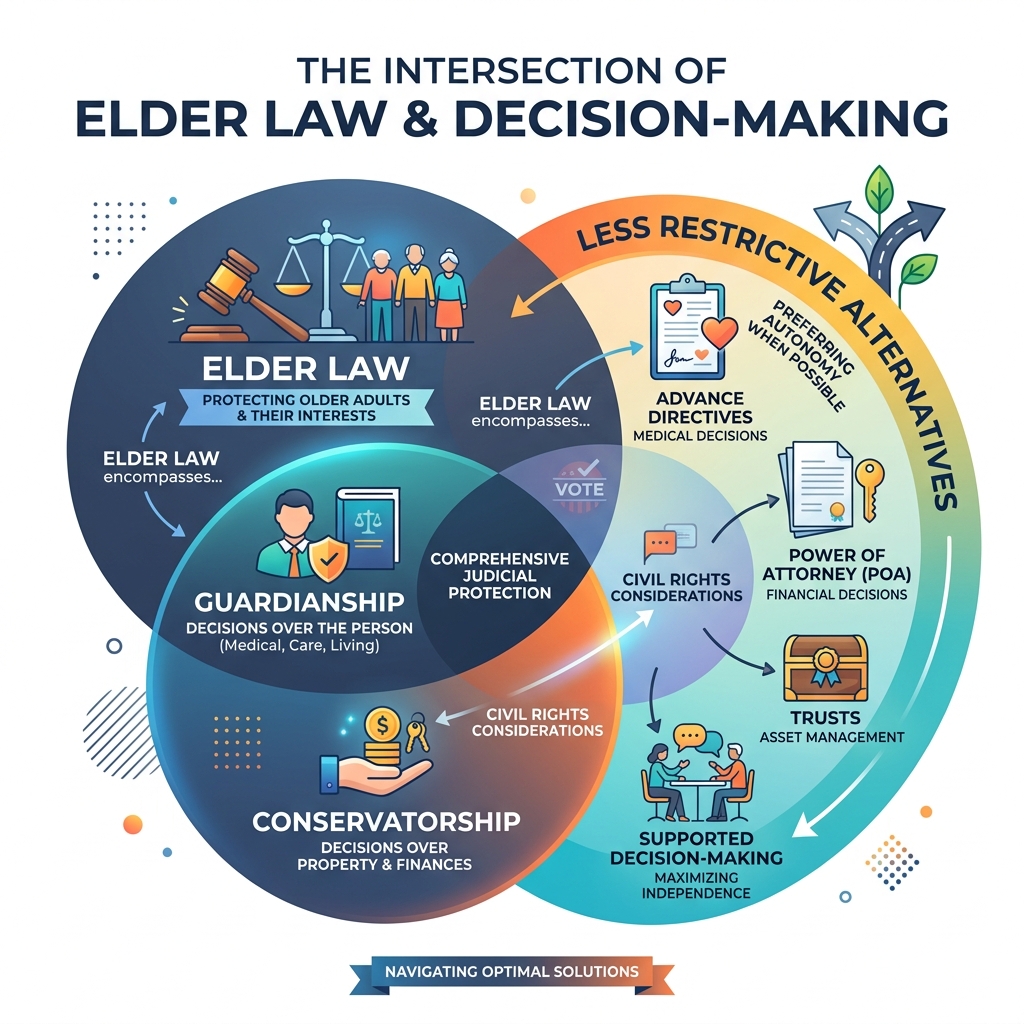
Terms related to elder law and guardianship:
Understanding Elder Law and Guardianship Basics
When we talk about elder law and guardianship, we are entering a territory where the court must balance a person’s individual liberty with their need for protection. At its core, Cornell Law School defines guardianship as a legal relationship where the court grants one person (the guardian) the authority to make decisions for another (the ward) who lacks the capacity to do so.
This isn’t a “one size fits all” situation. The court operates under a “best interests” standard, meaning every decision made by the guardian must prioritize the ward’s well-being. Because this process strips an individual of certain civil rights—like the right to choose where to live or how to spend money—it is heavily overseen by the court system.
One of the first hurdles families face is terminology. Depending on where you live, the roles might be called different things. In many states, including Texas and Arizona, we distinguish between the person who looks after the human being and the person who looks after the money.
Guardianship vs. Conservatorship: What’s the Difference?
While some states use these terms interchangeably, many create a clear divide between “body” and “wallet.”
| Feature | Guardianship (of the Person) | Conservatorship (of the Estate) |
|---|---|---|
| Primary Focus | Physical well-being and daily care | Financial assets and property |
| Decisions | Medical treatment, housing, food, clothing | Paying bills, selling real estate, investing |
| Goal | Ensure a safe and healthy lifestyle | Preserve and manage the person’s wealth |
| Reporting | Annual reports on the ward’s health/status | Annual financial accountings to the court |
Limited vs. Plenary Elder Law and Guardianship
The legal system prefers to use the “least restrictive” means possible. This means the court shouldn’t take away more rights than is absolutely necessary.
- Limited Guardianship: This is a tailored intervention. If a senior can still decide what they want to eat and wear but can no longer understand a complex medical diagnosis, the court might grant a guardian authority only over medical consent. This preserves as much autonomy as possible.
- Plenary Guardianship: This is full authority. It is usually reserved for cases of advanced dementia or total incapacity where the ward cannot make any safe decisions. The guardian handles everything from housing to healthcare to financial management.
The Role of the National Academy of Elder Law Attorneys (NAELA)
Finding the right help is vital. For over 35 years, the National Academy of Elder Law Attorneys (NAELA) has been the premier organization providing education, support, and resources for attorneys specializing in this field. NAELA members are specifically trained to handle the nuances of aging, including special needs planning and public benefit optimization. When we look for qualified co-counsel or resources, NAELA is often our first stop because their members understand the ethical weight of these cases.
Types of Guardianship and Legal Roles
In elder law and guardianship, roles are divided to ensure specialized care. In states like Texas, the court may appoint one person for both roles or separate them if the family dynamics or the size of the estate requires it.
- Guardian of the Person: Responsible for “life” decisions. This includes where the ward lives, what doctors they see, and ensuring they have adequate supervision and social interaction.
- Guardian of the Estate: This person (sometimes called a conservator) manages the money. They have a fiduciary duty—the highest legal standard of care—to protect the ward’s assets from waste or exploitation.
Emergency and Successor Roles
Sometimes, we can’t wait two months for a court hearing.
- Temporary/Emergency Guardianship: If a senior is in immediate physical danger or their bank account is being drained by a scammer, a court can issue an emergency order that lasts for a short window (often 60 days) until a full hearing can occur.
- Successor Guardians: Life happens. If the primary guardian gets sick or passes away, having a “backup” or successor guardian named in the original petition prevents the ward from falling into a legal limbo.
State Variations in Elder Law and Guardianship
While the general principles are similar, the “rules of the road” change at the state line.
- Texas: Texas law is very protective of the ward’s rights. The process is handled in probate courts, and there is a heavy emphasis on finding alternatives before a permanent guardian is appointed. You can learn more in our guide on Navigating Elder Guardianship in Texas: A Compass for Caregivers.
- Arizona: Similar to Texas, Arizona often uses the term “Conservator” for financial roles and “Guardian” for personal care. The Maricopa County Superior Court is known for strict oversight of these roles.
- Maryland: Offers a unique Public Guardianship program through local Area Agencies on Aging as a last resort for seniors who have no family or friends to step in.
The Legal Process: How to Obtain Guardianship
Obtaining guardianship is not as simple as filling out a form. It is a formal lawsuit that requires evidence. Here is the general path we navigate with our clients:
- The Petition: We file a legal document with the court stating why the person is incapacitated and why no other options (like a Power of Attorney) will work.
- Medical Evaluation: A doctor must examine the senior and provide a detailed report. This isn’t just a note saying “they are old”; it must specifically detail their cognitive deficits and how those deficits affect decision-making.
- The Court Investigator/Evaluator: The court will appoint a neutral third party to visit the senior, interview the proposed guardian, and report back to the judge on whether the guardianship is actually needed.
- Notice to Family: You cannot do this in secret. All “interested parties” (usually children, siblings, and spouses) must be notified and given a chance to object.
- The Hearing: This is where the judge hears testimony. If the senior (the “proposed ward”) objects, they are entitled to an attorney to fight the petition.
- Letters of Guardianship: If the judge agrees, they sign an order and the clerk issues “Letters.” These are the “golden tickets” that allow the guardian to talk to banks, doctors, and landlords.
Proactive Planning and Less Restrictive Alternatives
The best way to handle elder law and guardianship is to avoid the “guardianship” part entirely. Guardianship is expensive, public, and time-consuming. We always encourage families to look for less restrictive options for intervention while their loved one still has the capacity to sign documents.
The Power of “Paperwork”
If you have these documents in place, you likely won’t ever need a judge to appoint a guardian:
- Durable Power of Attorney (Financial): You choose who manages your money if you can’t.
- Advance Health Care Directive / Medical Power of Attorney: You choose who makes medical decisions and outline your wishes for end-of-life care.
- Revocable Living Trusts: These allow for the seamless management of assets without court intervention.
- Supported Decision-Making: A newer, less formal approach where the senior keeps their rights but signs an agreement allowing a “supporter” to help them understand choices and communicate decisions.
If you find yourself in a position where these documents don’t exist, check out our resource on 5 Smart Ways to Find a Guardianship Attorney You’ll Wish You Knew Sooner to help you navigate the next steps.
Challenges, Responsibilities, and Elder Abuse Prevention
Being a guardian is a job—and a hard one at that. It comes with significant fiduciary obligations. You aren’t just “helping out”; you are an officer of the court.
The Guardian’s To-Do List
- Annual Reporting: Most courts require a yearly report. For the person, you describe their health and living situation. For the estate, you must provide a line-item accounting of every penny spent.
- Bond Requirements: In many cases, the court requires the guardian of the estate to post a “bond”—a type of insurance policy—to protect the ward’s money from theft or mistakes.
- Court Monitoring: The court stays involved. If you want to sell the ward’s house, you usually have to ask the judge for permission first.
Preventing Abuse and Exploitation
Guardianship is a powerful tool for abuse prevention. It allows us to freeze accounts being targeted by scammers or remove a senior from a home where they are being neglected. However, because guardians have so much power, the system also guards against “guardian abuse.” This is why meticulous record-keeping is the guardian’s best friend.
Overcoming Common Obstacles
- Family Disputes: If three siblings all want to be the guardian, the case can turn into a “mini-divorce” trial. Mediation is often a better (and cheaper) path than a contested hearing.
- Proving Incapacity: Sometimes a senior has “good days and bad days.” Proving that they are consistently unable to care for themselves requires strong medical testimony.
- Guardian Resignation: If a guardian can no longer serve, they must petition the court to resign and ensure a successor is ready to take over. You can’t just “quit” and leave the ward unprotected.
Frequently Asked Questions about Elder Law
Who can serve as a legal guardian for an older adult?
Generally, any capable adult over 18 can serve. Courts usually prioritize family members (spouse, adult children, parents). However, the court will conduct background checks. If there is a history of a felony or financial crimes, that person will likely be disqualified. If no family is available or if the family is fighting, the court may appoint a professional guardian or a public agency.
How long does the guardianship process typically take?
In a standard, non-contested case, expect the process to take 2 to 3 months. This accounts for the 28-day notice window required in many jurisdictions and the time needed for the court investigator to complete their report. If the guardianship is contested (meaning the senior or a family member fights it), it can drag on for a year or more.
Can a guardianship be modified or terminated?
Absolutely. Guardianship is not always a life sentence. If a person was incapacitated due to a stroke or a temporary medical condition and they recover, they can petition the court for a “Restoration of Capacity.” The court will review new medical evidence and, if satisfied, will return the person’s legal rights to them.
Conclusion
Navigating elder law and guardianship is a journey no one wants to take alone. It’s a path filled with emotional hurdles and complex legal requirements that can feel overwhelming. At National Probate Partners, we specialize in bringing clarity to these situations. Whether you are in Texas or Arizona, our team offers compassionate, experienced service to resolve probate challenges and protect your loved ones’ “golden years.”
If you are just starting this process or want to avoid it through proactive estate planning, the right information is your best defense. Don’t wait for a crisis to decide how your family’s future will be guarded.
For more help getting started, read our guide on 5 Smart Ways to Find a Guardianship Attorney You’ll Wish You Knew Sooner or contact us today to discuss your family’s needs.