
Why Estate Succession Planning Could Be the Most Important Thing You Do This Year
Estate succession planning is the process of legally arranging how your assets — including your business, property, and investments — will transfer to the right people at the right time, with the least possible tax burden and family conflict.
Here’s a quick overview of what it involves:
| Key Element | What It Means |
|---|---|
| Estate planning | Manages personal assets (home, savings, investments) after death or incapacity |
| Business succession planning | Ensures your business keeps running and transfers smoothly |
| Tax strategy | Minimizes estate, gift, and generation-skipping taxes |
| Legal documents | Wills, trusts, powers of attorney, buy-sell agreements |
| Family communication | Aligns heirs and stakeholders on expectations |
If you own a business and haven’t revisited your plan recently, you’re not alone — and you’re not safe.
According to Forbes, 85% of business owners have estate plans that are either outdated or simply not enough. That’s not a small gap. That’s a gap that can force a family business into probate court, trigger a painful sale, or leave heirs fighting over decisions the owner never documented.
The stakes got higher in 2025. The federal estate tax exemption sits at $13.99 million per individual — but that number is set to drop sharply after December 31, 2025. Without action now, many families who thought they were “under the threshold” may suddenly face a 40% tax rate on a significant portion of what they’ve spent a lifetime building.
Estate succession planning isn’t just a legal checkbox. It’s how you protect your family, your business, and your legacy — before a crisis forces the decision for you.
The Fundamentals of Estate Succession Planning
When we talk about Estate succession planning, we are really looking at two different but deeply intertwined puzzles. One puzzle is your personal life: who gets the house, the sentimental jewelry, and the retirement accounts? The other puzzle is your professional life: who sits in your chair at the office when you’re gone, and who actually owns the company shares?
For many business owners in Texas and Arizona, these two worlds are often one and the same. Your business might be your largest asset, and your children might be your most likely successors. However, treating them as a single “bucket” without a clear strategy is a recipe for disaster.
The Danger Of Declining Estate Planning Rates highlights that procrastination is the biggest enemy of legacy protection. If you don’t define the terms of the transfer, the state (and the tax man) will do it for you. Understanding the Estate: What It Means for Your Legacy is the first step in realizing that an “estate” isn’t just for billionaires; it’s for anyone who has worked hard to build something they want to see continue.
| Feature | Personal Estate Plan | Business Succession Plan |
|---|---|---|
| Primary Goal | Distribute personal wealth and care for heirs | Ensure business continuity and leadership transition |
| Key Assets | Home, bank accounts, life insurance, heirlooms | Stock, LLC interests, intellectual property, equipment |
| Core Documents | Will, Living Trust, Healthcare Proxy | Buy-Sell Agreement, Operating Agreement, ESOPs |
| Focus | Inheritance and guardianship | Management roles and operational stability |
Estate Planning vs. Business Succession Planning
It’s helpful to think of estate planning as the “Who gets what?” and succession planning as the “Who does what?”
Estate planning focuses on the transfer of ownership. It deals with the legal title of your assets. If you pass away, your estate plan dictates that your 51% share of the family LLC goes to your spouse or children.
Business succession planning, however, is about management and operational continuity. Just because your daughter inherits 51% of the company doesn’t mean she knows how to run the manufacturing floor or manage the 50 employees who rely on that paycheck. A true succession plan identifies the next CEO, trains them, and outlines the transition of power to ensure the business doesn’t skip a beat.
Why Family Business Owners Need Both
Family businesses face a unique set of challenges. We often see situations where one child is heavily involved in the business while two others have pursued different careers. If you leave the business equally to all three, you’ve just handed the “working” child two “bosses” who may not understand the industry but have the power to demand dividends or veto growth strategies.
Legacy Planning: A Comprehensive Guide to Protecting Your Estate emphasizes that a robust plan protects family harmony just as much as it protects dollars. By integrating both plans, we can use tools like life insurance or other assets to “equalize” the inheritance for non-involved children while leaving the business control to the child who actually wants to run it.
With 85% of plans currently outdated, now is the time to ensure your tax minimization strategies are actually working for your current asset levels.
Strategic Tools for Transferring Business Ownership
Once we understand the why, we have to look at the how. Transferring a business isn’t as simple as signing over a car title. We need tools that allow for a smooth handoff while protecting the company’s cash flow.
One of our favorite strategies is the use of nonvoting stock. This allows you to give your heirs the economic value of the business (the dividends and the growth) without giving them a vote in how the company is run. It’s a fantastic way to start moving wealth out of your taxable estate while you remain firmly in the driver’s seat.
Other powerful tools include:
- Employee Stock Ownership Plans (ESOPs): These allow employees to own part of the company, which can provide a ready market for your shares and significant tax benefits.
- Buy-Sell Agreements: Think of this as a “business pre-nuptial agreement.” It dictates exactly what happens if an owner dies, becomes disabled, or wants to retire. It prevents outside parties from suddenly becoming your new business partner.
- Family Limited Partnerships (FLPs): These allow you to centralize management and can often provide “valuation discounts” for gift and estate tax purposes because the interests being gifted are restricted.
When choosing these tools, it’s vital to understand the Trust vs Probate: What’s the Difference and Why It Matters. In states like Arizona and Texas, keeping business interests inside a trust can help your family avoid the public, time-consuming, and often expensive probate process.
The Role of Trusts in Estate Succession Planning
Trusts are the Swiss Army knives of Estate succession planning. They aren’t just for avoiding probate; they are sophisticated vehicles for tax planning and asset protection.
- Revocable Living Trusts: These are your foundation. You maintain control during your life, but the assets pass to your heirs immediately upon your death without court intervention.
- Irrevocable Trusts: Once you put assets in here, you generally can’t take them back. Why do this? Because it removes the asset from your taxable estate, protecting it from future appreciation taxes.
- Dynasty Trusts: Designed to last for generations, these can protect wealth from estate taxes and creditors for your children, grandchildren, and beyond.
- Spousal Lifetime Access Trusts (SLATs): These allow you to move money out of your estate for tax purposes while still allowing your spouse access to the funds if they need them.
- Irrevocable Life Insurance Trusts (ILITs): These hold life insurance policies so the death benefit isn’t taxed as part of your estate, providing “instant liquidity” to pay taxes or buy out heirs.
Advanced Financial Strategies for Liquidity
A common problem in Estate succession planning is being “asset rich and cash poor.” If your estate is worth $20 million but $18 million of that is tied up in a warehouse and heavy machinery, where does the family get the cash to pay a 40% federal estate tax?
We look at strategies like:
- Grantor Retained Annuity Trusts (GRATs): You put an appreciating asset into the trust and receive an annuity for a set term. If the asset grows faster than the IRS-assumed rate, that extra growth passes to your heirs tax-free.
- Installment Sales: You “sell” the business to your heirs in exchange for a promissory note. They pay you over time using the business’s own profits.
- Intentionally Defective Grantor Trusts (IDGTs): A bit of a mouthful, but these allow you to sell assets to a trust without triggering capital gains taxes, effectively freezing the value of the asset for estate tax purposes.
Liquidity Sources for Estate Taxes:
- Life insurance proceeds (held in an ILIT).
- Cash reserves within the business.
- Commercial loans (though interest rates can be a sting).
- Section 6166 deferrals (allowing you to pay estate taxes over 15 years in certain cases).
Navigating Taxes and the 2025 Exemption Sunset
If there is one thing we want you to take away from this guide, it’s this: The clock is ticking.
Right now, we are living in a “golden age” of gift and estate tax exemptions. In 2025, an individual can pass on $13.99 million ($27.98 million for a married couple) without paying a dime in federal estate tax. However, the legislation that created these high limits is scheduled to “sunset” on December 31, 2025.
Unless Congress acts, the exemption is expected to drop by about half—likely to the $6 million to $7 million range. For a successful business owner in Scottsdale or Corpus Christi, that difference could mean millions of dollars in unnecessary taxes.
Estate planning guide: 4 steps to a successful estate plan | Fidelity notes that the 40% tax rate on everything above the exemption is one of the steepest “success taxes” in the country.
Maximizing the Lifetime Gift Tax Exclusion
One of the best ways to beat the sunset is to “use it or lose it.” By gifting business shares or assets now while the exemption is high, you lock in that tax-free transfer.
Even if you aren’t ready for a multi-million dollar transfer, don’t ignore the annual gift exclusion. In 2026, you can gift up to $19,000 to as many individuals as you like without it even touching your lifetime exemption. If you and your spouse gift $19,000 each to your three children and their spouses, you’ve moved $228,000 out of your estate in a single year, tax-free.
If you’re feeling overwhelmed by these numbers, checking out a Probate Lawyer FAQ: What You Need to Know When Hiring a Probate Lawyer can help you understand how to find the right partner to navigate these waters.
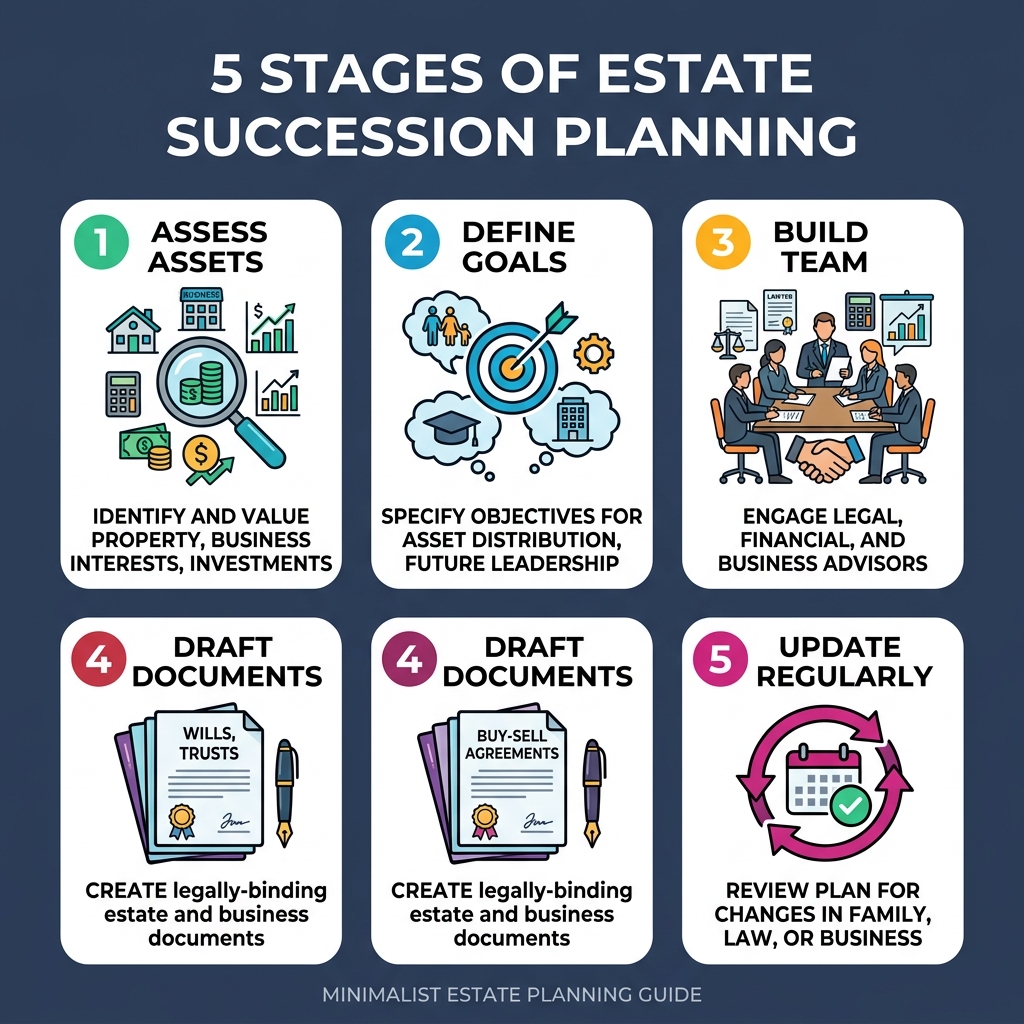
Key Steps to Integrated Estate Succession Planning
Don’t try to eat the whole elephant at once. We recommend a phased approach:
- Asset Inventory: List everything. Business value, real estate, IP, bank accounts, and debts.
- Vision Definition: What do you want the business to look like in 10 years? Do you want your name still on the door?
- Stakeholder Communication: Talk to your family. You might find out your “successor” actually wants to be a painter in Italy, or your “quiet” child has a secret passion for the family business.
- Assemble Your Team: You need an estate attorney, a tax expert, and a financial advisor working together.
- Regular Updates: A plan from 2018 is a relic. Review your documents every 2-3 years or after any major life event.
Overcoming Challenges in Family Business Transitions
The hardest part of Estate succession planning isn’t the math—it’s the people. Family dynamics can turn a simple legal transfer into a decades-long feud.
One of the biggest hurdles is separating ownership (who gets the profit) from management (who makes the decisions). We often suggest creating a formal board of advisors or directors, which can include outside professionals to provide a “neutral” perspective and help the next generation learn the ropes without the parent-child baggage getting in the way.
Separating Ownership and Management Effectively
You can use different classes of stock to achieve this. Voting shares go to the children running the company. Nonvoting shares go to the children who aren’t involved. This ensures the “workers” have the authority to pivot the business during a market downturn, while the “non-workers” still get their fair share of the family legacy.
For more insights on the legal side of these transitions, The Ultimate Probate Lawyer FAQ 2025 Edition – National Probate Partners covers how to structure these roles to survive legal scrutiny.
The Importance of Open Communication
We’ve seen it time and again: a business owner keeps their plan a secret because they don’t want to cause conflict while they’re alive. The irony is that secrecy is the #1 cause of conflict after they pass.
Transparency is your best friend. Holding a “family council” meeting where you explain the why behind your decisions can prevent a lot of hurt feelings and lawsuits later. If you’re worried about how to start these conversations, Hiring a Probate Lawyer in 2026: What You Need to Know explains how a professional can act as a mediator to keep things productive.
Common Succession Pitfalls to Avoid:
- Procrastination: Waiting for a “perfect” time that never comes.
- The “Share and Share Alike” Trap: Giving equal management power to unequal participants.
- Ignoring Taxes: Failing to plan for the 2025 sunset.
- No Incapacity Plan: Not having a Durable Power of Attorney to keep the business running if you get sick.
Frequently Asked Questions about Succession
What happens if a business owner dies without a succession plan?
Without a plan, the business often grinds to a halt. Bank accounts may be frozen, employees may leave due to uncertainty, and the business interests will likely head into probate. This can lead to forced asset sales to pay off creditors or taxes, often at “fire sale” prices. How Much Does a Probate Lawyer Cost? can give you an idea of the financial burden this adds to your grieving family.
How does the 2025 tax sunset affect small business owners?
It effectively lowers the “safety net.” If your business and personal assets are worth $10 million, you are currently safe from federal estate tax. After 2025, you could suddenly be $3 million to $4 million over the limit, potentially owing the IRS over $1 million. Do You Need a Probate Attorney? Unpacking Their Role discusses how to plan ahead to avoid this exact scenario.
Can I retain control of my business after transferring ownership?
Yes! Through the use of nonvoting stock, trusts, and specific management contracts, you can move the equity (the value) out of your estate while keeping the voting rights (the control) for as long as you are able to serve. How Do I Know If I Need a Probate Lawyer? is a great resource if you’re trying to figure out which legal path allows for this “phased” transition.
Conclusion
At National Probate Partners, we know that you’ve put your heart and soul into your business and your family. Whether you are in Scottsdale, Arizona, or Corpus Christi, Texas, the laws surrounding Estate succession planning are complex, but the goal is simple: peace of mind.
We specialize in helping business owners nationwide navigate the intersection of probate law and estate administration. From utilizing the specific benefits of Texas estate law to helping military families in the Armed Forces Pacific or Europe, our mission is to ensure your legacy is preserved exactly as you intended.
Don’t let the 2025 sunset catch you off guard. Whether you need to build a plan from scratch or update a dusty binder from a decade ago, we are here to help you resolve complex challenges efficiently and compassionately.
Ready to protect what you’ve built? Contact a Probate Lawyer today for a professional consultation. Let’s make sure your business and your family thrive for generations to come.