
Understanding Ancillary Probate: When Estate Settlement Crosses State Lines
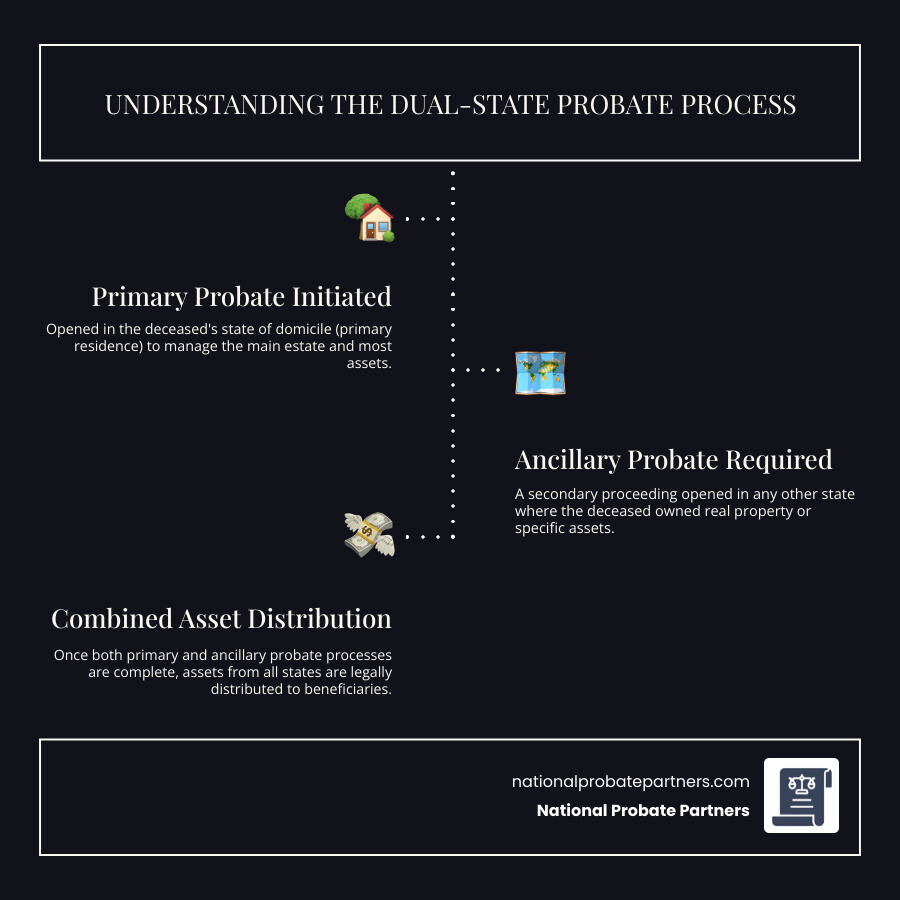
Ancillary probate is a secondary probate proceeding required when a deceased person owned property in a state other than their primary state of residence (domicile). Here’s what you need to know:
Quick Answer: What is Ancillary Probate?
- Definition: A separate court process that runs alongside the primary probate in your home state
- When Required: When the deceased owned real estate or certain assets in another state
- Why Necessary: The probate court in the home state lacks legal jurisdiction over out-of-state property
- Common Trigger: Vacation homes, rental properties, or land in different states
- Key Impact: Adds extra time, legal fees, and complexity to estate settlement
If you’re settling a loved one’s estate and finding property scattered across multiple states, you’re facing a surprisingly common challenge. In the United States, approximately 65.7% of households own homes, and for those over 65, that number jumps to nearly 80%. Many of these homeowners purchase vacation properties, retirement homes, or investment real estate in states different from where they live.
This creates a legal complication: each state has its own property laws and probate procedures. The probate court where your loved one lived simply doesn’t have the power to transfer title to property located in another state. That’s where ancillary probate comes in.
Think of it this way: if your parent lived in New York but owned a beach house in Florida, you’ll need to open a primary probate case in New York and an ancillary probate case in Florida. Each proceeding requires separate court filings, potentially separate attorneys, and additional fees.
The good news? Understanding ancillary probate is the first step toward managing it effectively. Even better, with proper estate planning, it can often be avoided entirely.
What is Ancillary Probate and When is it Required?
To truly grasp ancillary probate, it helps to understand the word “ancillary” itself. According to the Dictionary, “ancillary” is an adjective meaning “providing necessary support to the primary activities or operation of an organization, institution, industry, or system.” In the context of estates, ancillary probate is precisely that: a secondary legal proceeding that supports the primary probate process.
Legally, ancillary probate is defined as “a secondary proceeding required in another state than the original probate proceeding.” It becomes necessary “where the deceased left property or assets in more than one state, and because each state has different property laws, a probate proceeding must be made in each state where property is located.” This definition from the Wex Definitions Team at Cornell Law School perfectly encapsulates the core concept.
So, when is ancillary probate required? It’s triggered when a deceased individual, known as the “non-domiciliary decedent,” owned property in a state different from their primary residence, or “domicile.” For example, California Probate Code 12501 describes ancillary probate as “proceedings in this state for administration of the estate of a non domiciliary decedent.” This means if someone who lived in Arizona owned property in Texas, a Texas ancillary probate would be required to manage that Texas property.
The fundamental reason for this requirement lies in jurisdiction. Probate courts in the deceased’s home state (the domiciliary state) simply do not have legal authority over real property or certain tangible assets located in another state. Each state has sovereign control over the real estate within its borders. Without a local probate court’s authorization in that second state, the property cannot be legally transferred, sold, or distributed to heirs.
This is a common scenario, especially in regions like Arizona and Texas, where people often own second homes, investment properties, or even mineral rights. If a loved one passed away as a resident of Arizona but owned a vacation home in Corpus Christi, Texas, or a ranch in West Texas, that Texas property would necessitate an ancillary probate in Texas, even if their primary estate is being probated in Arizona. Understanding the specifics of ancillary probate is crucial for anyone navigating the complexities of their loved one’s assets. For more on how we define and manage an estate, you can read our guide on Understanding the Estate.
Primary vs. Ancillary Probate: Key Differences
While both primary and ancillary probate administer a deceased person’s estate, they serve distinct purposes. Primary probate, or domiciliary probate, is the main proceeding in the state where the deceased legally resided. This is where the bulk of the estate, including personal property and local real estate, is managed.
Ancillary probate is a secondary proceeding required in any other state where the deceased owned real property. Here are the key differences:
| Feature | Primary Probate (Domiciliary) | Ancillary Probate |
|---|---|---|
| Location | State of the deceased’s legal residence (domicile) | Any other state where the deceased owned property |
| Purpose | Administer the main estate and validate the will | Administer specific out-of-state assets |
| Jurisdiction | Over all assets within the domiciliary state | Only over assets located within that specific state |
| Will Validity | Original validation of the will | Typically accepts the will validated in the domiciliary state |
| Executor | Appointed by the domiciliary court | Often the same executor, formally recognized by ancillary court |
| Proceedings | Comprehensive: inventory, debt payment, distribution | Streamlined, focused on transferring specific assets |
| Letters | Issues Letters Testamentary | Issues its own form of Letters or recognizes foreign Letters |
In primary probate, the court validates the Will and issues “Letters Testamentary,” granting the executor legal authority. For ancillary probate, the court typically accepts the validity of the Will and Letters from the home state (often called “foreign Wills”). However, the ancillary court must still issue its own orders to grant authority over local assets.
This process can become complex if the deceased died without a will (intestate), as each state has unique intestacy laws. For more general questions, see The Ultimate Probate Lawyer FAQ 2025 Edition.
The Role of the Executor in Ancillary Probate
The executor appointed in the primary proceeding must also manage the ancillary probate. Their fiduciary duty extends to the additional jurisdiction, where they act as the “foreign executor.”
Their responsibilities include:
- Petitioning the Ancillary Court: Filing certified copies of the will and Letters from the home state.
- Recognition of Authority: Obtaining local court approval to manage assets in that state.
- Asset Accounting: Identifying and valuing specific out-of-state assets.
- Managing Local Debts: Addressing creditors or claims specific to the ancillary jurisdiction.
- Transferring Property: Overseeing the legal sale or transfer of property as directed by the will or state law.
While the primary executor usually has priority, they must typically engage local legal counsel licensed in the ancillary state to steer specific court procedures. For more on hiring counsel, see our Probate Lawyer FAQ.
Common Assets and Costs of Ancillary Administration
Ancillary probate is primarily triggered by assets that are “immovable” or have a fixed location, requiring the jurisdiction of the state where they are situated. The most common asset requiring ancillary probate is real estate. This includes vacation homes, rental properties, undeveloped land, or even a fractional interest in a property. For example, if your loved one was a resident of Arizona but owned a plot of land in Texas, that Texas property would need to go through ancillary probate in Texas.
Beyond traditional real estate, other assets that frequently necessitate ancillary probate include:
- Mineral Rights, Oil, and Gas Interests: These are often considered real property interests, especially in states like Texas. If a decedent owned mineral rights in Texas but lived in Arizona, those rights would require Texas ancillary probate.
- Tangible Personal Property: In some cases, very valuable tangible items like vehicles, boats, or airplanes that are titled and registered in a state different from the decedent’s domicile might also trigger ancillary probate, though this is less common than with real estate.
- Business Interests: Certain types of business entities or partnership interests that are legally tied to real property in an out-of-state jurisdiction can also lead to the need for ancillary administration.
The burdens associated with ancillary probate are primarily financial and logistical. We’re talking about doubling up on many aspects of the probate process:
- Double Court Fees: You’ll likely pay court filing fees in both the domiciliary state and the ancillary state.
- Attorney Fees: In most cases, you’ll need to hire a probate attorney in the domiciliary state and a separate probate attorney in the ancillary state. This means two sets of legal fees, significantly increasing the overall cost. For an idea of typical costs, refer to our guide on Probate Lawyer Cost.
- Accounting Burdens: The executor must manage separate inventories, appraisals, and accountings for the assets in each state, adding to the administrative complexity and time commitment.
- Delays: Running two separate probate proceedings simultaneously inevitably prolongs the entire estate settlement process. What might be a straightforward probate in one state can become a lengthy ordeal when an ancillary proceeding is involved.
- Potential for Disputes: Managing assets and procedures across state lines can sometimes lead to misunderstandings or disagreements among beneficiaries, potentially escalating into Probate Disputes.
These added costs and complexities can quickly diminish the value of the estate and cause considerable stress for the grieving family. It’s why proactive estate planning is so highly recommended.
Strategies to Avoid Ancillary Probate
Ancillary probate is often avoidable with proactive estate planning. Here are effective strategies to minimize the burden on your heirs:
- Joint Ownership with Rights of Survivorship: Property held in joint tenancy or as tenants by the entirety passes automatically to the surviving owner upon death, bypassing probate entirely.
- Transfer-on-Death (TOD) Deeds: States like Arizona and Texas allow TOD deeds for real estate. You designate a beneficiary who inherits the property automatically, while you retain full control during your lifetime.
- Gifting Strategies: Gifting property during your lifetime removes the asset from your estate. This should be done with legal advice to manage potential tax implications.
- Business Entities: Holding out-of-state real estate in an LLC or partnership can avoid ancillary probate. Your ownership interest is considered personal property, which is probated in your home state, while the entity continues to own the real estate.
Consulting an experienced attorney is vital to determine the best approach. For more on planning, see Hiring a Probate Lawyer in 2026: What You Need to Know. Some situations may not require formal probate, as noted in When Formal Probate Isn’t Needed.
Using a Living Trust to Avoid Ancillary Probate
A revocable living trust is one of the most robust tools for avoiding both primary and ancillary probate.
- Asset Titling: You transfer ownership of assets (like a Texas vacation home) into the name of the trust.
- No Personal Ownership: Because the trust owns the assets at the time of death, probate is not required to transfer them.
- Successor Trustee: Your named successor trustee manages and distributes assets according to your instructions without court involvement.
- Seamless Transfer: This allows for a private, efficient transfer of property across state lines.
If you own property in multiple states, such as Arizona and Texas, a properly funded trust ensures your successor can manage both without opening separate court cases. This saves beneficiaries significant time and expense. To see if this is right for you, read How Do I Know If I Need a Probate Lawyer?.
Navigating Multistate Probate Within the US
While our initial research included details about international probate procedures, our focus at National Probate Partners is on assisting clients within the United States, particularly in states like Arizona and Texas, and for those serving in the Armed Forces. Even within the U.S., state laws can vary significantly, making ancillary probate a complex endeavor.
When an individual passes away as a resident of Arizona but owns property in Texas, or vice versa, the estate will likely face the need for ancillary probate. This isn’t about international borders, but rather the distinct legal sovereignty of each U.S. state. Each state has its own probate codes, court procedures, filing fees, and even rules about what constitutes proper notice to heirs and creditors.
For example, Texas has specific provisions for handling foreign wills and estates, including those from other U.S. states. The process for an Arizona resident with Texas property would involve:
- Opening Primary Probate in Arizona: The initial probate proceeding would be filed in Arizona, where the decedent was domiciled.
- Filing for Ancillary Probate in Texas: A separate application would then be filed in the appropriate Texas county court where the property is located. This typically involves submitting certified copies of the will (if any), the order admitting the will to probate from Arizona, and the Letters Testamentary or Administration issued by the Arizona court.
- Local Texas Counsel: It is almost always necessary to retain a Texas-licensed attorney to steer the Texas court system, even if the primary executor has an attorney in Arizona.
- Texas-Specific Procedures: The Texas ancillary court will ensure compliance with Texas law for the administration and transfer of the Texas property, which may include specific requirements for inventory, appraisal, and notice.
The same principles apply if a Texas resident owned property in Arizona. An Arizona ancillary probate would be necessary, following Arizona’s specific probate statutes and court rules. The implication here is that “multijurisdictional” doesn’t just refer to different countries; it very much applies to different states within the U.S. Each state, whether Arizona, Texas, or one of the others where our clients reside, maintains distinct property and probate laws. Understanding these variations is paramount to efficiently settling an estate.
Frequently Asked Questions about Ancillary Probate
What happens if there is no will (intestacy)?
If a person dies intestate and owns property in multiple states, the assets in each state are distributed according to that specific state’s laws. For example, an Arizona resident’s local assets follow Arizona law, but their Texas real estate follows Texas intestacy statutes. These laws can differ regarding who qualifies as an heir and what percentage they receive, potentially leading to conflicting results and family disputes. In these cases, local legal guidance in each state is critical.
Can I handle ancillary probate without a local lawyer?
Handling ancillary probate without a local lawyer is generally not advisable and often not permitted by the court.
- Jurisdictional Expertise: A local lawyer understands the specific probate codes and court rules of that state.
- Court Appearances: Many proceedings require filings or appearances that only a local attorney can manage efficiently.
- Risk Mitigation: Mistakes can lead to personal liability for the executor or significant delays.
We recommend engaging counsel in both the home state and the ancillary state to ensure a coordinated administration.
How long does the ancillary process typically take?
The duration depends on the estate’s complexity, court caseloads, and state-specific statutory periods (such as creditor claim windows). Generally, an uncontested ancillary probate takes between 6 months and 2 years. Because it often relies on documents from the primary probate, the overall timeline for the estate is usually longer than a single-state proceeding.
Conclusion
Understanding ancillary probate is crucial for anyone involved in settling an estate with multijurisdictional assets, especially across states like Arizona and Texas. While it introduces additional layers of complexity, cost, and time, it is a necessary legal step to properly transfer out-of-state property.
The good news is that with proactive estate planning, you can significantly minimize or even entirely eliminate the need for ancillary probate. Strategies such as joint ownership with rights of survivorship, Transfer-on-Death deeds, and particularly the establishment of a revocable living trust, offer effective ways to ensure your assets pass smoothly and privately to your beneficiaries, no matter where they are located.
At National Probate Partners, we specialize in helping individuals and families steer these intricate probate challenges. Our experienced team provides personalized and compassionate service, guiding you through every step of the estate administration process, whether it involves a simple primary probate or complex multijurisdictional issues. We are dedicated to helping you resolve current probate matters efficiently and implement robust estate plans to avoid future probate complications.
If you’re facing the complexities of ancillary probate or want to ensure your estate plan protects your loved ones from this burden, we are here to help. Do You Really Need a Probate Lawyer? Contact Us for a Free Consultation. Let us provide the clarity and support you need.