
When One Probate Isn’t Enough: What Ancillary Letters Testamentary Mean for Your Estate
Ancillary letters testamentary are official documents issued by a probate court in a secondary state — one where the deceased owned property but did not live — that authorize an executor to manage and transfer those out-of-state assets.
Here’s the short version of what you need to know:
- What they are: Court-issued documents granting an executor legal authority over a decedent’s property located outside their home state
- Why they’re needed: Each state has exclusive jurisdiction over real property within its borders — the home state court simply cannot control it
- When they’re required: Whenever a decedent owned real estate, mineral rights, a vehicle, or other tangible property titled in another state
- How to get them: File an ancillary probate petition in the state where the property is located, using authenticated copies of the home state’s will and probate orders
- How to avoid them: Proper estate planning tools like living trusts, joint tenancy, or transfer-on-death deeds can bypass the need entirely
Settling an estate is already hard. Then you discover a deed to a property in another state.
Suddenly, the probate process you thought was nearly finished now spans multiple states, multiple courts, and multiple sets of rules. That’s an experience many executors face — and it’s exactly why ancillary letters testamentary exist.
Think of it this way: your loved one’s home state handles the primary probate. But every other state where they owned property gets to say, “Not so fast — you need our court’s permission too.”
This guide walks you through everything you need to know — from understanding what ancillary letters are and when they’re required, to getting them issued and avoiding the process altogether next time.
Ancillary letters testamentary word roundup:
Understanding Ancillary Letters Testamentary and the Probate Process

To understand ancillary letters testamentary, we first have to look at how courts view their own power. In the legal world, this is called “jurisdiction.” A court in Texas has the power to decide who owns a house in Corpus Christi, but it has zero authority over a condo in Scottsdale, Arizona.
According to the Legal Information Institute at Cornell (Wex), letters testamentary are the official documents that prove an executor has the legal right to act on behalf of an estate. Without them, you’re just a person with a piece of paper (the will) that hasn’t been “activated” by the government.
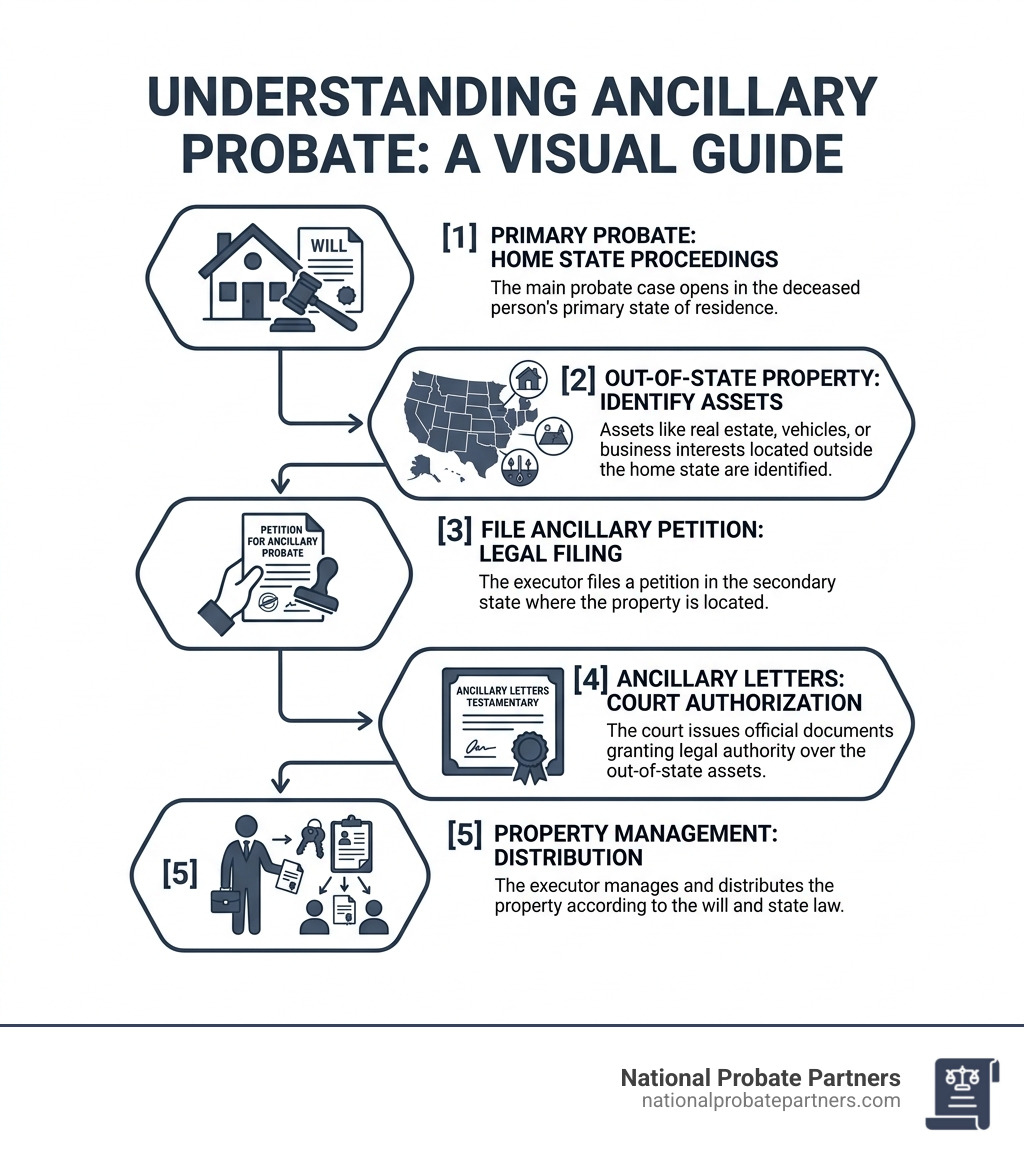
When a person dies, their “domiciliary” probate (the main one) happens in the state where they lived. However, if they left behind real estate or tangible assets in another state, the local authorities there won’t recognize the home-state letters. You must open a secondary, or ancillary probate proceeding, to get the legal “key” to those specific out-of-state doors.
Domiciliary vs. Ancillary Letters Testamentary
The difference is all about geography.
- Domiciliary Letters: Issued by the court in the decedent’s home state. This covers all “intangible” property (like bank accounts or stocks) and any property physically located in that home state.
- Ancillary Letters: Issued by a “foreign” jurisdiction (any state other than the home state). These give the executor legal standing to sell, transfer, or manage property in that specific second state.
Powers and Duties Granted by Ancillary Letters
Once you hold ancillary letters testamentary, you are a fiduciary in that second state. This means the court has entrusted you with specific powers, including:
- Asset Collection: Taking control of the out-of-state property.
- Debt Payment: Settling any debts owed to creditors in that specific state.
- Tax Filings: Paying any local inheritance or estate taxes (like the New York State Tax Waiver process).
- Property Distribution: Ensuring the property actually reaches the beneficiaries named in the will.
When and Where You Need Ancillary Letters Testamentary
Generally, you need ancillary letters testamentary whenever the decedent owned property that “stays put.” If it’s stuck in the ground or titled in another state, the home-state executor can’t touch it without help.
The most common “trigger” assets include:
- Real Estate: Houses, vacation homes, or vacant land.
- Mineral Rights: Very common in Texas, where oil and gas interests are treated as real property.
- Business Interests: Ownership in a local partnership or LLC that isn’t easily moved.
- Tangible Personal Property: Vehicles, boats, or airplanes registered in that state.
State-Specific Rules for Ancillary Letters Testamentary
Every state has its own “flavor” of probate law. Since we serve clients in places like Texas and Arizona, we see these differences every day.
| State | Primary Statute | Key Requirement |
|---|---|---|
| Texas | Texas Estates Code Section 501.006 | Requires proof that the executor is qualified in the home state and not disqualified in Texas. |
| Arizona | Maricopa County Superior Court Rules | Uses “Proof of Authority” for out-of-state personal representatives. |
| New York | SCPA § 1608 | Requires ancillary administration only if there is active administration in the home state. |
| Kansas | K.S.A. 59-807 | Grants letters to the designated executor if they qualify within 7 days of the court’s finding. |
In California, under Probate Code 12501, the process is similar—the court must see that the out-of-state executor has been properly vetted before they can sell that Malibu beach house.
Identifying Out-of-State Property Post-Filing
What happens if you’re halfway through probate in Texas and suddenly find a deed for a cabin in Arizona? Don’t panic. You’ll need to notify your attorney immediately to file a supplemental petition. This “jurisdictional expansion” is common, but it does mean you’ll need to start the ancillary process in that second state to ensure a clear chain of title.
Step-by-Step Guide to Obtaining Ancillary Letters
Getting ancillary letters testamentary isn’t about re-proving the whole case. It’s more about “recording” the win you already had in the home state. Here is the general path:
- Gather Authenticated Records: You can’t just bring a photocopy of the will. You need “authenticated” or “exemplified” copies. This usually involves a “triple seal” — a clerk signs it, a judge certifies the clerk’s signature, and the clerk then certifies the judge’s signature.
- File the Petition: Submit these records to the probate court in the county where the property is located. For example, if the property is in Phoenix, you’d use the Maricopa County Superior Court probate forms.
- Court Hearing: Some states require a brief hearing to ensure the executor meets local eligibility.
- Oath and Bond: You may need to take a local oath of office. Depending on the state and the will, you might also have to post a “bond” (insurance) to protect the estate’s local creditors.
- Issuance: The court clerk issues the ancillary letters testamentary.
Full Administration vs. Muniment of Title
In Texas, we often have two choices:
- Full Ancillary Administration: This is the “full-strength” version where the court issues letters, and the executor has active power to manage assets and pay debts.
- Muniment of Title: This is a “probate-lite” version. If the only goal is to transfer the title of a house to a beneficiary and there are no debts, Texas allows you to simply record the out-of-state will in the local property records. It’s faster and cheaper, but it doesn’t give you ancillary letters testamentary to do things like sell the property or collect bank accounts.
Qualifications for Out-of-State Executors
Can an out-of-state resident serve as an executor? Usually, yes. However, states like Texas require you to appoint a “Resident Agent” — someone living in the state who can receive legal mail on your behalf. There are also specific protections for military members under 10 USC 1044d, which ensures military testamentary instruments are recognized across state lines.
Costs, Timelines, and Avoiding Ancillary Probate
Let’s talk about the elephant in the room: the cost. Doing probate once is expensive; doing it twice feels like an insult.
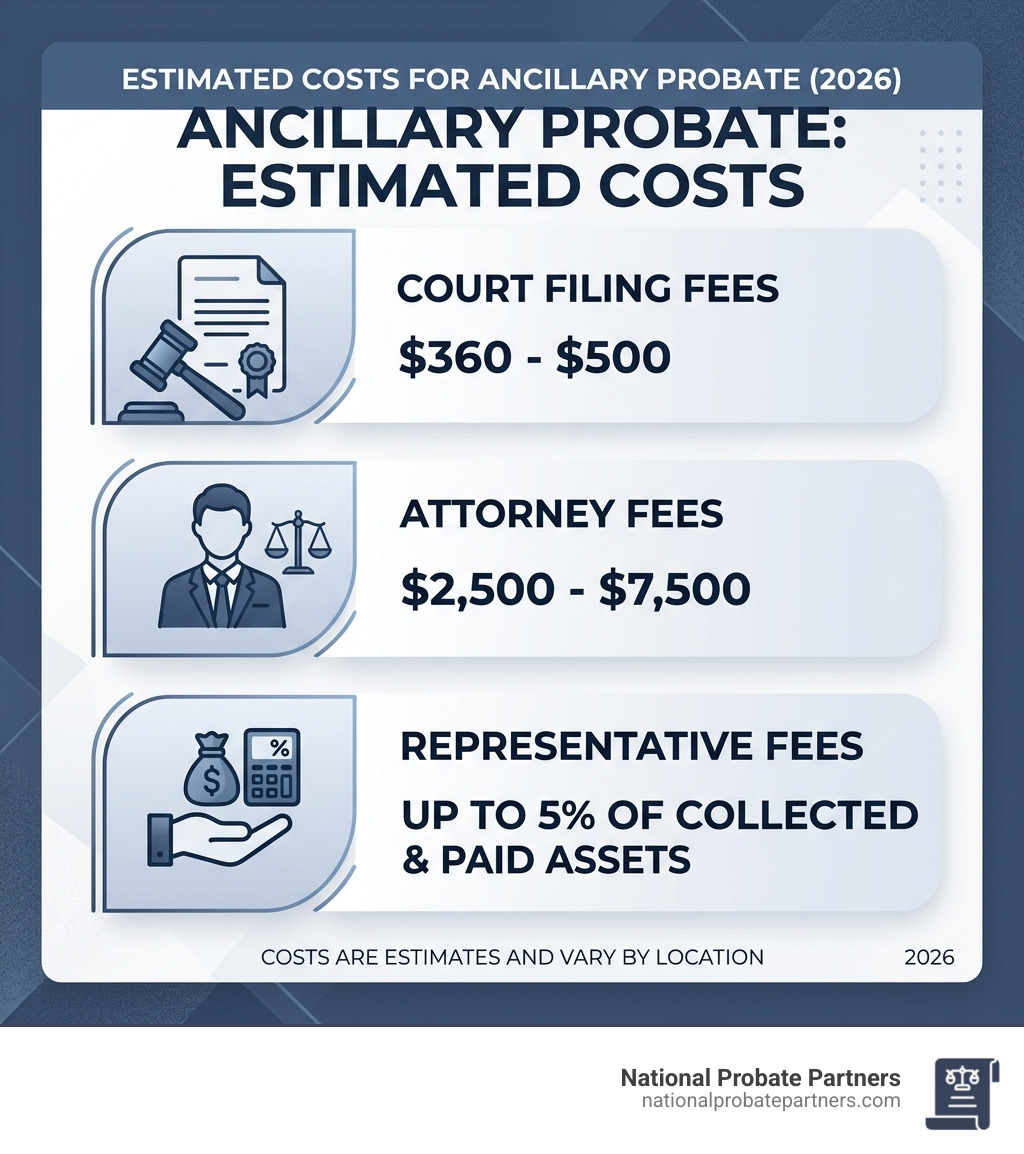
In Texas, court filing fees typically run between $360 and $500. Attorney fees for a straightforward ancillary case can range from $2,500 to $7,500 for flat-fee services. Additionally, Texas law allows an ancillary representative to charge a fee of up to 5% of the assets they collect and 5% of the assets they pay out.
Typical Timelines and Potential Delays
- Texas: Usually takes 4 to 6 months.
- California: Obtaining the actual letters usually takes 6 to 10 weeks from the initial filing.
- Potential Delays: The biggest “time-sinks” are waiting for tax waivers (common in New York) and the time it takes to get exemplified copies from the home-state court.
Common Pitfalls and How to Address Them
The most common headache is document rejection. If your home-state clerk misses one seal on the authenticated copies, the ancillary court will send you back to square one. Another pitfall is failing to notify local creditors. Even though the primary probate is elsewhere, the ancillary state wants to make sure its own citizens get paid before the money leaves the state.
How to Avoid Ancillary Probate Entirely
The best way to handle ancillary letters testamentary is to never need them. We often help clients at National Probate Partners set up:
- Living Trusts: The trust owns the out-of-state property, so it doesn’t go through probate at all.
- Joint Tenancy with Right of Survivorship: The property passes automatically to the surviving owner.
- Transfer-on-Death (TOD) Deeds: Available in many states (like Texas and Arizona), these allow property to transfer to a beneficiary upon death without a court order.
- LLCs: In some cases, putting real estate into an LLC turns “real property” into “intangible personal property,” which can often be handled in the home state.
Frequently Asked Questions about Ancillary Letters Testamentary
Do ancillary letters testamentary expire?
In many jurisdictions, like California, letters are generally considered valid for one year. While the “authority” remains until the estate is closed, many banks and title companies will demand “fresh” certified copies (usually less than 60 days old) to ensure the executor hasn’t been removed or the estate hasn’t been settled.
What if the decedent died without a will?
If there is no will, the process is called “Ancillary Administration” rather than “Ancillary Probate.” Instead of ancillary letters testamentary, the court issues “Ancillary Letters of Administration.” The process is similar, but the court will use the local state’s laws of “intestate succession” to decide who gets the property.
Is a local probate attorney required?
While not always strictly required by law for every single step, it is highly recommended. Each county has its own “local rules” and procedural nuances. A Texas attorney knows how to navigate the Texas Estates Code, while an Arizona attorney understands the Maricopa County filing system. Trying to do it yourself from 1,000 miles away is a recipe for document rejections and delays.
Conclusion
At National Probate Partners, we know that discovering out-of-state property can feel like a roadblock. Whether you’re dealing with a family ranch in Texas, a condo in Arizona, or mineral rights across the country, we’re here to help you navigate the complexities of ancillary letters testamentary.
Our team provides personalized, compassionate service to resolve these multi-state challenges efficiently. We don’t just help you through the current crisis; we work with you to plan for the future so your own heirs can avoid the “double probate” trap.
Ready to clear the title on that out-of-state property? Contact us today and let’s get your estate administration back on track.
Learn more about the process: Everything You Need To Know About Ancillary Probate