
When You Need Estate Administration Help: A Clear Starting Point
If you’re looking for estate administration help, here’s what you need to know right away:
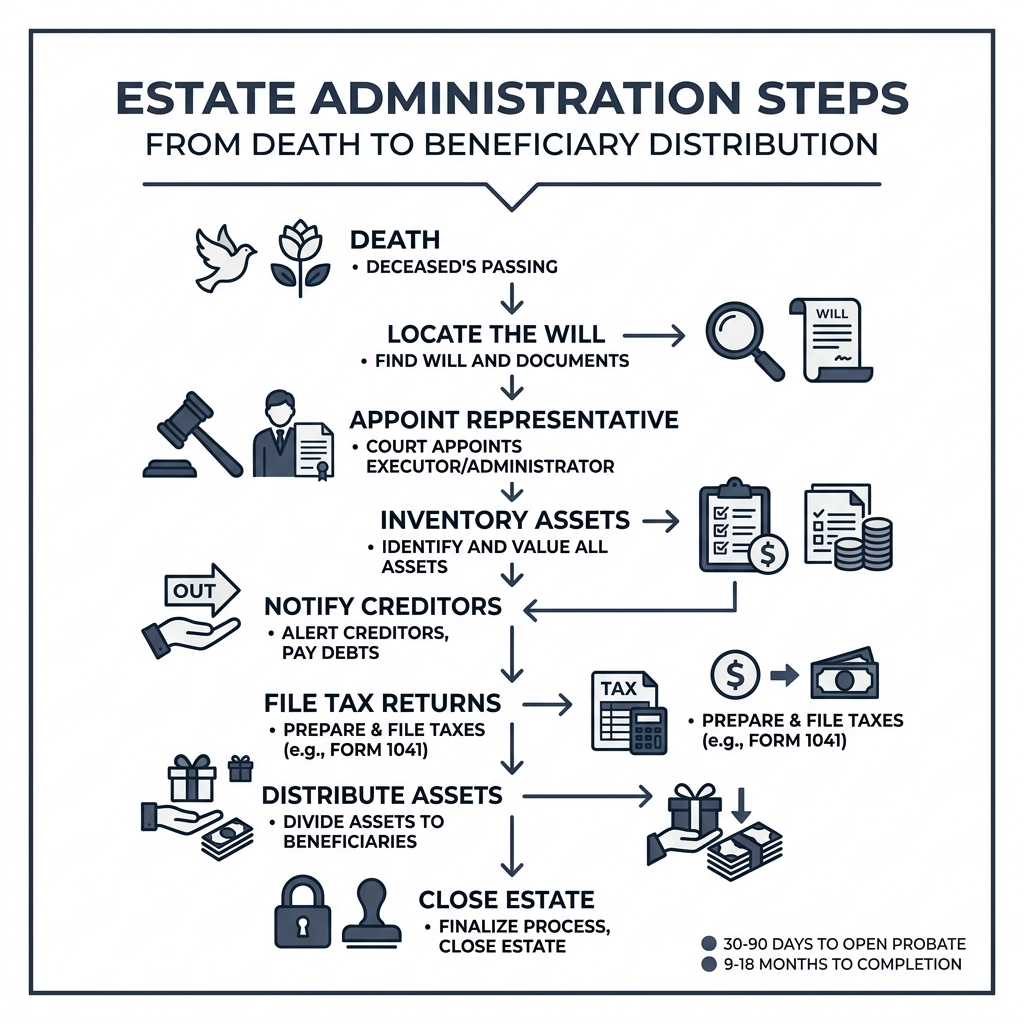
Estate administration is the legal process of collecting a deceased person’s assets, paying their debts and taxes, and distributing what remains to the rightful heirs or beneficiaries. It typically involves these core steps:
- Locate the will and file it with the probate court
- Appoint a personal representative (executor or administrator)
- Inventory and value all assets
- Notify creditors and settle outstanding debts
- File required tax returns (including Form 1041 if the estate earns over $600 in income)
- Distribute assets to beneficiaries and close the estate
Most estates go through probate, which opens 30 to 90 days after death depending on your state. The full process typically takes 9 to 18 months – sometimes longer for complex estates.
Losing someone you love is hard enough. Then the paperwork arrives.
Suddenly you’re responsible for a legal process you’ve never dealt with before – probate courts, tax filings, creditor claims, and family members all waiting on you to figure it out. It’s a lot to carry while you’re grieving.
The truth is, estate administration is more complex than most people expect. Even straightforward estates involve legal deadlines, government agencies, and financial decisions that can have real consequences if handled incorrectly. Personal representatives can be held personally liable for mistakes made during the process.
This guide walks you through every stage – from the first steps after a death to the final distribution of assets – so you know exactly what to do, what to watch out for, and when to call in professional help.
Learn more about estate administration help:
Understanding the Basics of Estate Administration Help

When we talk about estate administration help, we are looking at the big picture of wrapping up a person’s life. Think of it as a final accounting. It isn’t just about reading a will (which, by the way, rarely happens in a dramatic library setting like in the movies). It is a structured legal process to ensure that everyone the deceased owed money to gets paid and everyone they loved gets what they were promised.
At its core, probate is the court-supervised process used to validate a will and oversee the distribution of assets. However, not every asset has to go through this “maze.” Assets with designated beneficiaries—like life insurance policies or 401(k)s—usually bypass the court entirely.
The court will eventually issue what are called “Letters Testamentary” (if there’s a will) or “Letters of Administration” (if there isn’t). These documents are like a golden ticket; they give the personal representative the legal authority to talk to banks, sell property, and sign tax returns on behalf of the estate.
For a deeper dive into what constitutes an estate, check out our guide on Understanding the Estate: What It Means for Your Legacy. You can also find more details on the Responsibilities of an estate administrator directly from the IRS to ensure you don’t miss any federal requirements.
Executor vs. Administrator: Who is in Charge?
In estate administration help, titles matter. If the deceased person left a will, they likely named an executor. This is the person they trusted to carry out their final wishes.
If there is no will, or the named executor can’t do the job, the court appoints an administrator. Both roles are collectively known as the “personal representative.” Regardless of the title, this person has a fiduciary duty. This is a fancy legal way of saying they must act in the best interest of the estate and the beneficiaries, not themselves. You can’t use the estate’s bank account as your personal ATM!
Legal priorities for who gets to be the administrator are often set by state laws, such as the Wills, Estates and Succession Act (though specific rules vary between Texas and Arizona, the general principle of priority—spouse, then children, then other kin—remains similar).
When is Probate Actually Required?
One of the first questions we hear is, “Do we really have to go to court?” The answer depends on what the person owned and how they owned it.
- Small Estates: Many states have a “fast track” for smaller estates. In Texas, for example, a Small Estate Affidavit can be used if the estate is worth less than $75,000 (excluding the homestead). Arizona has similar thresholds for personal property ($75,000) and real property ($100,000).
- Joint Tenancy: If a house was owned as “joint tenants with right of survivorship,” the property usually passes directly to the surviving owner.
- Beneficiary Designations: Accounts labeled Payable on Death (POD) or Transfer on Death (TOD) go straight to the named person.
If you are staring at a pile of paperwork and wondering if you can skip the court, it might be time to ask: How Do I Know If I Need a Probate Lawyer?
The Step-by-Step Process of Settling an Estate
Navigating the estate administration maze requires a map. While every estate is unique, the path usually looks like this:
| Requirement | Small Estate | Regular Estate |
|---|---|---|
| Asset Limit | Typically <$50k–$100k (varies by state) | No upper limit |
| Court Involvement | Minimal (Affidavit) | Full Supervision |
| Timeline | 30–90 days | 9–18 months |
| Notice to Creditors | Usually not required | Mandatory |
The process officially kicks off with a petition for probate. This is filed in the county where the deceased lived. Once the court approves the petition and appoints the personal representative, the real work begins.
You must provide notice to all “interested persons”—meaning anyone who might inherit something or anyone the deceased owed money to. This starts a clock for creditors to make their claims. If they don’t speak up within a certain timeframe (often 4 to 6 months), they may be out of luck.
While specific state codes like Md. Code, Estates and Trusts § 7-104 provide detailed timelines for other regions, the general flow of petitioning, notifying, and accounting is a standard part of estate administration help across the United States.
Gathering Documents and Valuing Assets
Before you can give anything away, you have to know what is there. This is often the most time-consuming part of estate administration help. You’ll need:
- Multiple original death certificates (everyone from the bank to the cell phone provider will want one).
- The original will.
- Deeds, titles, and recent financial statements.
You are required to file an Inventory and Appraisal. This document lists everything the deceased owned at its “fair market value” on the date of death. For bank accounts, this is easy. For a house or a collection of vintage guitars, you’ll likely need a professional appraiser.
Don’t forget to look for “hidden” assets. We recommend you Search for unclaimed property via state databases to see if there are old utility deposits or forgotten bank accounts waiting to be claimed.
Managing Taxes, Debts, and Creditor Claims
The taxman doesn’t stop calling just because someone has passed away. As the administrator, you are responsible for:
- The Final Income Tax Return: Filing the deceased person’s last Form 1040.
- Estate Income Tax (Form 1041): If the estate assets (like a house being sold or stocks) generate more than $600 in income during the administration period, you must get an EIN from the IRS and file this return.
- Federal Estate Tax (Form 706): This only applies to very large estates (over $12.92 million for 2023).
You must also verify that debts are legitimate before paying them. If the estate is “insolvent”—meaning there is more debt than money—there is a very specific order in which creditors get paid (usually funeral expenses and taxes first). Never pay debts out of your own pocket!
For more on these tax duties, see the Responsibilities of an estate administrator guide.
Overcoming Common Challenges and Special Cases
Even with the best estate administration help, roadblocks can appear. Family disputes are the most common. A “will contest” can happen if someone believes the deceased was pressured into signing the will or wasn’t in their right mind. These disputes can freeze an estate for years.
Another challenge is “fractionation,” particularly in land ownership. When land is passed down to multiple heirs over generations without a clear plan, you end up with dozens of people owning tiny percentages of a single plot. This makes the land almost impossible to sell or manage.
If the estate involves trusts, the process shifts slightly. A trust administration lawyer helps manage assets that are held outside of probate. You can learn about this specialized role in Beyond Probate: The Role of a Trust Administration Lawyer.
Navigating Intestacy and Indian Trust Assets
When someone dies without a will, they have died “intestate.” In this case, the state’s default laws decide who gets what. Usually, it goes to the spouse and children, but the split can be surprising. For example, in some states, if you have children from a previous marriage, your current spouse might only get a portion of the estate, not all of it.
Special rules also apply to Indian trust assets. The American Indian Probate Reform Act of 2004 (AIPRA) was created to limit fractionation of trust lands. If you are dealing with Individual Indian Money (IIM) accounts or trust land, the Department of the Interior and the Bureau of Indian Affairs (BIA) get involved.
Probate for these assets can take years because it follows federal rules. It is vital to Plan for the Future by understanding how these specific inheritance rules work, especially the “single heir rule” for small interests.
Professional Estate Administration Help for Complex Situations
You don’t have to do this alone. In fact, in many cases, you shouldn’t. Professional estate administration help is essential if:
- The estate owns a business.
- There is out-of-state property (requiring “ancillary probate”).
- There are significant tax issues or complex investments.
- Beneficiaries are fighting.
Hiring an expert can actually save the estate money by avoiding costly tax penalties or legal mistakes. If you’re looking ahead, check out Hiring a Probate Lawyer in 2026: What You Need to Know to stay informed on the latest legal trends.
Timelines, Costs, and Simplification Strategies
Let’s talk numbers. The average probate case takes 9 to 18 months. Why so long? Much of that time is spent waiting on statutory notice periods for creditors or for the IRS to process tax returns.
Costs also add up. You can expect to encounter:
- Filing Fees: Usually around $400–$500 to open the case.
- Attorney Fees: These are often set by state law as a percentage of the estate value or billed hourly.
- Appraisal Fees: To value property and jewelry.
- Surety Bonds: A type of insurance the court may require to protect the beneficiaries from executor mistakes.
Curious about the breakdown? Read more on How Much Does a Probate Lawyer Cost?
Proactive Strategies to Simplify Estate Administration Help
The best way to “navigate the maze” is to build a bridge over it. You can simplify things for your own heirs by using these tools:
- Living Trusts: Assets in a trust do not go through probate. They are managed by a successor trustee and can be distributed in weeks, not years.
- POD/TOD Accounts: Adding a “Payable on Death” beneficiary to your bank account is free and keeps that money out of court.
- Joint Titling: Owning property as joint tenants with rights of survivorship ensures the home passes automatically to the survivor.
Understanding Trust vs. Probate: What’s the Difference and Why It Matters is the first step in proactive planning.
Frequently Asked Questions about Estate Settlement
How long does the estate administration process typically take?
Most formal probate cases take between 9 and 18 months. Simple estates with no real estate and no disputes might wrap up in 6 months, while complex estates involving business valuations or federal estate tax returns (Form 706) can take several years.
What happens if there is no will (intestacy rules)?
If there is no will, the estate is distributed according to state “intestacy” laws. The state essentially writes a will for you. Generally, assets go to your closest living relatives (spouse, children, parents, siblings). If you are in a long-term relationship but not married, your partner may receive nothing under these default rules.
What are the costs involved in estate administration?
Costs generally include court filing fees (roughly $435 in many jurisdictions), publication fees for creditor notices, appraisal costs, and professional fees for attorneys and accountants. Total costs often exceed $1,000 for even simple cases and can reach 3% to 7% of the estate’s total value for more complex administrations.
Conclusion
At National Probate Partners, we know that estate administration help is about more than just numbers and laws—it’s about people and their legacies. Whether you are in Scottsdale, Arizona, or Corpus Christi, Texas, the goal is the same: peace of mind for you and a smooth transition for your family.
By staying organized, understanding your tax obligations, and knowing when to seek professional guidance, you can navigate the administration maze with confidence. If the deceased owned property in multiple states, you might even need to look into Everything you need to know about ancillary probate to ensure every asset is accounted for.
Don’t let the paperwork overwhelm your time of grieving. Reach out for the support you need to close this chapter correctly.