
Why US Estate Planning Is the Most Important Thing You’re Probably Putting Off
US estate planning is the process of deciding what happens to your assets, your family, and your healthcare if you die or become incapacitated — and putting legal documents in place to make sure those wishes are followed.
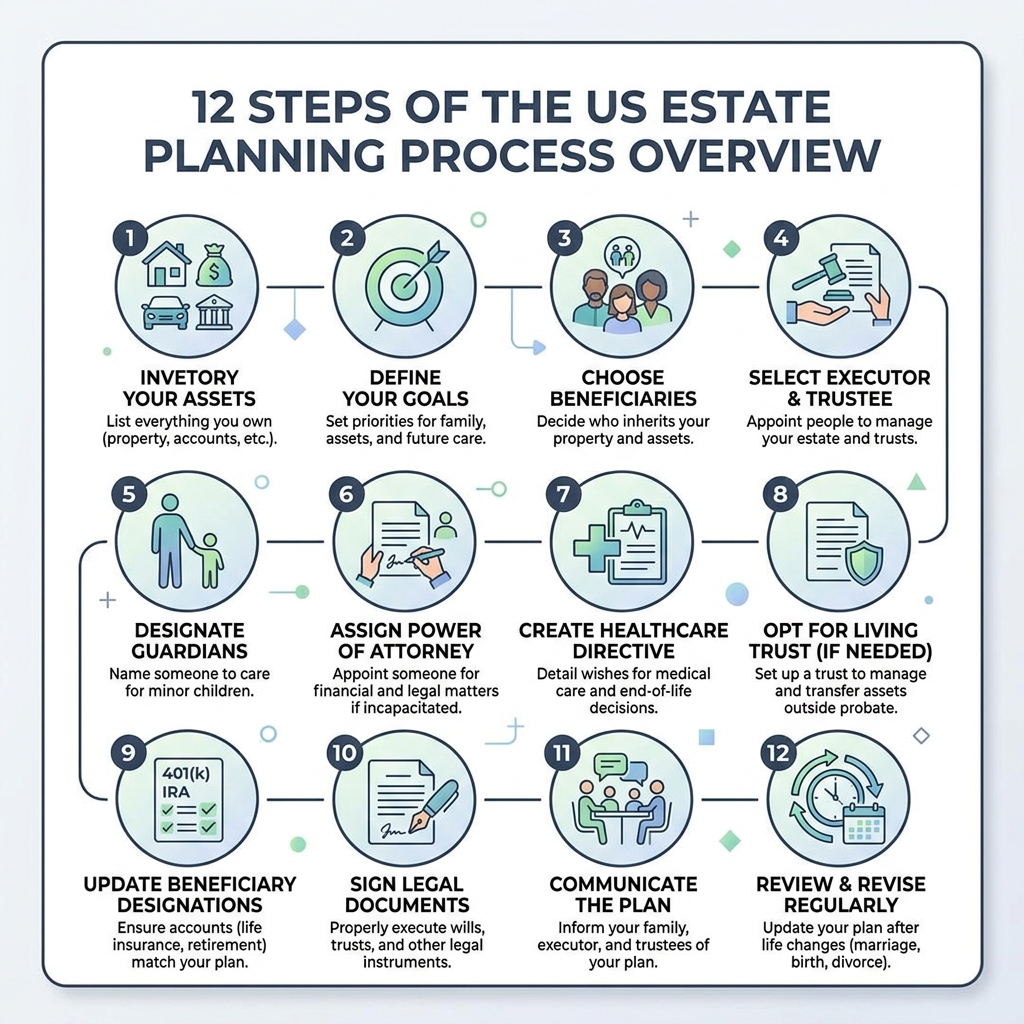
Here’s a quick overview of what a complete estate plan typically includes:
- Will – directs who receives your property after death
- Revocable living trust – transfers assets without going through probate
- Power of attorney – appoints someone to manage finances if you’re incapacitated
- Healthcare directive / living will – records your medical wishes
- Beneficiary designations – overrides your will on accounts like IRAs and 401(k)s
- Guardian designation – names who raises your minor children
Everyone over 18 needs an estate plan — not just the wealthy.
Without a plan, state law decides who gets your assets, who raises your children, and who makes medical decisions on your behalf. That process can take years and cost your family far more than proper planning ever would.
If you’ve recently lost a loved one and are now dealing with their estate, you already know how overwhelming this can be. The legal paperwork, the family dynamics, the creditor calls — it’s a lot. That’s exactly why planning ahead matters so much.
The good news? Estate planning doesn’t have to be complicated or expensive. Whether your estate is modest or complex, this guide walks you through everything you need to know — from core documents to taxes to probate — in plain English.
Understanding the Foundations of US Estate Planning

At its heart, US estate planning is about more than just money; it is about wealth preservation and ensuring that the people you love are cared for. According to the Wex legal definition, it is the process by which an individual or family arranges the transfer of assets in anticipation of death. However, we like to think of it as “life planning.” It involves understanding the estate—which is the total of all your real and personal property, from your home and car to your bank accounts and even your digital assets.
A foundational step in this process is creating an asset inventory. You cannot plan for what you haven’t accounted for. This includes:
- Tangible assets: Real estate, vehicles, jewelry, and collectibles.
- Intangible assets: Bank accounts, stocks, retirement funds, and life insurance.
- Digital assets: Social media accounts, cryptocurrency, and online businesses.
One of the most critical realizations for many is that beneficiary designations on accounts like IRAs or 401(k)s often supersede what is written in a will. If your will says your sister gets everything, but your ex-spouse is still the named beneficiary on your life insurance policy, the insurance company is legally bound to pay your ex.
Without these documents, you fall under intestacy laws. This means the state (whether you are in Texas, Arizona, or elsewhere) uses a one-size-fits-all formula to distribute your property. Usually, this prioritizes spouses and children, but it can lead to distant relatives inheriting your hard-earned wealth while your close friends or preferred charities get nothing.
Why Everyone Needs a Plan Regardless of Wealth
There is a common myth that estate planning is only for the “top 1%.” In reality, if you are over 18, you need a plan.
- Joint Life Expectancy: Statistics show that a man retiring at 62 can expect to live 20 more years, and a woman 23 more. Joint life expectancy is typically three years longer than the longest-living spouse. You need a plan that covers those decades of potential incapacity, not just death.
- Family Harmony: Clear instructions prevent the “who gets Mom’s wedding ring” disputes that can tear families apart.
- Incapacity Planning: If you are in an accident and cannot speak for yourself, who pays your mortgage? Who decides on your surgery?
- Digital Legacy: In our modern world, your digital footprint needs a “digital executor” to manage or close accounts.
The American Bar Association emphasizes that estate planning is a professional process involving goals, concerns, and family structure. It is a gift of peace of mind to your survivors.
Special Considerations for Indian Trust Beneficiaries
For our clients who are Indian trust beneficiaries, the rules are different and more complex. The American Indian Probate Reform Act of 2004 (AIPRA) created a federal probate code specifically to limit “fractionation”—the process where land interests become so small through multiple generations of heirs that the land becomes unusable.
Planning for the Future is vital here. Without a will, trust assets are distributed by the U.S. government, which can take years. AIPRA includes a “single heir rule” for small interests (less than 5%) to prevent further fractionation. Managing Individual Indian Money (IIM) accounts and trust lands requires specific knowledge of federal law and often involves probate consolidation agreements.
The Essential Toolkit: Core Legal Documents
The “toolkit” of US estate planning consists of several key documents that work together. The most famous is the Last Will and Testament. This document allows you to:
- Name an executor to handle your affairs.
- Identify the named beneficiary for specific items.
- Appoint a guardian for minor children.
However, simply having a piece of paper isn’t enough. You must ask: Is that will valid? To be legally binding, it must meet state-specific requirements for signatures and witnesses. If you have minor children, finding a guardianship attorney is perhaps the most emotional but important step you will take, ensuring your children are raised by someone who shares your values.
Wills and Trusts in US Estate Planning
While a will is a great start, many people choose to add a Revocable Living Trust. The primary benefit? Trust vs. Probate is a major consideration. A trust allows your assets to pass to your heirs without the public, time-consuming, and often expensive court process of probate.
- Revocable Trusts: You maintain control during your life and can change them at any time.
- Irrevocable Trusts: These are harder to change but can offer significant tax benefits and creditor protection.
- Asset Protection: Trusts can protect your heirs from their own creditors or even a future divorce.
A word of caution: a trust only works if you “fund” it. This means re-titling your house, bank accounts, and investments into the name of the trust. Failing to do this is a leading cause of breach of trust issues and unintended probate.
Powers of Attorney and Healthcare Directives
What happens if you don’t die, but you simply can’t make decisions? This is where Powers of Attorney (POA) come in.
- Financial Power of Attorney: This gives someone the legal authority to manage your money and property.
- Medical Power of Attorney: This designates a “healthcare agent” to make medical decisions if you are unable to do so.
- Living Will: This is a directive that tells doctors exactly what kind of end-of-life care you want (e.g., “no ventilators”).
In states like Texas, navigating elder guardianship can be a legal nightmare if these documents aren’t in place. Without a POA, your family might have to go to court just to get permission to pay your bills with your own money.
Navigating Taxes and the Probate Process
Probate is the court-supervised process of authenticating a will and distributing assets. It isn’t always the “monster” people make it out to be, but it is public and can be slow.
| Probate Assets | Non-Probate Assets |
|---|---|
| Solely owned real estate | Property in a Living Trust |
| Personal belongings (cars, jewelry) | Jointly owned property (Right of Survivorship) |
| Bank accounts with no beneficiary | Accounts with “Transfer on Death” (TOD) tags |
| Interests in a partnership | Life insurance proceeds (with named beneficiaries) |
If you own property in multiple states (for example, a house in Texas and a vacation cabin in Arizona), your family might face ancillary probate, which means running two separate court processes.
Federal Taxes and Exemptions
The good news is that most Americans do not have to worry about the federal estate tax.
- The Exemption: For 2026, the federal estate tax applies only to estates worth more than $15 million.
- Historical Context: This is a massive increase from 2009 ($3.5 million) and 2012 ($5.12 million).
- Gift Tax: You can currently give away up to $19,000 per year, per recipient (for 2026) without even having to file a gift tax return. This is a great way to reduce the size of your estate while seeing your loved ones enjoy their inheritance.
- Inheritance Tax: While there is no federal inheritance tax, some states (though not Texas or Arizona) tax the person receiving the money.
Strategies to Simplify or Avoid Probate
Most of our work involves helping families find ways so that formal probate isn’t needed. Strategies include:
- Living Trusts: The gold standard for probate avoidance.
- Joint Ownership: Ensuring property is held as “joint tenants with right of survivorship.”
- TOD/POD: Adding “Transfer on Death” or “Payable on Death” designations to every account possible.
- Lifetime Gifting: Reducing your estate size while you are still here.
When you move beyond probate, you transition into trust administration, which is typically faster, cheaper, and private.
Professional Guidance vs. DIY Strategies
With the rise of online software, many people wonder: “Can I just do this myself?” While DIY tools like Quicken WillMaker can work for very simple, modest estates, they often miss the nuances that lead to litigation.
Hiring a probate lawyer is about more than just filling out forms. It’s about strategy. A professional can help you navigate blended family dynamics, special needs trusts for disabled heirs, and complex tax laws.
If you’re asking, “How do I know if I need a probate lawyer?”, consider these red flags:
- You own a business.
- You have assets in multiple states.
- You have a child with special needs.
- You expect family members to fight over your will.
Avoiding Common Pitfalls in US Estate Planning
Even with a plan, mistakes happen. We frequently see:
- Improper Titling: Having a trust but forgetting to move your house into it.
- Outdated Beneficiaries: Leaving your life insurance to an ex-spouse or a deceased relative.
- Lack of Liquidity: Having a multi-million dollar estate tied up in land with no cash to pay the funeral home or the taxes.
- Failing to Update: A plan from 1995 likely doesn’t reflect your current life.
These mistakes often lead to probate disputes that can drag on for years. Understanding the role of a probate attorney can help you avoid these traps before they become your family’s burden.
Frequently Asked Questions about Estate Maintenance
How often should I review my estate plan?
We recommend a review every 3 to 5 years. However, you should update it immediately after “Life Events”:
- Marriage or divorce.
- Birth or adoption of a child.
- Death of a named executor or guardian.
- A significant change in your financial situation.
- Moving to a new state with different laws.
For more details on keeping your plan current, check out The Ultimate Probate Lawyer FAQ.
What happens if I die without an estate plan?
You die “intestate.” Your assets will be frozen until the court appoints an administrator. The court—not you—will decide who gets your money and who raises your children. This process is almost always more expensive and stressful for your family. If you’re currently in this situation with a loved one’s estate, this FAQ on hiring a lawyer can help you understand the next steps.
Can I change my irrevocable trust?
While “irrevocable” sounds permanent, there are modern legal techniques like decanting (pouring assets from an old trust into a new one with better terms) or seeking court intervention with the consent of all beneficiaries. If you are dealing with a trust that no longer serves its purpose, consulting an inheritance attorney is your best path forward.
Conclusion
At National Probate Partners, we believe that US estate planning is an act of love. Whether you are in Scottsdale, Arizona, or Corpus Christi, Texas, our goal is to provide personalized, compassionate legal counsel that resolves complex challenges efficiently.
Don’t leave your legacy to chance or state formulas. Whether you need to create a new plan, update an old one, or navigate the probate of a loved one’s estate, we are here to help. Contact us today for a free consultation and take the first step toward true peace of mind.