
Understanding When a Will Can Be Challenged
Will contest grounds are the specific legal reasons for challenging a will’s validity in probate court. While inheritance disputes are growing, actual will contests are rare, with only about one in a hundred wills facing a court challenge.
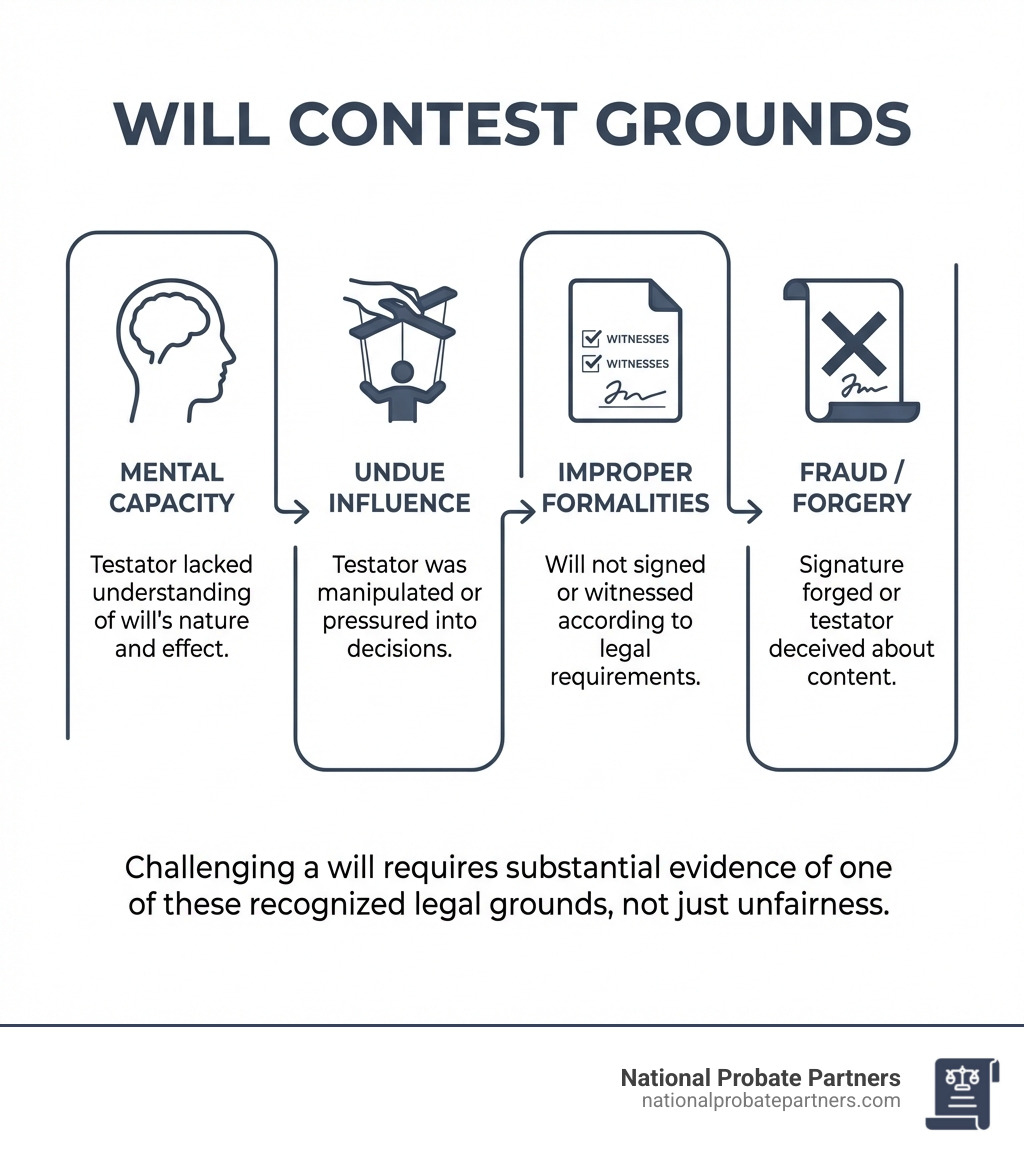
The main grounds for contesting a will include:
- Lack of Testamentary Capacity: The will-maker (testator) was not mentally capable of understanding the document.
- Undue Influence, Duress, or Coercion: The testator was manipulated or pressured into changing their will.
- Improper Execution: The will was not signed or witnessed according to state law.
- Fraud or Forgery: The signature was forged, or the testator was deceived.
- Revocation: A newer will exists, or the original was legally revoked.
A will contest is a formal legal proceeding. Courts are generally reluctant to overturn a will, presuming it reflects the testator’s true intentions. To succeed, a challenger needs legal standing (a financial interest in the outcome) and substantial evidence.
Importantly, unfairness is not a valid reason to contest a will. The law protects a person’s right to distribute their property as they wish, even if the decisions seem unjust to family members.
Who Can Challenge a Will? Understanding Legal Standing
Before considering will contest grounds, you must have the legal right to challenge a will, known as “legal standing.” Without it, a court will not hear your case.
To have legal standing, you must be an “interested party,” meaning your financial interest would be affected by the will’s validation or invalidation. You must stand to gain if the will is set aside.
Common interested parties include:
- Heirs-at-Law: Individuals who would inherit under state intestacy laws if no valid will existed (e.g., a spouse or children).
- Beneficiaries of a Prior Will: People named in a previous will who were disinherited or received less in the current will.
- Beneficiaries of the Contested Will: In some cases, a current beneficiary might have standing if their share would increase if a specific clause were invalidated.
This principle is consistent across states like California, Texas, and Arizona. For example, California law allows any “interested person”—someone who would benefit from setting the will aside—to initiate proceedings. This principle holds true for our clients in the United States and those serving in the Armed Forces Americas, Europe, and Pacific.
Simply being unhappy with the will is not enough. Determining if you have legal standing is a critical first step. We at National Probate Partners can help you with this initial assessment, as a court will dismiss your case without it.
Curious whether your situation warrants legal action? We can help you steer the complexities of probate law. Find out more about when you might need professional guidance: How Do I Know If I Need a Probate Lawyer?.
The Primary Will Contest Grounds Explained
Will contest grounds are the specific legal reasons a court might invalidate a will. It’s a misconception that you can contest a will for being unfair. Courts presume a will is valid and reflects the deceased’s true intentions, so the burden of proof on the challenger is high. The contest must be based on legal flaws in the will’s creation, not just dissatisfaction with its terms.

1. Lack of Testamentary Capacity
A common will contest ground is that the testator lacked “testamentary capacity,” meaning they were not of “sound mind” when signing.
The legal standard for a “sound mind” requires the testator to understand:
- They were signing a will to dispose of their property after death.
- The general nature of their property.
- Who their close family members and beneficiaries were (the “natural objects of their bounty”).
This capacity is judged at the moment the will was signed. A person with dementia might still be considered capable during a period of lucidity. Proving a lack of capacity is difficult and requires strong evidence, such as:
- Medical Records: Diagnoses of severe cognitive impairment like dementia or Alzheimer’s.
- Witness Testimony: Accounts from family, friends, or caregivers about the testator’s mental state.
- Professional Testimony: Opinions from the drafting attorney or a doctor who examined the testator near the time of signing.
The burden of proof is on the challenger. The high bar for this claim is demonstrated in cases like In re Marion R. Craig Trust, where a will was upheld despite the testator’s known mental health issues because the document itself showed he understood his property and beneficiaries.
For a deeper dive into this legal concept, we recommend reviewing this definition: The legal standard for capacity.
2. Undue Influence, Duress, or Coercion
This will contest ground alleges the testator was improperly manipulated or pressured, causing the will to reflect the influencer’s wishes, not their own.
Proving undue influence is difficult and often relies on circumstantial evidence. Courts look for several “red flags”:
- Vulnerable Testator: The deceased was frail, isolated, or dependent on the influencer.
- Opportunity and Motive: The influencer had a close, often exclusive, relationship with the testator and actively participated in the will’s preparation to benefit themselves.
- Suspicious Changes: The will makes sudden, unnatural changes from previous plans, such as disinheriting family in favor of the influencer.
- Duress or Coercion: The testator was forced to act against their will due to threats or pressure.
A classic example is a caregiver isolating an elderly person from family and then pressuring them to change their will. Building a case requires piecing together evidence like financial records, witness accounts of isolation, and communications that show manipulation.
3. Improper Execution: One of the Most Common Will Contest Grounds
A will is a formal legal document that must follow strict state-specific rules. Failure to meet these requirements, known as “improper execution,” is a common will contest ground that can invalidate a will, even if the testator’s intentions were clear.
General requirements include:
- In Writing: The will must be a physical document.
- Signed by the Testator: The testator must sign it, or have someone sign for them in their presence and at their direction.
- Witnessed: Most states require at least two credible witnesses who sign in the testator’s presence. Often, witnesses cannot be beneficiaries.
While not always required, a notarized “self-proving affidavit” can simplify probate and help prevent challenges.
For example, Texas law requires a will to be in writing, signed by the testator (or for them), and attested by two credible witnesses over 14 who are not beneficiaries and sign in the testator’s presence. A missing signature or improper witnessing can invalidate the entire will.
Holographic (Handwritten) Wills: Some states, including Texas and Arizona, recognize wills written entirely in the testator’s handwriting and signed by them, without witnesses. These can be easier to challenge due to the lack of witness testimony.
Understanding these rules is vital. For details on Texas’s requirements, see the Texas Estates Code: Texas requirements for a valid will.
4. Fraud or Forgery
Fraud and forgery are serious will contest grounds involving intentional deception.
- Forgery: Faking the testator’s signature or altering the will without their consent. This is often proven with handwriting analysis by forensic experts.
- Fraud in the Inducement: Lying to the testator to influence their decisions, such as falsely claiming an heir is dead to get them disinherited.
- Fraud in the Execution: Deceiving the testator about the document they are signing, for example, by telling them it is a different type of form.
In these cases, the will is invalid because it doesn’t reflect the testator’s true intent. Proving fraud requires compelling evidence from investigations into financial records, communications, and witness testimony.
5. Revocation: Is This the Final Will?
Finding multiple wills can lead to disputes over which one is valid. “Revocation”—whether an earlier will was legally canceled—is an important will contest ground.
A will can be revoked in several ways:
- By a Subsequent Will: Creating a new will that explicitly revokes all prior wills is the most common method.
- By Codicil: A codicil amends a will, and its provisions override any conflicting terms in the original document.
- By Physical Act: Intentionally destroying a will (e.g., tearing or burning it) with the intent to revoke it. Accidental destruction does not count.
- By Operation of Law: In some states, major life events like divorce or marriage can automatically alter or revoke parts of a will.
For instance, Texas law permits revocation through a new will or by physical destruction. A contest may arise when an older will is presented against a newer one, focusing the dispute on whether the new document is valid and properly revoked the old one.
You can learn more about how a will can be legally revoked here: How a will can be revoked.
The Will Contest Process: From Petition to Verdict
Contesting a will is a formal legal process in probate court with strict steps and deadlines.
The process begins after a will is submitted for probate. An “interested party” with valid will contest grounds must act quickly.
- Filing a Petition: The challenger files a petition with the probate court, stating their legal standing and the grounds for the contest.
- Notification and Findy: All interested parties are notified. Both sides then engage in “findy,” exchanging information, documents (medical records, prior wills), and conducting depositions (sworn testimony).
- Mediation or Settlement: To save time and money, many contests are resolved through mediation or a settlement agreement before trial.
- Trial: If no settlement is reached, the case goes to trial, where a judge or jury hears evidence to determine the will’s validity.
- Verdict and Appeals: The court issues a verdict, which may be appealed to a higher court.

A critical factor is the statute of limitations. Each state, including Texas and Arizona, has a strict deadline for filing a contest, often starting when the will is admitted to probate. Missing this deadline permanently bars your right to challenge the will, making prompt legal advice essential.
Navigating this process requires specialized knowledge. We at National Probate Partners can guide you through every step. Learn more here: Probate Disputes: What You Need to Know From a Probate Lawyer.
What Evidence Is Needed for Will Contest Grounds?
Proving will contest grounds requires compelling evidence to reconstruct the circumstances of the will’s creation. The type of evidence depends on the claim:
- Lack of Capacity: Medical records showing cognitive decline, along with testimony from witnesses and medical experts about the testator’s mental state.
- Undue Influence: Testimony about isolation or pressure, financial records showing unusual transactions to the influencer, and communications (emails, texts) revealing manipulation.
- Improper Execution: Testimony from the will’s witnesses and handwriting analysis if a signature is disputed.
- Fraud or Forgery: Testimony from forensic document examiners and witnesses who can attest to deception.
- Revocation: The existence of a newer, valid will or testimony about the physical destruction of the old one.
Gathering this evidence is challenging since the testator cannot testify. A thorough investigation by an experienced probate litigation attorney is crucial.
What Are the Potential Outcomes of a Successful Contest?
Successfully proving will contest grounds can lead to several outcomes:
- Will Invalidated Entirely: If fundamental flaws are found, the entire will is declared invalid.
- Partial Invalidation: Only specific clauses affected by the flaw (e.g., a gift resulting from undue influence) are removed, while the rest of the will stands.
- Prior Will Reinstated: If the contested will is invalidated, a previous, valid will might be reinstated to direct the estate’s distribution.
- Intestate Succession: If the will is invalidated and no prior will exists, the estate is distributed according to state intestacy laws, which prioritize legal heirs like spouses and children.
- Settlement: Many cases end in a settlement agreement, where the parties agree on a compromise distribution of assets to avoid a full trial.
A successful contest is a complex process with no guaranteed outcome, but it can provide financial relief and justice.
How to Prevent Your Will From Being Contested
While no will is completely immune to a challenge, you can take proactive steps to reduce the likelihood of a successful will contest. The goal is to create a legally sound document that clearly expresses your intentions.
Here’s how to safeguard your legacy:
- Work with an Experienced Attorney: A skilled estate planning attorney will ensure your will meets all state requirements (like those in Texas or Arizona) and is structured to withstand potential challenges.
- Confirm Testamentary Capacity: If there are any concerns about your mental state, consider getting a medical evaluation on the day you sign the will to provide strong evidence of your capacity.
- Avoid Undue Influence: Do not involve beneficiaries in the drafting or execution of your will, especially if you are dependent on them. Always seek independent legal advice.
- Follow Proper Execution Formalities: Sign your will in the presence of disinterested witnesses as required by state law. Including a notarized “self-proving affidavit” adds another layer of protection.
- Use Clear Language: State your intentions clearly to avoid misinterpretation. If disinheriting someone, consider including a brief, non-defamatory explanation.
- Include a “No-Contest” Clause: This clause, also called an “in terrorem” clause, states that a beneficiary who unsuccessfully challenges the will forfeits their inheritance. It can be a powerful deterrent.
- Review and Update Regularly: Review your will every 3-5 years and after major life events (marriage, divorce, birth, death) to keep it current.
- Consider a Video Recording: Recording the signing ceremony can provide visual proof of your capacity and freedom from coercion.
Taking these steps helps create a robust estate plan that minimizes the risk of a future will contest. Our team at National Probate Partners specializes in meticulous estate planning. Learn more here: Do You Need a Probate Attorney? Unpacking Their Role.
Frequently Asked Questions about Will Contests
We often hear similar questions from clients who are either considering contesting a will or want to protect their own will from future challenges. Here are some of the most common inquiries we receive:
How much does it cost to contest a will?
Contesting a will is expensive, so it’s important to weigh the potential costs against the financial gain. Typical expenses include:
- Attorney Fees: Can be hourly or on a contingency basis (a percentage of the recovery).
- Court Costs: Filing fees and other administrative court expenses.
- Expert Witness Fees: Costs for medical experts or forensic document examiners.
- Investigation Costs: Expenses for gathering evidence like medical records and conducting depositions.
A will contest is a significant financial and emotional commitment. For more on legal fees, see: How Much Does a Probate Lawyer Cost?.
What is the difference between contesting a will for invalidity versus unfairness?
This is a critical distinction.
- Contesting for Invalidity: This is a legal challenge based on established will contest grounds (e.g., lack of capacity, undue influence, fraud). The goal is to prove the will is legally flawed.
- Contesting for Unfairness: In most U.S. states, including Texas and Arizona, you cannot contest a will simply because you feel it is unfair. The law protects a testator’s right to distribute their property as they wish, even if it means disinheriting a child or making unequal gifts. Courts will not second-guess these personal decisions if the will is legally valid.
Unlike some other countries, most U.S. states prioritize the testator’s freedom of choice over claims of unfairness.
What are the time limits for contesting a will?
Every state has a strict “statute of limitations,” or deadline, for filing a will contest. These deadlines vary significantly by state but are absolute. For example, the time limit can be as short as 30 days or as long as six months from when the will is admitted to probate.
If you miss this deadline, you lose your right to challenge the will, no matter how strong your will contest grounds are. It is crucial to consult an attorney immediately to learn the specific deadline in your state (Texas, Arizona, or other US jurisdictions where our clients reside).
Conclusion: Protecting Your Rights and Your Loved One’s Legacy
Dealing with a will after a loved one’s death is difficult, and finding potential problems with it adds more stress. Understanding the will contest grounds—such as lack of capacity, undue influence, or improper execution—is the first step to protecting your rights and honoring your loved one’s true wishes.
Will contests are rare but have high financial and emotional stakes. This type of litigation is a specialized field requiring deep knowledge of state laws (whether in Texas, Arizona, or other US jurisdictions) and a strategic approach to evidence.
At National Probate Partners, we provide compassionate and efficient service for these sensitive situations. Whether you are considering a will contest or want to protect your own estate plan, our experienced team is here to guide you.
If you have questions about a will’s validity or believe you have grounds for a contest, seek professional legal advice immediately. We can help you explore your options.
For expert guidance on probate disputes and will contests, connect with us: Navigating probate disputes with an experienced lawyer.