
When Aging Loved Ones Need Protection: Understanding Your Options
Elder guardianship Texas is a court-supervised process where a judge appoints a guardian to make decisions for an adult (the ward) who cannot manage their own affairs due to incapacity.
Quick Answer: What You Need to Know
- Last Resort: Texas courts require exploring alternatives first.
- Two Types: Guardian of the Person (health/living) and Guardian of the Estate (financial).
- Process: Requires an attorney, doctor’s evaluation, court hearing, and proof of incapacity.
- Costs: Typically $3,000-$10,000+ in legal fees, plus annual costs.
- Alternatives: Power of Attorney, Supported Decision-Making, and others.
With a growing elderly population, more Texas families face tough questions. What happens when a parent with dementia can’t manage their health or finances, or refuses help despite clear needs?
Legal incapacity in Texas means a person who, because of a physical or mental condition, is substantially unable to provide for their own food, clothing, or shelter, care for their physical health, or manage their financial affairs.
Guardianship protects vulnerable adults, but it is also a highly restrictive legal action. It removes fundamental rights, such as choosing where to live, how to spend money, or even voting. For this reason, Texas law treats guardianship as a last resort, requiring proof that no less restrictive alternative will suffice.
This guide covers when guardianship is necessary, how it works, its alternatives, and how to steer the legal process with compassion.
Understanding Elder Guardianship in Texas: The Basics

What is Guardianship and Who Needs It?
Guardianship is a legal process in Texas designed to protect adults who can no longer protect themselves. A court appoints a guardian to make decisions for an incapacitated adult, known as the ward, ensuring their health, financial, and safety needs are met.
An adult may need a guardian if a physical or mental condition prevents them from providing for their basic needs, managing their health, or handling finances. This often applies to seniors with advanced dementia or individuals with severe disabilities. Crucially, guardianship is a last resort, used only when less restrictive alternatives are not enough.
Defining Legal Incapacity Under Texas Law
The Texas Estates Code defines an incapacitated person as an adult who, due to a physical or mental condition, is substantially unable to provide for their own food, clothing, or shelter, care for their physical health, or manage their financial affairs. Proving this in court requires clear and convincing evidence.
A person can have a disability without being legally incapacitated. For instance, someone in a wheelchair may be fully capable of managing their own affairs. Incapacity specifically refers to a substantial inability to care for oneself or one’s estate. The official A Texas Guide to Adult Guardianship offers more detail.
Guardianship vs. Conservatorship in Texas
In Texas, the terms “guardianship” and “conservatorship” have distinct meanings. Guardianship refers to the court-appointed process for an incapacitated adult. Conservatorship, however, is the legal term for child custody. Understanding this distinction is key to avoiding confusion when discussing legal interventions for vulnerable individuals.
Types and Responsibilities of a Guardian
Guardianship is not a one-size-fits-all solution. Texas law allows for different types of guardianships custom to the ward’s specific needs.
Guardian of the Person
A Guardian of the Person makes personal decisions regarding the ward’s physical care and well-being. Responsibilities include:
- Deciding on medical treatment and healthcare.
- Determining where the ward will live (e.g., at home or in a care facility).
- Ensuring the ward’s needs for food, clothing, and shelter are met.
- Advocating for the ward’s quality of life.
Guardian of the Estate
A Guardian of the Estate manages the ward’s financial affairs and property under close court supervision. Responsibilities include:
- Paying bills and managing income.
- Investing assets prudently.
- Applying for benefits like Medicaid or Social Security.
- Managing property and bank accounts, often requiring court approval for transactions.
The expertise of a Probate Lawyer is valuable for ensuring compliance.
Combined, Limited, and Temporary Guardianships
Texas law offers flexible guardianship structures:
| Type of Guardianship | Description | Key Responsibilities | Duration |
|---|---|---|---|
| Guardian of Person | Manages personal decisions for the ward. | Medical, residential, daily care, social decisions. | Indefinite (until termination or modification) |
| Guardian of Estate | Manages financial affairs and property for the ward. | Paying bills, managing assets, investments, applying for benefits. | Indefinite (until termination or modification) |
| Combined Guardianship | One guardian serves as both Guardian of the Person and Guardian of the Estate. | All responsibilities of both roles. | Indefinite |
| Limited Guardianship | Guardian has specific, court-defined powers, while the ward retains other rights. | Only powers explicitly granted by the court; maximizes ward’s independence. | Indefinite (can be modified) |
| Temporary Guardianship | Established quickly for emergencies, to protect the ward or their assets from imminent danger. | Immediate care, medical decisions, asset protection. | 60 days (unless contested) |
A limited guardianship is preferred as it is less restrictive, allowing the ward to retain rights they can still exercise, such as voting. This preserves the ward’s autonomy. Temporary guardianships are for emergencies, providing a short-term solution (usually 60 days) to protect a ward or their assets from immediate danger.
Who Can (and Cannot) Serve as a Guardian?
Texas courts prefer to appoint willing and able family members as guardians. However, some individuals are legally disqualified, including:
- Minors.
- Incapacitated individuals.
- Anyone indebted to or in a dispute with the proposed ward.
- Those with certain criminal convictions.
- Anyone the court deems unsuitable.
Family members must register and complete training, while non-family professional guardians must be fully certified by the Judicial Branch Certification Commission (JBCC).
Reporting and Accounting Requirements
Guardianship involves ongoing court oversight to protect the ward. Key reporting duties include:
- Annual Report of the Person: Details the ward’s physical and mental condition, living situation, and care.
- Annual Account of the Estate: A detailed financial report of all income, expenses, and asset management.
To maintain authority, guardians must file these reports to renew their “Letters of Guardianship,” which typically expire after 16 months. This continuous court supervision is a cornerstone of the Texas guardianship system.
The Legal Process for Establishing Elder Guardianship in Texas
Establishing elder guardianship Texas is a formal legal process in probate court that involves significant steps.

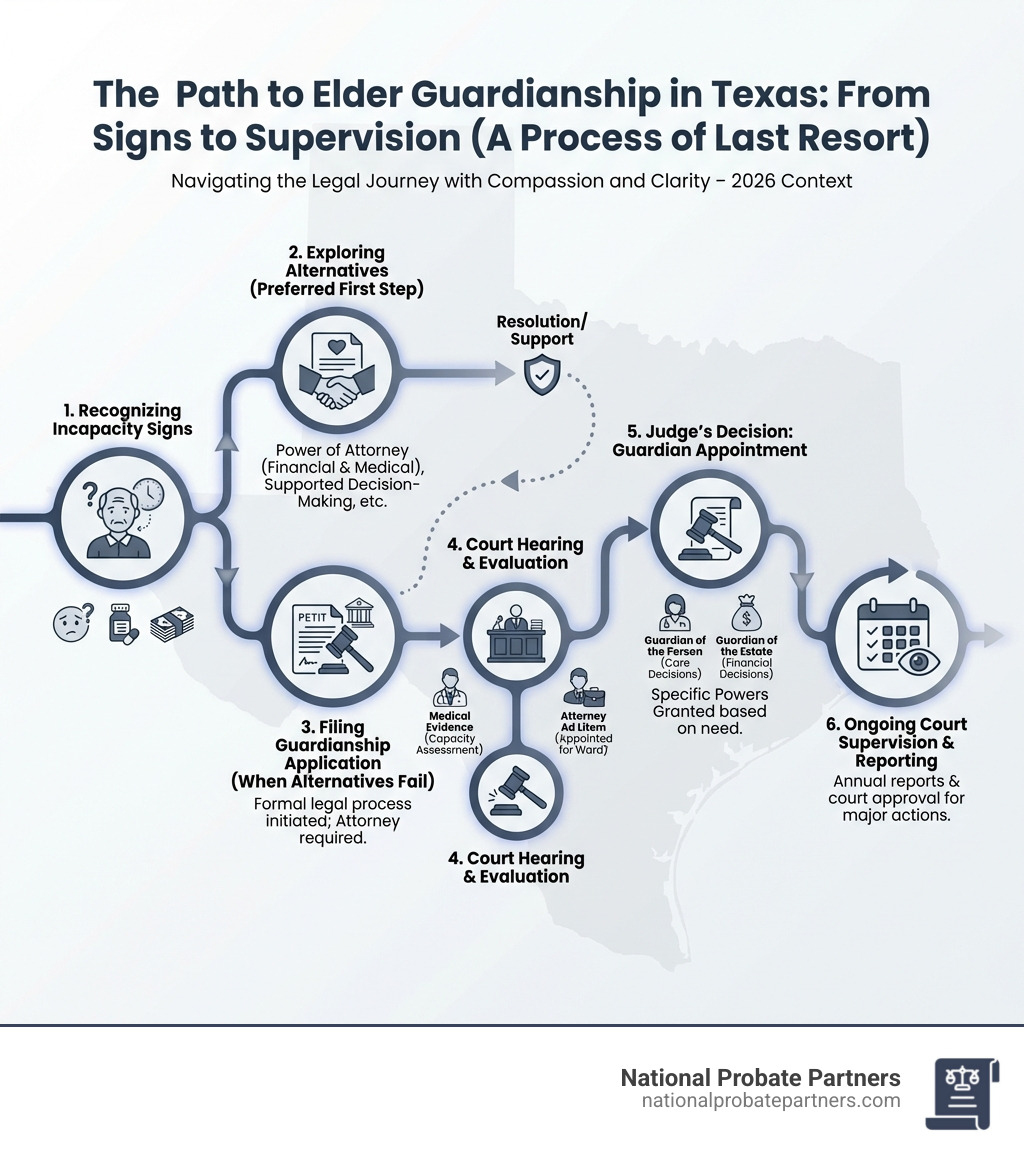
Step-by-Step: The Court Appointment Process
The process for appointing a guardian follows structured legal procedures:
- Hire an Attorney: Engage a Texas attorney specializing in guardianship law. The process is too complex to handle alone.
- File an Application: Your attorney files an application with the court, detailing information about the proposed ward and guardian, the alleged incapacity, and why alternatives are not feasible.
- Doctor’s Evaluation: A Texas-licensed physician must examine the proposed ward and submit a Certificate of Medical Examination (CME) to the court, certifying their condition. This is critical evidence.
- Notify Interested Parties: The proposed ward and close relatives must be formally notified of the application.
- Appoint an Attorney Ad Litem: The court appoints an independent attorney ad litem to represent the proposed ward’s best interests.
- Court Hearing: At a formal hearing, the judge reviews evidence and testimony to determine the proposed ward’s ability to manage their own care and property.
- Judge’s Decision: If the judge finds the person is incapacitated and guardianship is necessary, they will appoint a guardian who must then take an oath, post a bond (if applicable), and receive official Letters of Guardianship.
For a deeper dive, review the ESTATES CODE CHAPTER 1101. GENERAL PROCEDURE TO APPOINT GUARDIAN.
The Role of the Court and Burden of Proof
The probate court’s primary role is to protect the proposed ward. The burden of proof is high: incapacity must be proven by clear and convincing evidence. This strict standard is used because guardianship removes a person’s fundamental rights. The court must also find the proposed guardian is eligible. After appointment, the court’s oversight continues through mandatory annual reports, a critical safeguard in the system.
The Costs Associated with Guardianship
Establishing guardianship can be expensive, with costs varying based on case complexity and whether it’s contested. Typical costs include:
- Attorney Fees: Often the largest expense, ranging from a few thousand dollars to much more for contested cases.
- Court Filing Fees: For filing the application and other documents.
- Bond Premiums: An annual premium for an insurance policy protecting the ward’s assets (for a Guardian of the Estate).
- Attorney Ad Litem Fees: Compensation for the ward’s court-appointed attorney.
- Physician/Psychologist Fees: For the required medical evaluation.
These costs are typically paid from the ward’s estate, not by the guardian personally. Our article How Do I Know If I Need a Probate Lawyer? can offer more guidance on legal assistance.
Is Guardianship Necessary? Exploring Less Restrictive Alternatives
At National Probate Partners, we always emphasize that guardianship is a last resort. Before pursuing such a restrictive measure, families should explore all available alternatives.
Why Alternatives Should Be Your First Step
Exploring alternatives is the first step because it preserves an individual’s autonomy and rights. Guardianship should only be used when absolutely necessary. Less restrictive options can often achieve the same protective goals without the legal and personal burdens of guardianship, helping individuals retain their dignity and independence. The Texas Council for Developmental Disabilities offers more information on common alternatives.
Key Alternatives to Elder Guardianship in Texas
Texas law strongly encourages using less restrictive alternatives, including:
- Durable Power of Attorney (DPOA): Allows a person to appoint an agent to make financial decisions, even after they become incapacitated.
- Medical Power of Attorney (MPoA): Designates an agent to make healthcare decisions if the principal cannot.
- Supported Decision-Making Agreements: Allows individuals with disabilities to make their own choices with help from trusted supporters.
- Revocable Living Trusts: A successor trustee can manage assets held in a trust if the creator becomes incapacitated, avoiding court intervention.
- Representative Payee: Appointed by agencies like the Social Security Administration to manage a person’s government benefits.
- Surrogate Decision-Maker: Can be appointed without court action to make medical decisions for an incapacitated person if no MPoA exists.
- Community Services: Services like meal delivery, transportation, and money management programs can help an individual live independently. Contact local Area Agencies on Aging (AAAs).
When Guardianship is the Only Viable Option
Sometimes, guardianship is the only viable option, especially in these situations:
- No Prior Planning: The person became incapacitated without executing Powers of Attorney or other directives.
- Total Incapacity: The individual is completely unable to make rational decisions, even with support.
- Elder Abuse or Exploitation: Guardianship is needed to protect a vulnerable elder from harm when other interventions fail.
- Refusal to Accept Help: The person refuses necessary care, putting themselves at grave risk.
In these cases, guardianship is a critical tool for protection.
A Ward’s Rights and What Happens After Appointment
Even after a guardian is appointed, the ward retains certain fundamental rights, and the court continues its oversight to ensure these rights are upheld.
The Texas Bill of Rights for Wards
The Texas Estates Code provides a Bill of Rights for Wards to ensure they are treated with dignity and their independence is maximized. Guardians are legally obligated to uphold these rights, which include:
- The right to be treated with dignity and respect.
- The right to personal relationships and visitation.
- The right to privacy and appropriate medical care.
- The right to manage their own finances to the extent they are capable.
- The right to vote, unless specifically removed by court order.
For a comprehensive overview, the Guardianship Guide from TexasLawHelp.org is an excellent resource.
When a Guardian Fails: Removal and Consequences
Courts take a guardian’s failure to fulfill their duties very seriously. A guardian can be removed and face severe consequences for:
- Failure to Fulfill Duties: Neglecting the ward’s personal care or medical needs.
- Mismanagement of Funds: Unauthorized spending or theft of the ward’s assets.
If concerns arise, any interested person can petition the court for removal. The court will investigate, and if misconduct is found, the guardian will be removed and a successor appointed. Guardians can be held personally liable for damages and may face criminal penalties for certain actions.
How to Modify or Terminate a Guardianship
Guardianships are not always permanent and can be changed if the ward’s situation changes.
- Restoration of Rights: If a ward regains capacity, they can petition the court to terminate the guardianship.
- Modification: The guardian’s powers can be modified if the ward’s condition changes, either increasing or decreasing the level of support needed.
- Termination Upon Death: Guardianship automatically ends when the ward dies. The guardian of the estate then helps transfer assets to the probate estate.
Any modification or termination requires a court hearing to ensure it is in the ward’s best interest.
Frequently Asked Questions about Elder Guardianship in Texas
Here are answers to some of the most common questions about elder guardianship Texas.
How long does the guardianship process take?
An uncontested guardianship can take 1 to 3 months. However, contested or complex cases can take six months or more, depending on the court’s schedule and the county.
Can a guardian place a ward in a nursing home?
A Guardian of the Person can decide the ward’s residence, including placement in a nursing home, but the decision must be in the ward’s best interest and be the least restrictive appropriate environment. This authority does not extend to involuntary commitment to a mental health facility, which requires a separate legal process.
What resources are available for guardianship services in Texas?
Numerous resources are available to help you steer elder guardianship Texas:
- Texas Health and Human Services (HHS) Guardianship Services Program: Provides guardianship services for vulnerable adults who have been victims of abuse, neglect, or exploitation. See the Texas Health and Human Services website.
- Area Agencies on Aging (AAAs): Offer services and information for older adults, including referrals to legal and community resources.
- Legal Aid Societies: May provide free or low-cost legal help for those with limited income.
- Disability Rights Texas: Provides legal services and advocacy for people with disabilities.
- The Arc of Texas: Supports people with intellectual and developmental disabilities and advises on alternatives.
- The Texas Guardianship Association: Offers education and advocacy for Texas guardians.
- Probate Lawyers: A specialized Probate Lawyer can provide expert legal guidance for your specific situation.
Conclusion
Elder guardianship Texas is a powerful legal tool for protecting vulnerable adults, but it is a last resort because it removes an individual’s fundamental rights. At National Probate Partners, we help families explore less restrictive alternatives first, such as Powers of Attorney, to preserve a loved one’s dignity and independence.
When guardianship is the only option, navigating the legal process requires experienced and compassionate guidance. Our team is dedicated to helping Texas families resolve these challenges with efficiency and care.
If you are facing difficult decisions about an aging loved one, we can help you understand the complexities of elder guardianship Texas. Contact our team today to discuss your family’s needs and find the best path forward.