
When Every Decision Counts: Understanding Power of Attorney vs Legal Guardianship
Understanding the difference between power of attorney vs legal guardianship can determine whether your family handles a crisis smoothly — or ends up in a lengthy, expensive court battle.
Here’s the quick answer:
| Power of Attorney | Legal Guardianship | |
|---|---|---|
| How it’s created | Signed document while person has capacity | Court order after incapacity is proven |
| Who chooses | The individual themselves | A judge |
| Court involvement | None | Required |
| Cost | Low (hundreds to low thousands) | High ($5,000–$15,000+) |
| Privacy | Private document | Public court record |
| When it starts | Immediately or upon incapacity | After court hearing |
| Can be reversed | Yes, by the principal | Requires another court order |
The bottom line: A power of attorney is a proactive planning tool you set up in advance. Guardianship is a reactive court process that happens when no plan exists.
Both tools serve the same basic purpose — allowing someone to act on behalf of a person who can’t manage their own affairs. But how you get there, who’s in control, and what it costs are very different.
A sudden illness or accident can change everything in hours. Bills need paying. Medical decisions can’t wait. If no legal documents are in place, your family may face a slow, costly court process at the worst possible moment.
That’s why knowing which path fits your situation — before a crisis hits — matters so much.
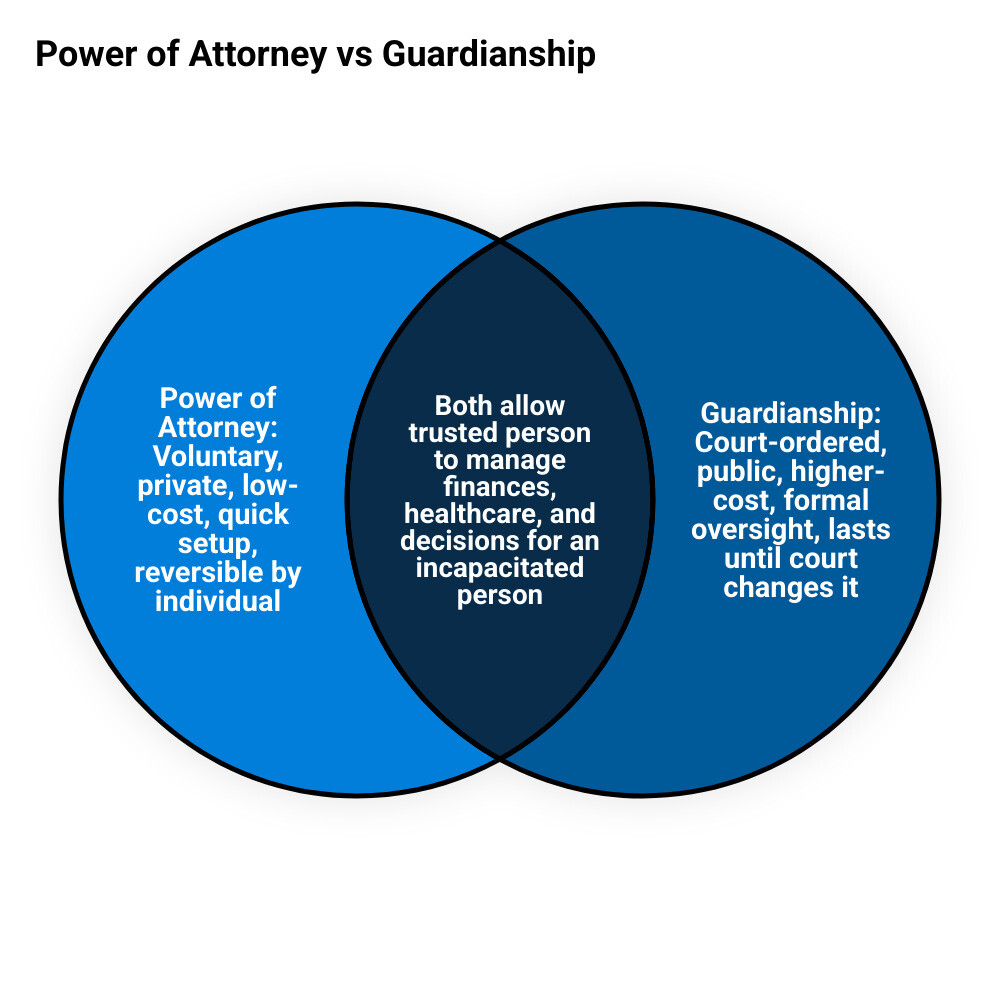
Power of attorney vs legal guardianship terms you need:
Understanding the Core Differences: Power of Attorney vs Legal Guardianship
When we talk about power of attorney vs legal guardianship, we are essentially talking about who holds the “steering wheel” of your life if you are no longer able to drive. In a Power of Attorney (POA), you hand the keys to a co-pilot you trust while you are still clear-headed. In a guardianship, a judge decides who should take the wheel after you’ve already pulled over—or worse, after an accident has occurred.

The most fundamental difference is voluntary appointment versus court intervention. A POA is a private contract. You, as the “principal,” choose an “agent” (also called an attorney-in-fact) to handle your affairs. This person is someone you trust implicitly—perhaps a spouse, a child, or a lifelong friend.
Guardianship, on the other hand, is a legal relationship where the court strips an individual (the “ward”) of certain rights and gives them to a “guardian.” This is a significant loss of freedom and dignity. While we often think of guardianship in the context of high-profile cases like Britney Spears, it happens every day in probate courts across Scottsdale, Arizona, and Corpus Christi, Texas, when families realize Mom or Dad can no longer manage their own safety or finances.
According to research, Power of Attorney vs. Guardianship: What You Need to Know highlights that guardianship is generally considered a last resort. Why? Because it is public, restrictive, and expensive.
The Role of Legal Capacity in May 2026
As we move through May 2026, the legal landscape continues to emphasize the importance of “capacity.” To sign a POA, you must have the mental competence to understand what you are doing. You must know who you are appointing and what powers you are giving them.
If a person has already developed advanced dementia or is in a coma, it is too late for a POA. You cannot sign a legal document if you do not have the capacity to understand it. This is why proactive planning is so vital. We often see families in our Corpus Christi office who waited just a few months too long, and unfortunately, their only remaining path is the court-ordered one. If you want to stay in control, you have to act while you still have your “signing authority.” For more on this, check out our more info about Power of Attorney Corpus Christi guide.
Privacy and Oversight Differences
If you value your privacy, the power of attorney vs legal guardianship debate has a clear winner. A POA is a private document. Unless it’s filed with a county clerk for real estate purposes, the general public never sees it. Your finances and medical choices stay between you, your agent, and your doctors or banks.
Guardianship is a public record. To establish it, a petitioner must file a public document in probate court stating that you are “incapacitated.” This often involves filing medical reports that detail your physical or mental decline. Furthermore, a guardian must submit annual reports to the court, detailing every penny spent and every major medical decision made. While this judicial review protects the ward from abuse, it also means a judge is effectively looking over your family’s shoulder for the rest of your life.
How Authority is Established: Choice vs. Court Order
Establishing authority is the difference between an invitation and an invasion. One is welcomed; the other is imposed.

Creating a Power of Attorney vs Legal Guardianship Agent
To create a POA, you simply need to work with a lawyer to draft a document that meets your state’s requirements—whether that’s under the Texas Estates Code or Arizona statutes. You choose your trusted individual, define exactly what they can (and cannot) do, and sign it in front of a notary (and sometimes witnesses). It’s a clean, streamlined process.
When selecting an agent, we recommend choosing someone who is not only trustworthy but also organized. Managing someone else’s life is a “fiduciary duty,” meaning they must act in your best interest, not their own. Choosing the right person is a major part of guardianship law firm selection.
The Judicial Process of Appointing a Guardian
Appointing a guardian is a “full-court press.” It begins with a petition filed by someone (usually a family member) who believes you can no longer care for yourself.
In Texas, the process is particularly rigorous. The court will appoint a “guardian ad litem”—an independent attorney whose job is to represent your best interests and investigate the situation. There will be a hearing where a judge listens to medical evidence and testimony. The proposed ward has the right to attend and even contest the guardianship. It is a protective process, but it can be adversarial and emotionally draining. As noted by Powers of Attorney vs Guardianship Texas – Ford + Bergner LLP, the court must find that guardianship is the “least restrictive” alternative available before they will grant it.
Scope of Authority and Decision-Making Powers
The “scope” refers to how much power the person has over your life. Is it a “light touch” or “total control”?
Financial and Medical Power of Attorney vs Legal Guardianship Roles
In POA, you can split duties. You might have a Financial Power of Attorney for bank accounts and a Medical Power of Attorney (or Healthcare Proxy) for surgery and treatment decisions. These are often “durable,” meaning they stay in effect even if you become incapacitated. You can tailor these documents to be as broad or as limited as you like.
Guardianship can also be divided. In Texas, we have:
- Guardian of the Person: Responsible for food, shelter, and medical care.
- Guardian of the Estate: Responsible for managing money, property, and assets.
A “plenary” guardianship gives the guardian total control over both. A “limited” guardianship might only give the guardian power over specific areas, like where the ward lives, while letting the ward keep the right to vote or get married. For a deeper dive into these roles, see our guide on navigating elder guardianship in Texas.
When Guardianship Overrides a Power of Attorney
Here is a common question we get: “If I have a POA, can someone still get a guardianship over me?”
The answer is yes, but it’s harder. A court usually won’t appoint a guardian if a valid POA is already doing the job. However, if there is evidence of agent misconduct—like an agent stealing money or neglecting the principal—the court can step in. In such cases, the court order for guardianship will typically terminate or “override” the POA. This is a safety valve to prevent elder abuse, which unfortunately affects 1 in 10 Americans over the age of 60.
Costs, Timing, and State-Specific Considerations
Let’s talk dollars and cents. The financial gap between power of attorney vs legal guardianship is massive.
Financial Implications of Court Proceedings
A POA package—including financial, medical, and advance directives—might cost you a few hundred to a few thousand dollars in legal fees. It’s a one-time “insurance premium” for your peace of mind.
Guardianship is a different beast. In Texas, a contested guardianship often starts at $5,000 to $10,000 and can easily climb higher. Why? Because the law often requires two attorneys: one for the person seeking guardianship and one (the guardian ad litem) to represent the proposed ward. You also have filing fees, medical evaluation costs, and the cost of an “attorney bond”—a type of insurance the guardian must buy to protect the ward’s estate.
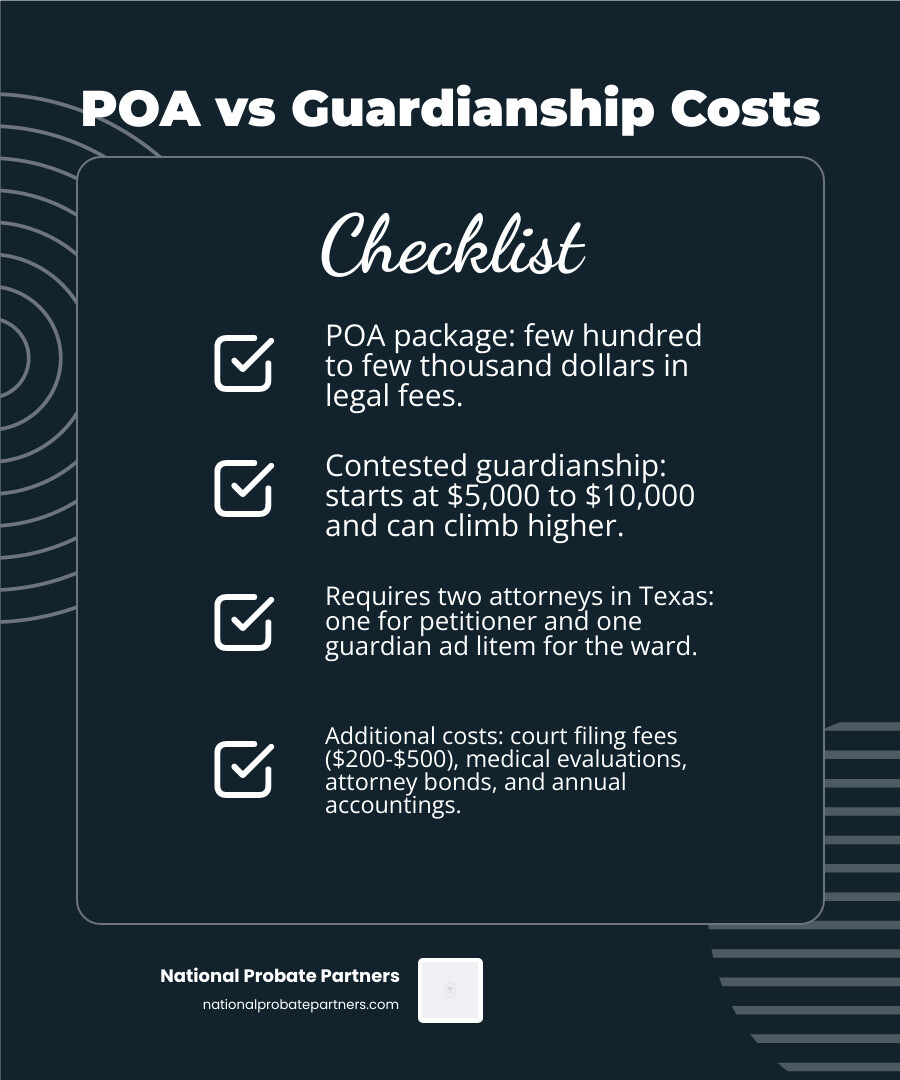
Common expenses in guardianship include:
- Court filing fees (approx. $200-$500)
- Medical expert testimony or certificates
- Annual accounting fees
- Ongoing attorney fees for court-required updates
For more on managing these costs, particularly for families, see our guardianship for children attorney Corpus Christi guide.
Less-Restrictive Alternatives to Guardianship
Modern probate law (especially in Texas and Arizona) is moving toward “Less-Restrictive Alternatives.” Judges don’t want to take away your rights if they don’t have to. Alternatives include:
- Supported Decision-Making: A formal agreement where you keep your rights but name “supporters” to help you understand choices.
- Advance Directives: Living wills that state your end-of-life wishes so no one has to guess.
- HIPAA Releases: Allowing family to talk to your doctors without needing full legal authority.
- Management Trusts: Using a trust to handle money instead of a court-supervised estate.
Planning Ahead: Can a Power of Attorney Prevent Guardianship?
The short answer is: Absolutely.
Think of a Power of Attorney as an insurance policy. You hope you never have to use it, but if the house catches fire, you’re glad it’s there. By having a well-drafted, durable POA, you effectively tell the court: “I’ve already handled this. I’ve chosen my person, I’ve given them instructions, and I don’t need a judge to intervene.”
Proactive planning reduces family conflict. We’ve seen siblings go to “war” over who should be Mom’s guardian. If Mom had signed a POA naming one child (or both as co-agents), that court battle likely never would have happened.
Proactive steps you can take today:
- Audit your documents: If your POA was signed in 2010, it’s time for an update. Laws change (like Michigan’s new Uniform Power of Attorney Act in 2024 or Texas updates).
- Talk to your family: Don’t let your choice be a surprise. Explain why you chose your agent.
- Store them safely: A POA is useless if no one can find it. Give copies to your agent and your primary doctor.
- Consult an expert: DIY forms are better than nothing, but they often fail at the bank or the hospital. A specialized firm like ours ensures your documents actually work when the pressure is on.
Frequently Asked Questions about Legal Authority
Can a power of attorney be revoked after someone becomes incapacitated?
No. To revoke a POA, you must have the same level of mental capacity you needed to sign it. If you have lost capacity, you can no longer revoke the document. This is why choosing the right person initially is the most important decision you’ll make. If an agent is acting badly and the principal is incapacitated, the only solution is usually to go to court and seek a guardianship to override the POA.
How long does it take to establish guardianship compared to a POA?
A POA can be drafted and signed in a single afternoon if you know who you want to appoint. Guardianship, however, usually takes 3 to 6 months. There are “temporary” or “emergency” guardianships that can be granted in days if there is an immediate threat to life or property, but these are short-term fixes while the full process moves forward.
Does a power of attorney end when the principal passes away?
Yes. This is a very common misconception. A Power of Attorney “dies” with the principal. Once a person passes away, the agent no longer has any authority to move money or sell property. At that point, the person’s Will takes over, and the Executor (in Texas) or Personal Representative (in Arizona) becomes the person in charge. If you need someone to handle things after you’re gone, you need a Will or a Trust, not just a POA.
Conclusion
At National Probate Partners, we’ve seen both sides of the power of attorney vs legal guardianship coin. We’ve seen the relief on a daughter’s face when she realizes her father’s POA allows her to pay his hospital bills without a court order. And we’ve seen the stress on a family’s face when they realize they have to sue their own loved one just to get them the help they need.
Our goal is to help you stay in the “choice-based” lane as long as possible. Whether you are in Scottsdale, Corpus Christi, or serving overseas in the Armed Forces, we offer experienced, personalized, and compassionate service to resolve complex probate challenges.
Don’t let legal jargon or procrastination take away your autonomy. Planning ahead isn’t just about documents; it’s about protecting your legacy and your family’s peace of mind. If you’re ready to secure your future or need help navigating a current guardianship crisis, we are here for you.
Check out our guide on 5 smart ways to find a guardianship attorney you’ll wish you knew sooner to take the next step.