
When You Need a Small Estate Lawyer: Quick Answers First
A small estate lawyer helps families transfer a deceased person’s assets quickly and affordably — without going through the full, costly probate process. If the estate qualifies (usually based on a dollar threshold set by your state), a simplified legal tool called a Small Estate Affidavit may be all you need.
Who needs a small estate lawyer?
- A family member or executor settling a modest estate after someone dies
- Heirs trying to access bank accounts, vehicles, or personal property
- Anyone dealing with an intestate death (no will left behind)
- People unsure whether the estate qualifies for simplified probate
Quick answers by situation:
| Situation | What you likely need |
|---|---|
| Estate under $75,000 in Texas (no will) | Small Estate Affidavit |
| Estate under $100,000 in Idaho (after debts) | Affidavit for Collection of Personal Property |
| Estate under $23,000 in Michigan (no real estate) | Small Estate Affidavit (form PC598) |
| Estate over state threshold | Full probate or alternatives like Muniment of Title |
| Heir disputes or complex assets | Small estate lawyer consultation |
When a loved one passes away with modest savings, a small bank account, or a few personal assets, the last thing grieving families want is a drawn-out, expensive legal process. As one probate resource puts it: “the average American has only $3,800 in savings and over $6,200 in credit card debt” — meaning most estates are far smaller than people assume.
For many families, full probate is simply overkill. It can take months, cost thousands of dollars, and require court appearances — all to distribute assets that may be worth far less than the legal fees themselves.
That’s exactly where simplified probate tools — and the right legal guidance — make a real difference.
This guide explains everything you need to know: what qualifies as a small estate, how the filing process works, which states have which rules, and when it makes sense to bring in a small estate lawyer rather than go it alone.
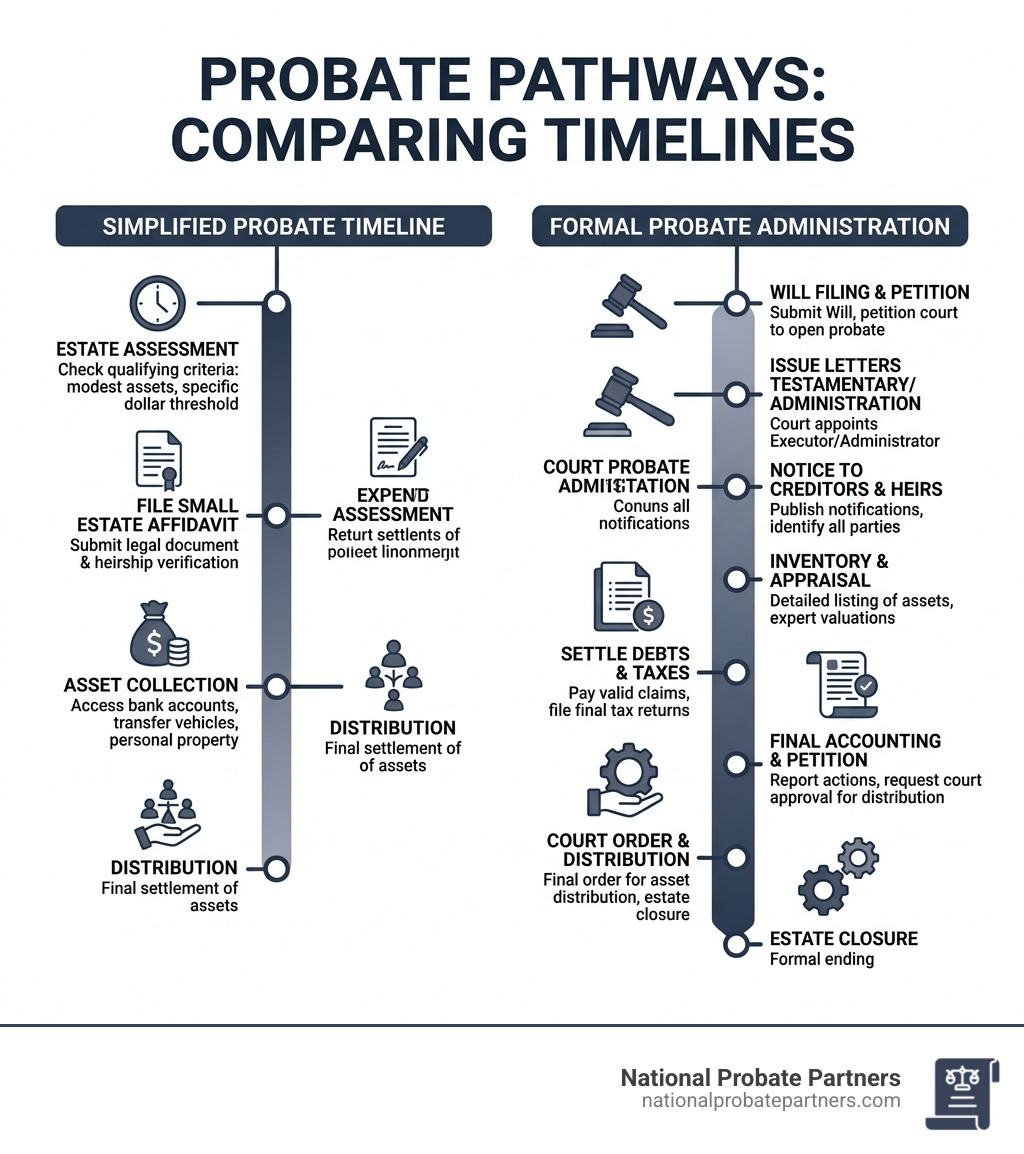
Understanding the Small Estate Affidavit (SEA)
The Small Estate Affidavit (SEA) is a powerful legal document that functions as a sworn statement. Its primary purpose is to allow the rightful heirs of a deceased person (the “decedent”) to collect assets without a formal court-supervised probate proceeding. Think of it as a “shortcut” that the law provides for estates that aren’t large enough to justify the heavy machinery of the court system.
When we use an SEA, we are essentially certifying to a bank, a title company, or a government agency that the estate meets specific legal criteria and that the people signing the document are the only ones entitled to the property. This process involves heirship verification—a clear mapping of the family tree to ensure no one is left out.

One of the most important aspects of the SEA is that it is a sworn document. This means the people signing it (the distributees) are doing so under penalty of perjury. Because of the legal weight this carries, most jurisdictions require the document to be notarized and, in many cases, approved by a judge before it can be used to transfer assets like bank accounts or vehicle titles. According to Small Estates & Legal Procedures | Probate Law Center – Justia, these procedures vary significantly by state, but they all share the goal of reducing the burden on grieving families.
When to Consult a Small Estate Lawyer for an SEA
You might be wondering, “If this is a simplified process, do I really need a lawyer?” While some families navigate this on their own, a small estate lawyer is often the difference between a quick resolution and a rejected filing.
If you aren’t sure where to start, you might ask yourself, How do I know if I need a probate lawyer? Generally, we recommend consulting a professional if there is any ambiguity regarding the decedent’s family history or if the assets are spread across different institutions. A lawyer ensures document accuracy, which is critical because even a small clerical error can cause a judge to reject the affidavit. Furthermore, coordinating multiple distributees—especially those living in different states—can become a logistical nightmare that we are well-equipped to handle.
Eligibility Requirements and State Value Thresholds
The most critical factor in determining whether you can use a simplified process is the “fair market value” of the estate. Every state sets its own limit, and as of April 2026, these thresholds vary widely across the regions we serve.
| State | Small Estate Threshold | Key Exclusions/Notes |
|---|---|---|
| Texas | $75,000 | Excludes homestead and exempt property |
| Idaho | $100,000 | Net value after liens and debts |
| Michigan | $23,000* | Adjusted annually; no real estate allowed |
| Arizona | $75,000 (Personal) | $100,000 limit for real property |
In Michigan, the threshold is adjusted for inflation. As of recent updates, it sits around $23,000 for personal property.
In Texas, the $75,000 limit is specifically for the “probate estate.” This is a vital distinction. Many assets, like life insurance with a named beneficiary or a joint bank account with right of survivorship, pass outside of probate and do not count toward this limit. Additionally, the family home (homestead) and certain exempt property (like a family car or furniture) are often excluded from the calculation.
For our clients in the military, Military Legal Assistance & Services can provide initial guidance, but a local small estate lawyer is usually needed to handle the specific county filings and state-level nuances.
Navigating Complex Valuations with a Small Estate Lawyer
Calculating the value of an estate isn’t always as simple as checking a bank balance. You must determine the fair market value of assets on the date of death, not the date you file the paperwork. This can get tricky with vehicles, stocks, or retirement funds.
Many families worry about the cost of legal help, often asking, How much does a probate lawyer cost? In small estate cases, the cost is typically a fraction of formal probate. We help by identifying which assets are “probate assets” and which are not, potentially saving the estate thousands in unnecessary fees. For instance, in Arizona, there are specific rules for personal property that differ from how real estate is handled.
Identifying Qualified Heirs and Distributees
An SEA is generally only available when the decedent died “intestate”—meaning they did not leave a valid will. When there is no will, state law determines who gets what. This is known as intestate succession.
Identifying “qualified heirs” requires a deep dive into family history. In Texas, for example, the affidavit must be signed by:
- All distributees (the heirs entitled to the property).
- Two “disinterested witnesses”—people who knew the decedent but will not inherit anything from the estate.
This can be complicated if there are minor children involved or if the decedent was married multiple times. If you have questions about who qualifies, our Probate lawyer FAQ: What you need to know when hiring a probate lawyer provides more insight into how legal standing is established.
The Step-by-Step Process for Filing a Small Estate
Filing a Small Estate Affidavit is a procedural dance that requires precision. While each county has its own flavor of rules—especially in large Texas hubs like Bexar, Travis, or Harris County—the general steps remain consistent.
- The Waiting Period: You cannot file immediately. In Michigan, you must wait 28 days. In Texas, the wait is also 30 days. This allows time for any potential creditors or a hidden will to surface.
- Gathering Documentation: You will need a certified copy of the death certificate, a detailed list of all assets (including account numbers and VINs for cars), and a list of all known debts.
- Drafting the Affidavit: The document must include the family history, a statement that the estate value is under the limit, and a list of who is entitled to which share of the property.
- The Signing: Every heir must sign the document in front of a notary.
- Filing and Fees: The affidavit is filed with the county clerk. Filing fees vary by county but are significantly lower than full probate costs.
- Judge Approval: In many jurisdictions, a judge must review and sign an order approving the SEA before it becomes “active.”
Common Challenges and How a Small Estate Lawyer Resolves Them
Even “simple” estates can hit snags. If you’re wondering, Do you need a probate attorney? Unpacking their role, consider these common hurdles:
- Heir Disputes: If one sibling refuses to sign the affidavit, the SEA process usually stops in its tracks. We act as mediators to resolve these conflicts.
- Creditor Claims: If the decedent had more debt than assets, the estate is “insolvent,” and an SEA cannot be used.
- Incomplete Documentation: Banks are notoriously picky. If the account number is off by one digit, they will reject the court-approved affidavit.
- Title Clearing: If the decedent owned a home, transferring that title to heirs requires specific language that must meet title company standards.
Alternatives to the Small Estate Affidavit
Sometimes, an SEA isn’t the right tool for the job. Depending on the assets involved and whether or not there was a will, we might recommend one of these alternatives:
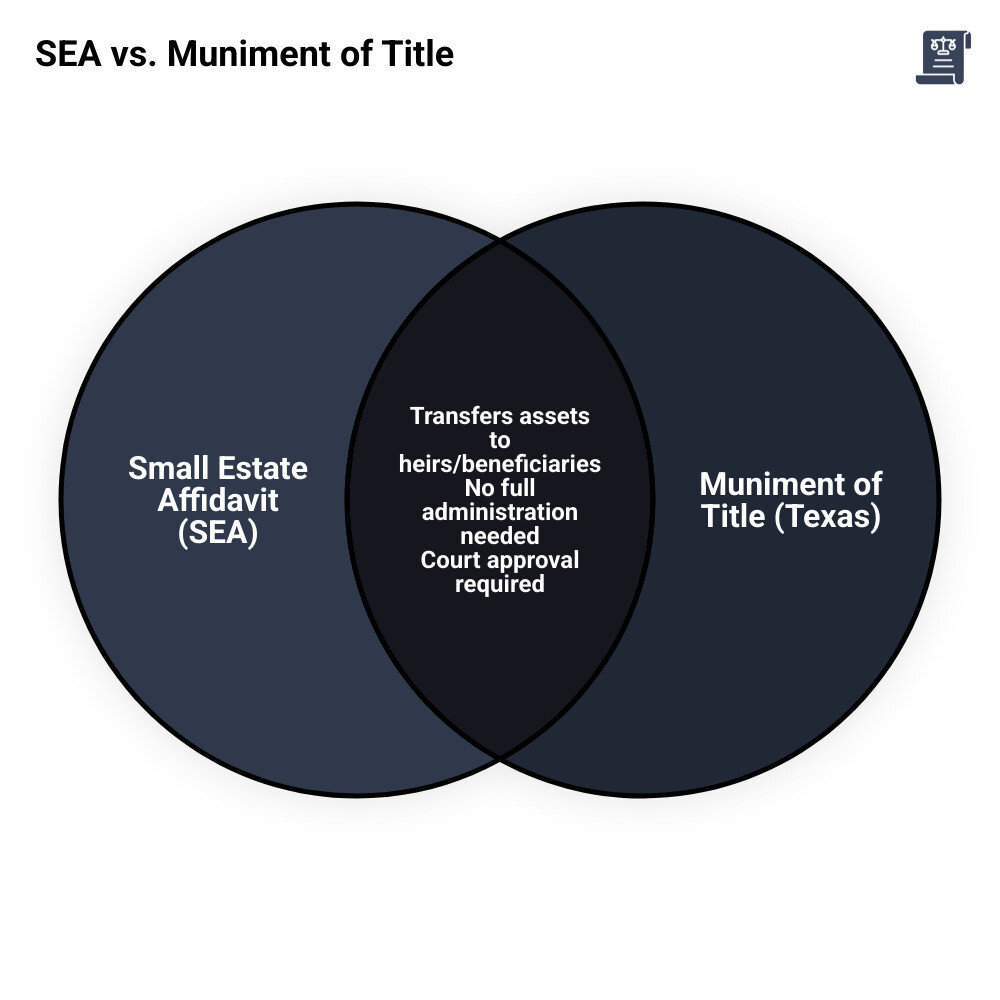
1. Muniment of Title (Texas Only) This is a unique Texas process used when there is a will, but no need for a full administration (no debts except for a home mortgage). The court admits the will to probate as a “muniment of title” only, which effectively transfers property to the beneficiaries named in the will without the need for an executor.
2. Affidavit of Heirship Often used for real estate, this is a sworn statement recorded in the county deed records. It doesn’t have the same “teeth” as a court order, but many title companies accept it to show a chain of title after a decedent passes. You can learn more about these options in our guide on When formal probate isn’t needed: A California estate planning checklist.
3. Summary Administration In states like Idaho or Florida, Summary Administration is a shortened probate process for estates that are small or where the person has been dead for more than two years.
Why You Should Hire a Small Estate Lawyer
At National Probate Partners, we believe that every family deserves a clear path forward, regardless of the size of the estate. Hiring a small estate lawyer isn’t just about filing papers; it’s about error prevention and peace of mind.
For families dealing with out-of-state heirs or complex assets like mineral rights or small business interests, the process can quickly become overwhelming. We provide personalized service across our locations, from Scottsdale, Arizona, to Corpus Christi, Texas.
For those serving overseas, we understand the unique challenges of military life. Whether you are seeking help through the Region Legal Service Office Western Pacific (RLSO WESTPAC) or the Legal Services Center – Kaiserslautern :: USAG Rheinland-Pfalz, we can coordinate with you to ensure your family’s assets are protected back home.
Frequently Asked Questions about Small Estates
Can a small estate affidavit be used to transfer real estate?
In Texas, the answer is “yes, but only for the homestead.” You can use an SEA to transfer the title of the decedent’s primary residence to a surviving spouse or minor children. However, if the decedent owned other real property (like a rental house or a ranch), an SEA will not work, and you will likely need a formal probate or a Muniment of Title.
How long does the small estate process typically take in 2026?
While it is much faster than the 6-12 months required for full probate, it isn’t instant. Once the initial 30-day waiting period has passed, the timeline depends on how quickly you can gather signatures and the current backlog at the county clerk’s office. Generally, most of our clients can resolve a small estate in 6 to 10 weeks.
What happens if the estate value exceeds the state threshold?
If the value of the probate assets (excluding the home and exempt property) exceeds the threshold—such as $75,000 in Texas—you cannot use the Small Estate Affidavit. In these cases, you will need to apply for a formal administration. We can help you determine if an “Independent Administration” is an option, which is still more efficient than a court-supervised “Dependent Administration.”
Conclusion
Navigating the loss of a loved one is difficult enough without the added stress of complex legal hurdles. If you are dealing with a modest estate, a small estate lawyer can help you bypass the “overkill” of formal probate and get assets into the hands of heirs where they belong.
At National Probate Partners, we specialize in making probate simple. Whether you need a Small Estate Affidavit in Houston or guidance from probate lawyers in Corpus Christi, our team is here to provide the compassionate, efficient service you need.
For more answers to your pressing questions, check out The ultimate probate lawyer FAQ 2025 edition – National Probate Partners or schedule a consultation. Let us help you protect your family’s legacy with the care and expertise it deserves.