
Why Every Fiduciary Needs a Clear Accounting and Trust Administration Guide
A fiduciary accounting and trust administration guide is the roadmap trustees, executors, and estate administrators use to manage trust assets, track financial activity, and report transparently to beneficiaries — all while staying legally compliant.
Here’s what fiduciary accounting and trust administration covers at a glance:
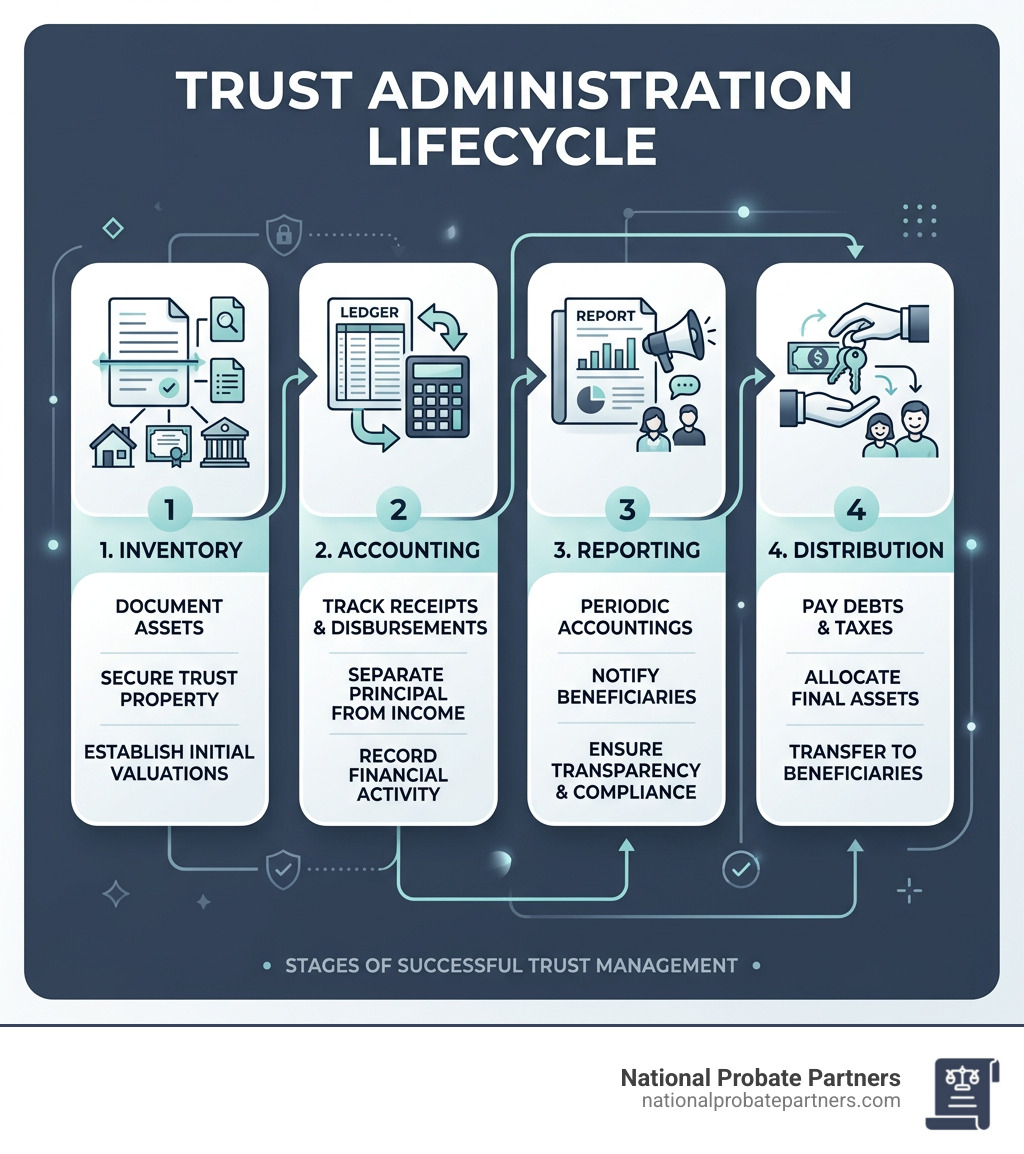
- Inventory all trust assets — document everything the trust holds at the start
- Track receipts and disbursements — record every dollar coming in and going out
- Separate principal from income — keep these two categories clearly distinct
- Report to beneficiaries — provide regular, accurate accountings on a set schedule
- Follow state and federal law — comply with the Uniform Trust Code, state statutes, and court requirements
- Protect yourself as a fiduciary — thorough records shield trustees from liability disputes
If you’ve recently been named a trustee or executor, you may already feel the weight of that responsibility. The legal obligations are real, the paperwork is complex, and the stakes — for you and the beneficiaries depending on you — are high.
Getting it wrong isn’t just stressful. It can expose you to personal liability.
Fiduciary accounting isn’t simply bookkeeping. It’s a formal, lengths-governed process with specific rules about what to record, how to present it, and when to share it. Whether you’re managing a simple family trust or a complex multi-state estate, understanding these principles is essential.
This guide breaks it all down — clearly, practically, and without the legal jargon.
Foundations of the Fiduciary Accounting and Trust Administration Guide
At National Probate Partners, we often see fiduciaries who are experts in their own professions but feel like fish out of water when it comes to trust accounting. To navigate this, we must look at the “Uniform Principles” that govern the industry. These aren’t just suggestions; they are the bedrock of professional compliance.
The modern landscape of fiduciary accounting was largely shaped by the National Fiduciary Accounting Project. Before this initiative, accounting formats varied so wildly that a beneficiary moving from one state to another might find their trust reports completely unintelligible. By establishing core standards, the project ensured that accountability remained the priority.
For us, as fiduciaries operating in places like Texas and Arizona, these standards provide a safety net. They ensure that whether we are appearing before a probate judge in Scottsdale or Corpus Christi, the financial story we tell is consistent, professional, and legally sound.
Core Principles of Fiduciary Accounting
If you are following a fiduciary accounting and trust administration guide, you need to know the “Big Seven” components of a proper account:
- Inventory: A detailed list of everything the trust owned on the date you took over.
- Receipts: Every penny that came into the trust (interest, dividends, sales proceeds).
- Disbursements: Every penny that went out (taxes, fees, utility bills for estate property).
- Carrying Values: The value of the asset when it entered the trust (usually the date-of-death value).
- Market Values: What the asset is worth right now.
- Information Schedules: Notes that explain “non-cash” events, like a stock split.
- Distributions: Records of what has already been given to beneficiaries.
Maintaining these records isn’t just about being organized; it’s about fulfilling your “duty to account.” In the eyes of the law, if it isn’t written down in the ledger, it didn’t happen.
Historical Evolution and the National Fiduciary Accounting Project
To understand why we do things this way, we have to look back to the 1970s. Before then, fiduciary reporting was a bit of a “Wild West.” In 1975, a coalition of professional groups—including the American Bar Association and the AICPA—formed the National Fiduciary Accounting Project.
Their goal was simple: create a format that 49 jurisdictions could agree on. They wanted reporting consistency so that a trustee’s performance could be measured accurately across state lines. Today, these milestones remain the industry insights we use to protect our clients. When we provide a report, we aren’t just handing over a spreadsheet; we are participating in a historical tradition of transparency that protects both the trustee and the heir.
Legal Frameworks: UTC, UPC, and State Variations
Navigating the legalities of trust administration requires understanding three major “alphabets”: the UTC (Uniform Trust Code), the UPC (Uniform Probate Code), and the Restatement (Third) of Trusts.
While these sound like dry legal texts, they are the rulebooks for your role. The UTC, in particular, emphasizes the “duty to inform.” This means you cannot keep “qualified beneficiaries” (those currently entitled to income or who would be if the trust ended today) in the dark.
| Reporting Obligation | Uniform Trust Code (UTC) | Uniform Probate Code (UPC) |
|---|---|---|
| Standard | High emphasis on disclosure to all “qualified” beneficiaries. | Focuses more on the court-supervised probate process. |
| Frequency | Generally requires annual reports and reports upon termination. | Often depends on whether the administration is “supervised.” |
| Waiver | Some notice duties are mandatory and cannot be waived. | More flexible depending on the specific terms of the will. |
Understanding these nuances is where Beyond Probate: The Role of a Trust Administration Lawyer becomes vital. A lawyer helps interpret how these codes apply to your specific situation, especially in states with unique variations.
Mandatory vs. Waivable Duties in a Fiduciary Accounting and Trust Administration Guide
One of the most debated areas in a fiduciary accounting and trust administration guide is UTC Section 813. This section deals with what a trustee must tell beneficiaries versus what the person who created the trust (the settlor) said they could keep quiet.
“Quiet trusts” are those where the settlor tries to limit the information given to beneficiaries—perhaps because they don’t want a young heir to know they are about to inherit a fortune. However, most jurisdictions (including Texas and Arizona) hold that certain duties are mandatory. You cannot completely waive the duty to act in good faith or the duty to keep beneficiaries aged 25 or older informed.
Settlor intent is important, but it doesn’t trump the beneficiary’s right to ensure the trustee isn’t mismanaging the funds. This balance is often a point of controversy and requires careful judicial oversight.
State-Specific Modifications: MO, NH, NM, and CA
While we focus our efforts on the United States, specifically Arizona and Texas, it is helpful to see how other states handle these laws to understand the national trend.
- California: Known for strict annual requirements and specific probate code formats.
- New Hampshire: Offers significant flexibility for “quiet trusts,” allowing more settlor control.
- Missouri: Has specific notice requirements that are very protective of beneficiary rights.
- New Mexico: Has adopted the UTC but with local statutes that tweak how notices are served.
In our home base of Texas, the Texas Trust Code provides the framework. In Arizona, the Arizona Trust Code (based on the UTC) governs. Regardless of the state, the goal remains the same: administrative flexibility balanced with transparency.
Practical Execution: Preparing and Presenting Accounts
Now, let’s get into the “how-to.” When you sit down to prepare your accounts, you are essentially creating a “charge-and-discharge” statement.
- The Charge: What did you start with, and what did you gain? (You are “charged” with responsibility for these).
- The Discharge: What did you spend or distribute? (You are “discharged” of responsibility for these once they leave the trust).

One of the biggest hurdles for new fiduciaries is distinguishing between Principal and Income.
- Principal is the “tree” (the actual house, the original stock certificates).
- Income is the “fruit” (the rent collected from the house, the dividends from the stock).
Many trusts have different beneficiaries for each. For example, a spouse might get the income for life, while the children get the principal after the spouse passes. If you accidentally pay a repair bill out of the wrong “pot,” you could end up in hot water with one of the beneficiaries.
Balancing Competing Interests in Fiduciary Accounting and Trust Administration Guide
Being a trustee is often a balancing act. On one side, you have the need for trustee protection—you want to provide enough information so that the statute of limitations starts running, preventing beneficiaries from suing you ten years later. On the other side, you have beneficiary transparency.
Communication is your best tool for risk management. We recommend:
- Using Software Tools: Don’t rely on a handwritten notebook. Use specialized fiduciary accounting software or at least a very well-structured spreadsheet.
- Following the AICPA Practice Guide: This provides the gold standard for financial disclosures.
- Regular Updates: Even if the law only requires an annual report, a quick quarterly check-in can prevent many disputes.
The Role of Courts and Future Statutory Reforms
Sometimes, despite your best efforts, a dispute arises. This is where the probate judge enters the picture. In a formal accounting, the court reviews your records and “settles” the account. Once a court approves your accounting, it generally becomes final, protecting you from future claims regarding that period.
The legal world is also moving toward “beneficiary-oriented laws.” This means that as technology integrates into our lives, the law is changing to include digital assets (like cryptocurrency or social media accounts) in the accounting process.
Goals for Modern Fiduciary Statutes
Legislative reform is constantly evolving to address:
- Digital Assets: How do we value and account for a Bitcoin wallet?
- Administrative Flexibility: Making it easier for non-professional trustees (like a family member) to comply without needing a CPA degree.
- Transparency: Ensuring beneficiaries have the tools they need to protect their interests.
Frequently Asked Questions about Trust Accounting
What is the difference between fiduciary accounting and tax accounting?
This is the most common point of confusion. Tax accounting is for the IRS; it follows the Internal Revenue Code to determine “taxable income.” Fiduciary accounting follows the trust document and state law to determine “fiduciary accounting income” (FAI).
For example, a capital gain might be “income” for tax purposes but “principal” for fiduciary accounting purposes. You must keep two sets of mental (and often physical) books to ensure you are satisfying both the taxman and the beneficiaries.
Can a settlor waive the trustee’s duty to provide an accounting?
Only to a certain extent. While a settlor can waive the requirement for a formal court accounting, most modern laws (like those in Arizona) state that the duty to keep beneficiaries reasonably informed is “mandatory.” You cannot use a “quiet trust” provision to hide fraud or gross negligence. If a beneficiary is over a certain age (often 25), they generally have a right to see the books.
How often must a trustee provide a report to beneficiaries?
Under UTC Section 813, which many states follow, you must provide a report at least annually and upon the termination of the trust. However, you should also provide a report whenever a beneficiary makes a “reasonable request.” At National Probate Partners, we suggest that being proactive is always better than being reactive.
Conclusion
Stepping into the role of a fiduciary is a noble but demanding task. Whether you are navigating the probate courts in Texas or managing a private family trust in Arizona, following a proper fiduciary accounting and trust administration guide is your best defense against legal challenges and family discord.
At National Probate Partners, we specialize in helping you navigate these complexities. From the initial inventory to the final distribution, we provide the experienced, personalized, and compassionate service needed to resolve complex probate and trust challenges efficiently.
Don’t let the weight of administration lead to costly mistakes. If you need professional guidance to ensure compliance and protect your legacy, consider the expertise of a professional. To learn more about how we can support your journey, explore our resource on Beyond Probate: The Role of a Trust Administration Lawyer. We are here to help you move forward with confidence.