
Understanding Your Rights and Responsibilities as a Beneficiary
A named beneficiary in a will is a person or organization specifically designated in a legal document to receive assets from someone’s estate after they pass away. If you’re reading this because a loved one has died and you believe you may be named in their will, here’s what you need to know right now:
Key Facts About Named Beneficiaries:
- You must be formally notified – The executor (personal representative) is legally required to send you a notice, typically within 2-3 months after the court validates the will
- The will controls most assets – But not all; life insurance, retirement accounts, and payable-on-death bank accounts go to whoever is named on those forms, regardless of what the will says
- You have legal rights – You can request a copy of the will, ask questions about the estate, and challenge the executor if they’re not fulfilling their duties
- It takes time – Simple estates may settle in six months, but complex ones with debts, taxes, or disputes can take years
Estate planning isn’t just about deciding who gets what. It’s about securing your legacy and providing peace of mind for the people you care about most. When done right, a clear will with properly named beneficiaries can prevent family disputes, speed up asset distribution, and ensure your wishes are honored.
But when things aren’t coordinated properly—when beneficiary designations conflict with a will, or when important details are missing—the result can be confusion, delays, and heartache for grieving families.
This guide will walk you through everything you need to understand about being a named beneficiary, from the legal definition to your rights during probate, to what happens when complications arise.
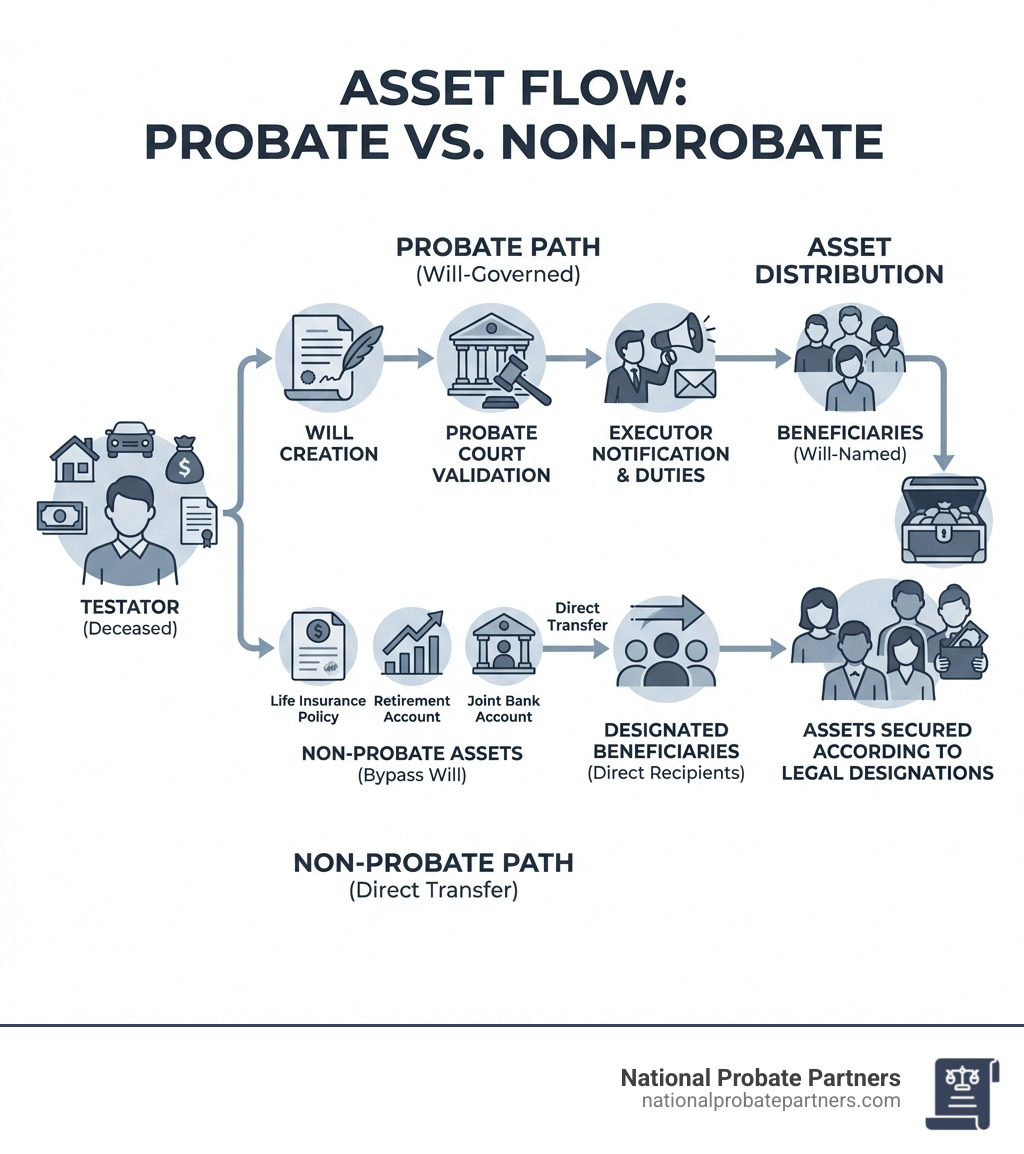
Understanding the Role of a Named Beneficiary in a Will
When someone creates a will, they’re essentially writing a script for what happens to their property after they’re gone. The stars of that script, the individuals or entities who receive the benefits, are the named beneficiaries in a will. This legal designation is crucial because it directs the probate court regarding the distribution of assets that form part of the testator’s (the person making the will) probate estate. It ensures that your cherished possessions, financial accounts, and even real estate are passed on exactly as you intend.

Without clear beneficiary designations, your estate could face unnecessary delays, expenses, and potential family disagreements. As Investopedia succinctly puts it, a Named Beneficiary: Overview, Types, and Related Risks is an individual or entity legally entitled to collect assets from various financial instruments and legal documents.
What is a Beneficiary? A Legal Definition
At its core, a beneficiary is an individual or entity designated to receive benefits. In the context of a will, this means someone who will inherit property from the testator. As Cornell Law School’s Legal definition of beneficiary explains, beneficiaries arise under different legal arrangements, including wills and trusts (distributions of property) and contracts (such as life insurance policies).
Beneficiaries can be natural persons (like a spouse, child, or friend), corporations, or organizations such as charities. You can name specific individuals, or even groups of people. For instance, you might make a “specific bequest” of your grandmother’s antique watch to your eldest grandchild, or leave a “residuary estate” (what’s left after all specific gifts and debts are paid) to your children, to be divided equally.
The “definite-beneficiary rule” in express trusts, for example, requires that the beneficiary’s identity be ascertainable. This means it needs to be clear who you intend to benefit, leaving no room for doubt.
Beneficiary vs. Heir: A Critical Distinction
While often used interchangeably in everyday conversation, “beneficiary” and “heir” have distinct legal meanings, and understanding the difference is vital for effective estate planning.
An heir is a relative who inherits property from a person who dies without a will (intestate). In such cases, state law dictates who the heirs are and how assets are distributed, following rules of “intestate succession.” This means the state decides, not you.
A beneficiary, on the other hand, is someone you choose to receive your assets, specifically named in your will or other legal documents. This choice allows you to bypass the state’s default rules and ensure your assets go to your intended recipients, whether they are family members, friends, or charitable organizations.
The crucial difference is control. You can choose your beneficiaries, but you cannot choose your heirs. You can even use a will to disinherit an heir, explicitly stating that a certain relative should receive nothing. However, this must be done carefully, as disinherited spouses, for example, often have specific rights to claim a portion of the estate regardless of the will. This is a common source of More on probate disputes, highlighting why clear planning is so important.
So, yes, a person can be both a beneficiary in a will and an heir. For instance, your child is an heir by relationship, but if you name them in your will to receive specific assets, they are also a beneficiary. This dual role doesn’t create conflict, but rather reinforces your wishes.
Will Beneficiaries vs. Account Beneficiaries: Which Takes Precedence?
This is perhaps one of the most critical distinctions in estate planning, and a common source of confusion. Many people assume their will governs all their assets, but that’s not always the case.
Here’s the golden rule: Beneficiary designations on specific accounts typically override what is written in your will.
This means that if your will states all your assets go to your spouse, but your life insurance policy names your children as beneficiaries, the life insurance proceeds will go directly to your children, bypassing your will entirely.
Why does this happen? Because certain assets are considered “non-probate assets” and have their own mechanisms for direct transfer upon death. These include:
- Life Insurance Policies: Proceeds go directly to the named beneficiary.
- Retirement Accounts: Such as 401(k)s and IRAs, these accounts pass directly to the designated beneficiary.
- Bank Accounts: With a “Payable-on-death” (POD) designation (POD), the funds go directly to the named person.
- Brokerage or Investment Accounts: With a “Transfer-on-death” (TOD) designation (TOD), these assets are transferred directly.
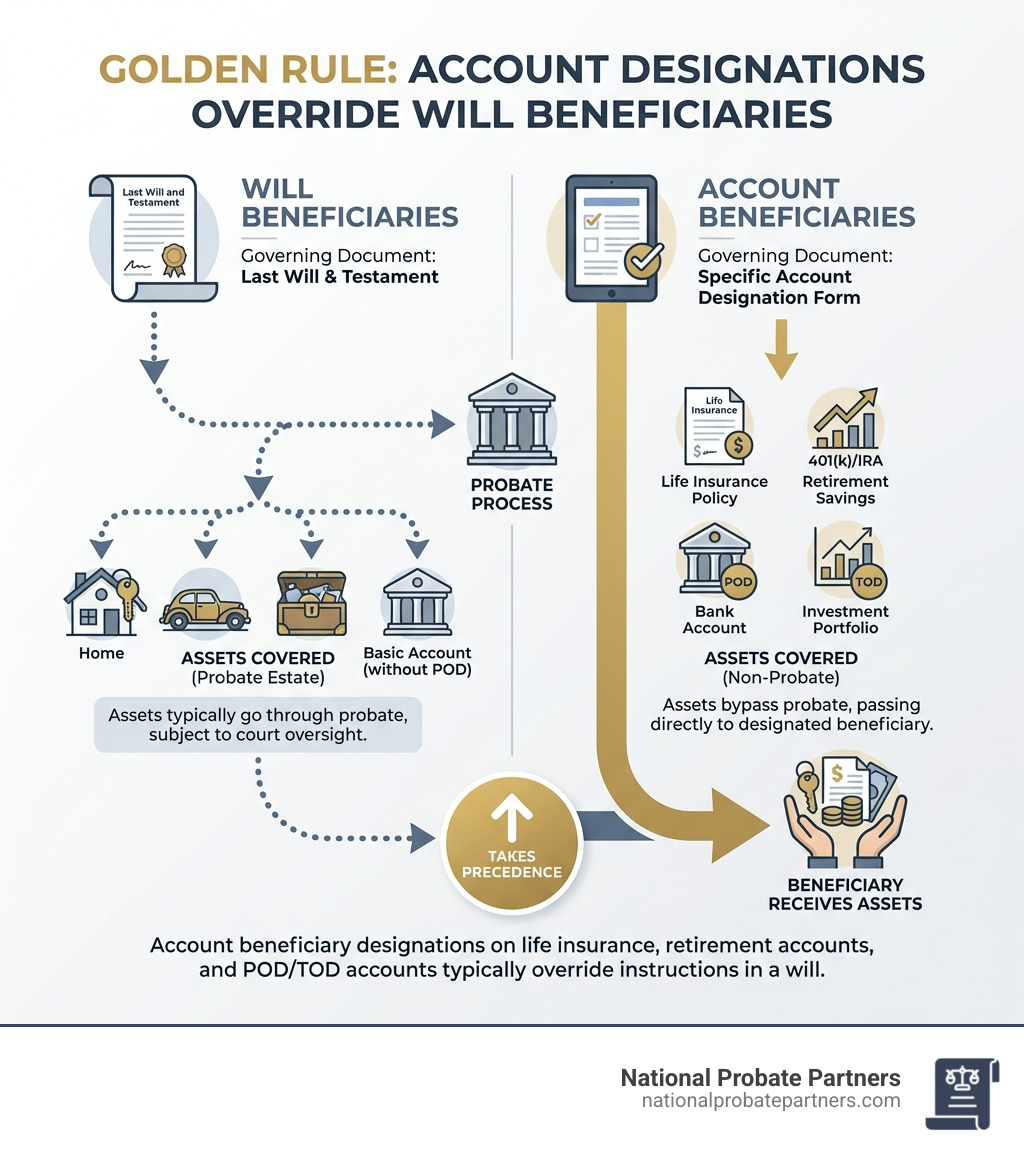
| Feature | Will Beneficiaries | Account Beneficiaries |
|---|---|---|
| Governing Document | Last Will and Testament | Specific account’s beneficiary designation form |
| Assets Covered | All assets in the probate estate (real estate, personal property, bank accounts without POD, etc.) | Non-probate assets (life insurance, 401(k)s, IRAs, POD/TOD accounts) |
| Probate Process | Assets typically go through probate | Assets bypass probate, passing directly to beneficiary |
| Precedence | Generally superseded by account designations for specific assets | Overrides will instructions for that specific asset |
| How to Change | Via a Codicil or new will | Via updating the beneficiary form with the financial institution |
As the statistics confirm, assets such as life insurance, annuities, pension plans, 401ks, and IRAs have beneficiary designation forms as part of the set-up process. These assets with beneficiary designations are typically excluded from the estate by default. Therefore, a beneficiary designation often overrides a will. Named beneficiaries of insurance policies and accounts like 401(k)s and IRAs take precedence over those designated in a will.
The takeaway here is clear: coordinating your will with your account beneficiary designations is paramount. We often see situations where a testator’s intentions in their will are inadvertently undermined by outdated or conflicting beneficiary forms on their financial accounts. This can lead to assets not going to the intended recipient and can create significant stress and legal complications for your loved ones.
Naming and Managing Beneficiaries in Your Will
Creating a will and naming beneficiaries is a powerful act of love and foresight. It allows you to direct your assets and ensure your legacy is preserved. However, it’s not a “set it and forget it” task. Life changes, and your will and beneficiary designations should evolve with it.
How to Properly Designate or Change a Named Beneficiary in a Will
Designating a named beneficiary in a will requires clarity and precision. Vague terms can lead to disputes and delays. When drafting or updating your will, ensure you provide:
- Full Legal Name: Avoid nicknames or abbreviations.
- Date of Birth: Helps to uniquely identify individuals.
- Relationship: Clarifies their connection to you.
- Social Security Number (SSN) or Tax ID: For financial institutions, this ensures proper identification.
- Address and Contact Information: So they can be easily located by the executor.
- Percentage of the Asset: If multiple beneficiaries are sharing an asset, clearly state the proportion each should receive.
To add or change a beneficiary in your will, you generally do so through a formal legal amendment called a codicil, or by executing an entirely new will. A codicil must be executed with the same formalities as a will, meaning it typically requires witnesses and proper signing. Most beneficiaries in wills are revocable beneficiary, meaning you can change or remove them at any time. For example, if you originally named your brother as the beneficiary of your will, but later decided to update it to your new spouse, you could do so.
The process of naming or changing a beneficiary is usually straightforward, but it’s important to do it carefully. We recommend reviewing your will and all beneficiary designations regularly, especially after significant life events like marriage, divorce, the birth of a child, or the death of a beneficiary.
What Happens if a Beneficiary Predeceases the Testator?
It’s a somber thought, but it’s crucial to plan for the possibility that a named beneficiary in a will might die before you do. If a beneficiary predeceases the testator, the disposition of their inheritance depends on several factors:
- Contingent Beneficiaries: This is why naming contingent beneficiaries (also known as secondary beneficiaries) is so important. A contingent beneficiary is your backup plan, receiving the inheritance if the primary beneficiary cannot. As Investopedia notes, a Primary Beneficiary: Explanation, Importance and Examples is first in line, but a contingent beneficiary ensures the asset still goes to an intended recipient without going through probate if the primary cannot inherit.
- Anti-Lapse Statutes: Many states have “anti-lapse statutes” that prevent a gift from failing if the deceased beneficiary was a close relative (e.g., a child or sibling) and left descendants. In such cases, the gift might pass to the deceased beneficiary’s children. These laws vary by state, so it’s essential to understand how they apply in Arizona or Texas.
- Per Stirpes vs. Per Capita: Your will can specify how shares should be distributed if a beneficiary dies.
- Per Stirpes: If a beneficiary dies, their share passes to their direct descendants (their children, grandchildren, etc.).
- Per Capita: The assets are divided equally among the surviving members of a class of beneficiaries.
- Residuary Clause: If there’s no contingent beneficiary and anti-lapse statutes don’t apply, the gift might fall into the residuary estate, distributed according to your will’s residuary clause. If there’s no residuary clause, it could lead to partial intestacy.
Planning for this scenario by naming contingent beneficiaries or specifying distribution methods like “per stirpes” can prevent unintended outcomes and additional complications for your estate.
The Special Case: Naming a Minor as a Beneficiary
Naming a minor as a named beneficiary in a will or on an account might seem straightforward, but it comes with legal complexities. Children under 18 (or in some states, under 19 or 21) generally cannot directly inherit money from a retirement account or life insurance policy. As SmartAsset points out, People who can’t be named as beneficiaries directly include minors.
If you list a minor child as a direct beneficiary, the court will typically appoint a guardian or conservator to manage the money for them until they reach the age of majority. This court involvement can be costly, time-consuming, and may not align with your wishes for how the funds should be managed.
To avoid this, we often recommend two primary strategies:
- Creating a Trust: You can establish a trust within your will (a testamentary trust) or a separate living trust, naming the trust as the beneficiary for the minor’s inheritance. The trust would then appoint a trustee (an adult you choose) to manage the assets according to your instructions until the child reaches a specified age or milestone.
- Custodian under UTMA: In many states, including Arizona and Texas, you can designate a custodian under the Uniform Transfers to Minors Act (UTMA). This allows an adult to manage the inherited assets for the minor without the need for a formal trust or court-supervised guardianship, though there are limits on how long the custodianship can last (typically until age 21 or 25, depending on the state).
Choosing the right approach depends on the size of the inheritance, your specific wishes for the minor, and the laws of your state.
The Executor, Probate, and the Beneficiary’s Inheritance
Once a testator passes away, their will doesn’t just magically execute itself. This is where the probate process and the executor (also known as the personal representative) come into play. The executor is the person or entity responsible for carrying out the instructions in the will and managing the estate through probate.
Probate is the legal process of proving the validity of a will, identifying and inventorying the deceased person’s property, paying their debts and taxes, and distributing the remaining property as the will directs. As Investopedia describes, What is probate? is the process where a judge decides who inherits according to state laws if no beneficiary is named, or to validate the will.
The Executor’s Legal Responsibilities to Beneficiaries
The executor has a significant legal obligation, known as a fiduciary duty, to act in the best interests of the estate and its beneficiaries. This means they must be transparent, honest, and diligent in their duties. Their responsibilities include:
- Notifying Beneficiaries: After the probate court validates the will and appoints the executor, they must formally notify all named beneficiaries in a will and legal heirs.
- Inventory of Assets: Identifying and cataloging all of the deceased’s assets.
- Paying Estate Debts: Settling any outstanding debts and liabilities of the estate.
- Filing Taxes: Preparing and filing all necessary federal and state income and estate tax returns.
- Distributing Assets: Distributing the remaining assets to the beneficiaries according to the terms of the will.
An executor cannot override a beneficiary designation on non-probate assets (like life insurance or retirement accounts) unless specifically ordered to do so by the court. Their role primarily pertains to assets governed by the will. For a deeper dive into their role, check out Unpacking the role of a probate attorney. Our team at National Probate Partners often works closely with executors to ensure these responsibilities are met efficiently and in compliance with state laws in Arizona and Texas.
The Notification Process: How Beneficiaries Find Out
If you are a named beneficiary in a will, you will eventually be notified by the executor or personal representative. While some people are told by the testator during their lifetime, the formal notification typically happens after the testator’s death.
Here’s how the process generally unfolds:
- Will Filing: The will must be filed with the probate court in the appropriate jurisdiction (e.g., in Arizona or Texas) within a set timeframe after death, sometimes as quickly as 30 days.
- Court Validation: The probate court validates the will and formally appoints the executor.
- Formal Notice: The executor then prepares and sends a formal “Notice of Appointment” form to everyone interested in the estate, including all named beneficiaries in a will, legal heirs, and creditors. This notice typically includes the personal representative’s contact information and details about the probate court overseeing the matter.
- Timelines: Many states require executors to notify beneficiaries within two or three months after the court validates the will and appoints them.
As a beneficiary, you have the right to request a copy of the will for review. If you have concerns about the executor’s actions or the will’s validity, you have the right to challenge it, though this should always be done with legal counsel.
What Happens When a Will Doesn’t Name a Beneficiary for an Asset?
Even with a will, sometimes an asset might not have a specific named beneficiary in a will. This can happen if:
- The will doesn’t explicitly mention every single asset.
- A specific beneficiary for an asset predeceases the testator, and no contingent beneficiary was named, and anti-lapse statutes don’t apply.
- The will is poorly drafted or incomplete.
In such cases, the will’s residuary clause becomes incredibly important. This clause specifies who receives “the rest, residue, and remainder” of the estate after all specific gifts, debts, and taxes have been paid. The person or entity named in this clause is the residuary beneficiary.
If an asset isn’t specifically bequeathed and there’s no valid residuary clause (or the residuary beneficiary cannot inherit), the estate faces partial intestacy. This means that portion of the estate will be distributed according to the state’s intestacy laws, as if there were no will for that particular asset. This can lead to unintended recipients, additional court involvement, and more time and expense for the estate.
This is precisely why we emphasize thorough estate planning and regular reviews. Our team helps clients ensure that every asset is accounted for, whether through specific bequests, a comprehensive residuary clause, or proper beneficiary designations on non-probate accounts. Understanding scenarios where When formal probate isn’t needed can also be beneficial in streamlining the process.
Frequently Asked Questions about a Named Beneficiary in a Will
Estate planning can raise many questions, especially when it comes to beneficiaries. Here, we address some of the most common inquiries we receive.
Can a beneficiary named in a will override other account designations?
No, generally not. This is a crucial point we’ve touched on already. Named beneficiaries in a will typically govern assets that pass through the probate process. However, assets like life insurance policies, retirement accounts (401(k)s, IRAs), and bank accounts with Payable-on-Death (POD) or Transfer-on-Death (TOD) designations are considered non-probate assets. These assets pass directly to the beneficiaries named on the account’s specific beneficiary designation form, bypassing your will and the probate process entirely. The account designation always takes precedence over the will for that particular asset.
Can I be a beneficiary and an heir at the same time?
Yes, absolutely! As we discussed earlier, an “heir” is a relative who would inherit by state law if there were no will. A “beneficiary” is anyone you specifically name in your will (or on an account) to receive assets. For example, your child is your heir by relationship. If you name that same child in your will to receive your house or a sum of money, they are also a named beneficiary in a will. There’s no conflict in being both; in fact, naming an heir as a beneficiary simply confirms your intention to leave them assets, rather than relying on state intestacy laws.
How long does it take for a beneficiary to receive their inheritance?
The timeline for a named beneficiary in a will to receive their inheritance can vary greatly. There’s no one-size-fits-all answer, as it depends on the complexity of the estate and the laws of the state where probate is occurring (e.g., Arizona or Texas).
- Simple Estates: A straightforward estate with clear directives, few debts, and cooperative beneficiaries might be settled in as little as six months.
- Complex Estates: Estates with significant assets, numerous debts, business interests, or, unfortunately, family disputes or will contests, can take years to resolve.
- Specific Bequests vs. Residuary: Beneficiaries of specific bequests (e.g., a car, a piece of jewelry, a specific sum of money) might receive their inheritance sooner than residuary beneficiaries. Residuary beneficiaries receive what’s left after all debts, taxes, and specific gifts have been distributed, so their wait is often longer.
The executor has a lot of work to do, from inventorying assets and paying creditors to filing taxes. This entire process takes time, and beneficiaries often need to be patient.
Securing Your Legacy: The Final Word on Will Beneficiaries
Understanding the role of a named beneficiary in a will is fundamental to sound estate planning. It’s about more than just distributing assets; it’s about expressing your final wishes, providing for your loved ones, and ensuring your legacy is handled with care and efficiency.
The key takeaway is the importance of coordinating your entire estate plan. This means aligning your will with all your non-probate asset beneficiary designations. A will that contradicts your life insurance policy or retirement account can lead to confusion, delays, and unintended consequences for your family. Regular reviews of your will and all beneficiary forms are essential, especially after major life events.
Clarity in your designations provides peace of mind for you and simplifies a difficult time for your beneficiaries. We understand that navigating these complexities can be daunting, but you don’t have to do it alone. Our team at National Probate Partners specializes in probate, estate administration, and estate planning across Arizona, Texas, and the United United States, including for military families in Armed Forces Americas, Europe, and Pacific. We offer experienced, personalized, and compassionate service to help you ensure your wishes are respected.
Don’t leave your legacy to chance. Contact us for help with your probate needs and let us help you create a comprehensive plan that truly reflects your intentions.