
Why Understanding Trust and Probate Matters for Your Estate
Trust and probate are two fundamental paths for transferring assets after death. A trust is a legal arrangement where a trustee holds and manages assets for beneficiaries, often avoiding court involvement. Probate is the court-supervised process of validating a will, paying debts, and distributing assets—it’s typically public, costly, and time-consuming.
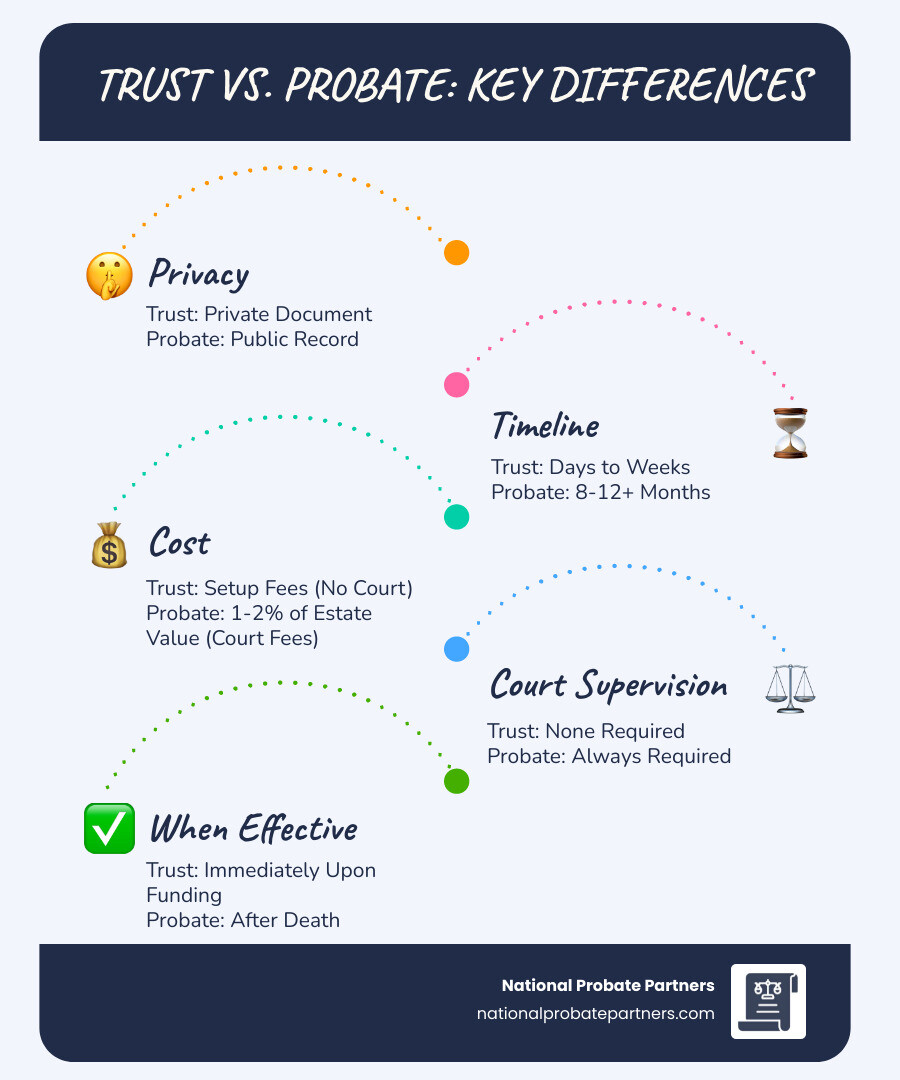
Quick Comparison:
| Aspect | Trust (Living) | Probate |
|---|---|---|
| Privacy | Private document | Public court record |
| Timeline | Days to weeks | 8-12 months (or longer) |
| Cost | Setup fees, no court costs | Probate fees (1-2% of estate value in many states) |
| Court Supervision | None | Required |
| When It Takes Effect | Immediately upon funding | After death |
Settling a loved one’s estate is a difficult time. Understanding the difference between trust and probate isn’t just about legal jargon—it’s about protecting your family’s privacy, minimizing costs, and ensuring assets reach the right people without unnecessary delays.
The core distinction is this: Assets held in a properly funded trust bypass the probate process entirely. Assets owned solely in the deceased person’s name—without beneficiary designations or joint ownership—must go through probate before they can be distributed.
Many people assume having a will eliminates probate. It doesn’t. A will actually requires probate to be legally enforced. A living trust, on the other hand, allows assets to transfer directly to beneficiaries without court involvement, maintaining privacy and saving both time and money.
Understanding Probate: The Court-Supervised Process
Probate is the court-supervised process that confirms a will’s validity, oversees estate administration, and ensures debts are settled and assets are distributed. While it provides a structured framework, it can be a source of frustration due to its costs, timelines, and public nature.

What is Probate and Why Is It Often Avoided?
Probate is the official legal process after someone dies. A court validates the will, inventories assets, pays debts, and distributes the remaining property to heirs. A judge appoints an executor to oversee this process.
So, why might someone want to avoid probate? The reasons are compelling and often boil down to three key factors:
- High Costs: Probate involves fees that can significantly reduce an estate’s value, including court, attorney, and executor fees. These costs can consume 1% to 2% or more of the estate’s total value. For example, in Texas, statutory attorney fees can be substantial, separate from other court costs.
- Long Timelines: The probate process is notoriously slow, often taking months or even years to complete. During this time, assets may be frozen and unavailable to beneficiaries, which can create financial hardship. A typical probate in states like Texas can last 6 to 12 months, or longer for complex cases.
- Lack of Privacy: Probate is a public process. The will, asset inventories, and other financial details become part of the public record, accessible to anyone.
For a deeper dive into the overall process, you can refer to this Guide to wills, estates, and probate court.
When is Probate Necessary?
Despite the desire to avoid it, probate is often required for assets the deceased owned solely in their name, without designated beneficiaries or joint ownership. Common scenarios where probate is essential include:
- Solely Owned Assets: This includes property titled only in the deceased’s name, such as bank accounts, real estate, or vehicles, with no other legal transfer mechanism.
- Real Estate: Property like a home or land owned solely by the deceased will almost always require probate to legally transfer title to heirs, especially in states like Texas and Arizona where clear title is critical.
- No Beneficiary Designations: If financial accounts (like bank or brokerage accounts) lack a “payable-on-death” (POD) or “transfer-on-death” (TOD) designation, the asset will likely go through probate.
- Financial Institution Requirements: Banks and other institutions often require a court order from probate to release funds from a deceased person’s solely owned accounts, protecting them from liability.
- Intestate Succession: If a person dies without a will (“intestate”), probate is necessary to identify legal heirs according to state law and distribute assets accordingly. This process can be more complex than probating a will.
- Disputes or Challenges: If there are disputes among heirs or challenges to the will, probate provides the legal forum to resolve these issues under court supervision.
While some states have simplified procedures for small estates, many estates in Texas, Arizona, and other US jurisdictions will necessitate probate. It’s wise to seek legal guidance to understand the specific requirements for your situation.
How to Bypass Probate Without a Trust
While trusts are an excellent way to avoid probate, other strategies can help assets bypass the process. These methods are often simpler but apply only to specific assets:
- Joint Ownership with Right of Survivorship: When one owner dies, their share automatically passes to the surviving joint owner(s) without probate. This is common for real estate and bank accounts.
- Payable-on-Death (POD) Accounts: You can name beneficiaries on bank accounts, and upon your death, the funds transfer directly to them, bypassing probate.
- Transfer-on-Death (TOD) Designations: Similar to POD, TOD designations apply to investment accounts, and in some states, real estate and vehicles, allowing them to pass directly to a named beneficiary.
- Life Insurance Policies: Proceeds are generally paid directly to the named beneficiary without going through probate.
- Retirement Accounts (IRAs, 401(k)s): Funds in these accounts pass directly to your named beneficiaries, avoiding probate. It’s crucial to keep these designations updated.
While these methods are effective for specific assets, they don’t offer the comprehensive planning benefits of a trust, such as managing assets for beneficiaries over time or planning for incapacity.
Exploring Trusts: A Private and Flexible Alternative
Trusts offer a compelling alternative to probate, prioritizing privacy, flexibility, and efficiency. A trust is a legal entity that allows a third party (the trustee) to hold and manage assets for beneficiaries. Unlike a will, which only takes effect after death through probate, a trust can be effective during your lifetime, providing seamless asset management and distribution.

The Core Components of a Trust
Understanding a trust means knowing the key players involved:
- Settlor (Grantor): The individual who creates the trust, sets its rules, and decides which assets to include.
- Trustee: The person or institution appointed to hold legal title to trust assets and manage them according to the trust’s terms. A trustee has a fiduciary duty—a significant legal responsibility—to act in the best interests of the beneficiaries.
- Beneficiary: The individuals or entities who will receive the benefits from the trust assets.
- Successor Trustee: An individual or institution named to take over as trustee if the initial trustee becomes incapacitated, resigns, or dies, ensuring continuity without court intervention.
For more detailed insights into the benefits of a living trust, especially concerning privacy and flexibility, you can explore resources like this Investopedia article.
Living Trusts vs. Testamentary Trusts
Trusts can be created during your life or through your will, which significantly impacts how they interact with the probate process.
| Aspect | Living Trust (Inter Vivos Trust) | Testamentary Trust |
|---|---|---|
| Creation | Created during your lifetime | Created within your will |
| Takes Effect | Immediately upon funding | Upon your death, after your will is probated |
| Probate Avoidance | Yes, for assets funded into the trust | No, the will creating it must go through probate |
| Privacy | Private document, avoids public record | Becomes public record as part of the probated will |
| Flexibility | Highly flexible, can be amended/revoked (if revocable) | Generally irrevocable once effective, terms set by will |
| Asset Mgmt. | Manages assets during life & after death | Manages assets only after death |
| Incapacity | Provides for asset management if you become incapacitated | No provision for incapacity during your lifetime |
- Living Trust (Inter Vivos Trust): A living trust is created during your lifetime. You transfer assets into it and typically act as the initial trustee, maintaining full control. Upon your death or incapacitation, a successor trustee takes over without court involvement. This is why living trusts are effective at avoiding probate and providing for incapacity.
- Testamentary Trust: A testamentary trust is created within your will and only becomes active after your death and after the will goes through probate. Because it’s part of a probated will, it does not avoid the probate process or offer the same privacy and incapacity planning benefits as a living trust.
Clients often prioritize the probate avoidance and privacy benefits of a living trust. However, a testamentary trust can still be a valuable tool if you are comfortable with your will going through probate but want to control how certain inheritances are managed.
Common Reasons to Establish a Trust
Trusts are versatile tools that can address a wide range of estate planning needs for families across Texas, Arizona, and for our service members. Here are some common reasons to establish a trust:
- Managing Assets for Minors: A trust can ensure a minor’s inheritance is managed by a responsible trustee until they reach a specified age (e.g., 25 or 30), rather than receiving a large sum at 18.
- Special Needs Beneficiaries: A special needs trust can provide for a loved one with a disability without jeopardizing their eligibility for essential government benefits like Medicaid or Supplemental Security Income.
- Blended Families: A trust can balance the needs of a current spouse with the desire to ensure children from a previous marriage ultimately inherit assets.
- Spendthrift Protection: If a beneficiary struggles with managing money, a trust can protect their inheritance. The trustee controls distributions, ensuring funds are used responsibly.
- Incapacity Planning: A living trust allows your successor trustee to manage your financial affairs if you become incapacitated, avoiding a costly and public court-appointed guardianship.
- Business Succession: For business owners, a trust can facilitate the smooth transition of ownership, ensuring the continuity of operations.
- Privacy: Trusts are private documents. Unlike wills, which become public record during probate, the terms and beneficiaries of a trust remain confidential.
- Estate Tax Planning: While the federal estate tax exemption is high ($13.61 million per individual in 2024), trusts can be structured to minimize potential taxes. This is less of a concern in states like Texas and Arizona, which currently have no state estate tax.
The Critical Intersection of Trust and Probate
The relationship between trust and probate is central to effective estate planning. While trusts are often used to avoid probate, it’s important to understand how they interact with asset ownership, tax implications, and potential legal challenges. Your estate settlement path will significantly impact the timeline, cost, and privacy of transferring your legacy.
Tax Implications: Trust and Probate Compared
Understanding the tax implications of both probate and trusts is crucial. While trusts are primarily used to avoid the probate process, they also have their own tax considerations.
- Probate Fees as a Cost: Probate fees (court, attorney, executor) are essentially a tax on the estate, reducing the amount that passes to beneficiaries. These are paid from the estate’s assets before distribution.
- Estate Taxes: The federal estate tax exemption is very high ($13.61 million per individual for 2024), meaning few estates will owe federal estate tax. Texas and Arizona currently do not levy a state-level estate or inheritance tax, which simplifies planning for residents.
- Income Tax on Trusts: Trusts are separate legal entities and can be subject to income tax.
- Revocable Living Trusts: During the settlor’s lifetime, income earned by the trust is typically reported on the settlor’s personal income tax return.
- Irrevocable & Testamentary Trusts: The tax treatment for these is more complex. Historically, some trusts offered tax advantages, but law changes have largely eliminated them. Income retained within a trust is often taxed at the highest marginal rates, making careful planning essential.
- Basis Step-Up: An important tax consideration for assets passing at death (whether through probate or a trust) is the “step-up in basis.” Generally, the cost basis of inherited assets is “stepped up” to their fair market value on the date of death. This can significantly reduce or eliminate capital gains tax for beneficiaries if they later sell the asset. This benefit applies to assets in a will and those in a revocable living trust.
Navigating these tax implications requires professional advice. We work with clients in Texas, Arizona, and the Armed Forces to structure their estates in the most tax-efficient manner possible.
Contesting a Will vs. Challenging a Trust
The legal battleground for challenging estate plans differs significantly between a will and a trust.
- Contesting a Will: When a will enters probate, it becomes a public document, making it relatively easier for an interested party to contest it. Common grounds for a challenge include:
- Undue Influence: The testator was coerced or manipulated.
- Lack of Testamentary Capacity: The testator was not of sound mind.
- Improper Execution: The will was not signed or witnessed correctly.
- Fraud: The testator was deceived into signing. A will contest can lead to a public, lengthy, and costly court battle, delaying asset distribution. We understand the complexities of Probate Disputes: What You Need to Know and are here to help.
- Challenging a Trust: A trust is a private document and does not go through public probate, making it inherently more difficult to challenge. While a trust can be challenged on similar grounds (e.g., undue influence), the process is more complex, and the burden of proof rests on the challenger. The privacy of a trust means disputes are less likely to become public knowledge, a significant advantage for many families.
The heightened privacy and stronger legal standing of a trust can provide greater peace of mind that your wishes will be carried out with fewer opportunities for public scrutiny or legal battles.
The Roles of an Executor vs. a Trustee
While both executors and trustees manage and distribute assets, their authority and oversight differ significantly. Understanding these roles is key to comprehending the difference between trust and probate.
-
Executor (or Personal Representative):
- Appointed By: Named in a will or appointed by the probate court.
- Authority: Gains legal authority only after the will is admitted to probate by the court.
- Oversight: Operates under the direct supervision of the probate court.
- Duties: Gathers assets, pays debts and taxes, and distributes remaining assets according to the will, all under court supervision.
- Public Record: All actions and financial details become part of the public probate record.
-
Trustee:
- Appointed By: Named in a trust document by the settlor.
- Authority: Gains legal authority immediately upon the event specified in the trust (e.g., death or incapacity), with no court appointment needed.
- Oversight: Operates privately according to the trust’s terms, with a fiduciary duty to the beneficiaries.
- Duties: Manages and invests trust assets, makes distributions to beneficiaries, keeps records, and files tax returns for the trust.
- Private Process: The trust administration remains private and outside of public court records.
An executor steers the public, court-supervised probate system, while a trustee manages assets privately according to a trust’s instructions. For guidance on Hiring a Probate Lawyer: What You Need to Know, we offer expert advice.
Frequently Asked Questions about Trust and Probate
We often receive questions from clients in Texas, Arizona, and the Armed Forces about the practicalities of trusts and probate. Here are some of the most common inquiries we address:
What is the biggest mistake people make when using a living trust?
The biggest mistake is failing to “fund” the trust. A trust only controls the assets that have been legally transferred into its name. Creating a trust document is just the first step; you must then retitle assets (like bank accounts, real estate, and investment accounts) from your individual name into the name of the trust. If assets are left outside the trust, they will still be subject to probate, completely defeating one of the main purposes of establishing a living trust.
Can a living trust help if I become incapacitated?
Yes. If you become incapacitated, your designated successor trustee can immediately step in to manage the trust’s assets on your behalf, avoiding the need for a court-appointed conservatorship or guardianship. This seamless transition ensures your financial affairs are managed privately and efficiently, without the expense, delay, and public scrutiny of court proceedings. This is a significant benefit of a living trust, providing peace of mind for you and your family.
Do I still need a will if I have a living trust?
Yes, absolutely. Even with a living trust, we strongly recommend having a “pour-over” will. This type of will acts as a safety net, directing any assets that were not funded into your trust (perhaps due to oversight or newly acquired property) to be “poured over” into the trust at your death. These assets would still go through probate, but once probated, they would then be managed under the terms of your trust. Additionally, a will is the only document where you can name a guardian for minor children—a crucial consideration for parents.
Conclusion: Making the Right Choice for Your Estate
Navigating the complexities of trust and probate is a cornerstone of responsible estate planning. While probate is a public and often lengthy court process, a properly funded trust offers a private, efficient, and flexible alternative. The right choice depends on your goals for privacy, cost, and control.
At National Probate Partners, we empower clients across Texas, Arizona, and the Armed Forces to make informed decisions. We are dedicated to crafting a personalized estate plan that reflects your wishes, minimizes potential burdens, and provides lasting peace of mind.
To ensure your legacy is protected and your wishes are carried out efficiently and privately, we invite you to connect with our experienced team.