
What Is a Domiciliary Executor? The Quick Answer
What is a domiciliary executor is one of the most searched questions by people suddenly thrust into managing a loved one’s estate — often while still grieving.
Here’s the short answer:
A domiciliary executor is the person legally appointed to manage and settle the estate of someone who has died, based in the state where that person permanently lived (their “domicile”).
At a glance:
- Who appoints them: Named in the deceased’s will, or appointed by a probate court if no will exists
- Where they operate: In the decedent’s home state — the state of permanent residence
- What they do: Collect assets, pay debts and taxes, and distribute what remains to beneficiaries
- Their authority comes from: Domiciliary Letters (also called Letters Testamentary) issued by the probate court
- How they differ from an ancillary executor: An ancillary executor handles assets in other states; the domiciliary executor oversees the primary estate
Settling an estate is rarely simple. Probate proceedings typically stay open anywhere from 9 to 15 months — sometimes much longer. If the decedent owned property in multiple states, had outstanding debts, or left behind a blended family, the role of domiciliary executor becomes even more demanding.
Understanding exactly what this role involves — and what authority it carries — is the first step to handling it well.

What is a domiciliary executor vocab to learn:
What is a Domiciliary Executor?
To understand the person, we first have to understand the place. In legal terms, a domiciliary estate refers to the collection of assets owned by someone in the state where they maintained their permanent home.
When we talk about what is a domiciliary executor, we are talking about the “primary” manager of that estate. Think of them as the CEO of the decedent’s final affairs. While there might be other “managers” (ancillary executors) if the person owned a beach house in another state, the domiciliary executor is the one who holds the master keys.
As the administrator of estate duties, this individual has a heavy fiduciary duty. This is a fancy way of saying they are legally required to act with the highest level of honesty and loyalty toward the estate and its beneficiaries. They aren’t just “helping out”; they are legally responsible for every penny.
Understanding the Role: What is a Domiciliary Executor?
The concept of “domicile” is the cornerstone of this role. It isn’t just where you happened to be standing when you passed away; it’s where you intended to be. For example, if a resident of Scottsdale, Arizona, goes to Texas for a temporary six-month work contract and passes away there, their domicile is still Arizona.
As of April 2026, courts look closely at the “intent to return.” This matters because the laws of the domicile state govern how the will is interpreted and how taxes are calculated. Being an executor of a will means you must navigate the specific probate court rules of that home state.
Whether you are in Corpus Christi or Scottsdale, the domiciliary executor is the one who petitions the local court to open probate. Once the court is satisfied that the person lived there, they grant the executor the legal authority to start moving money, selling cars, and talking to banks.
Domiciliary vs. Ancillary Executors
This is where things can get a bit “multi-state” and complicated. If the decedent only owned property in their home state, you only need a domiciliary executor. But what if they lived in Arizona and owned a rental property in Florida?
In that case, you might need two types of probate: Domiciliary (the main one) and Ancillary (the secondary one for out-of-state real estate).
| Feature | Domiciliary Executor | Ancillary Executor |
|---|---|---|
| Primary Location | Decedent’s permanent home state | Any state where real property is held |
| Main Duty | Oversees the entire estate and all personal property | Manages specific out-of-state real estate |
| Authority | Issued “Domiciliary Letters” | Issued “Ancillary Letters” |
| Coordination | Leads the process; coordinates with ancillary reps | Follows the lead of the domiciliary estate |
Because everything you need to know about ancillary probate involves coordinating between different state laws, the domiciliary executor usually has the task of finding a local representative in that other state. In many cases, the same person can serve as both, but they still have to “qualify” in each state separately.
Key Responsibilities and Legal Authority

You can’t just walk into a bank in Texas or Arizona and say, “I’m the executor.” The bank teller will (politely) ask for your “Letters.”
In what is a domiciliary executor, these “Letters” (either Domiciliary Letters or Letters Testamentary) are your golden ticket. They are the official court documents proving you have the legal right to handle the decedent’s assets.
According to the Texas State Law Library, an executor’s journey involves several high-stakes steps:
- Inventorying Assets: You must find everything—from the house and the 401(k) to the vintage stamp collection in the attic.
- Asset Protection: You have to make sure the grass is mowed at the house and the insurance premiums are paid so the estate doesn’t lose value.
- Creditor Notification: You are legally required to tell people the decedent owed money to that they have a chance to get paid.
Because the potential for personal liability is high, many people ask, “Do you need a probate attorney?” While not always strictly required by law for every simple estate, having an expert guide you through the “Unpacking” of these roles can prevent you from making a thousand-dollar mistake.
What is a Domiciliary Executor’s Duty to Creditors?
One of the most stressful parts of being an executor is dealing with debt. You aren’t just distributing money to the kids; you are the gatekeeper for the people the decedent owed money to.
Generally, you must publish a notice in a local newspaper to alert creditors. In many jurisdictions, creditors have a specific window—often a 90-day claim period—to file a claim against the estate. If you distribute all the money to the family and then a valid creditor shows up, you could be on the hook personally for that debt.
Your duties include:
- Tax Filings: Filing the decedent’s final income tax return and the estate’s tax return.
- Debt Settlement: Determining which debts are valid and paying them in the order of priority set by state law.
- Final Accounting: Showing the court (and the beneficiaries) exactly where every cent went before you close the estate.
If you have questions about the order of payments, checking a Probate Lawyer FAQ can help you understand the hierarchy of claims—usually, funeral expenses and taxes come first!
The Appointment Process and Qualifications

So, how do you actually become a domiciliary executor? It doesn’t happen automatically the moment someone passes away. Even if the will says, “I name my brother, John, as my executor,” John isn’t officially the executor until the judge says so.
The process usually looks like this:
- The Petition: You file the will and a petition with the probate court in the county of domicile.
- The Hearing: A judge reviews the will to make sure it’s valid and checks that you are qualified to serve.
- Qualification: Most states require you to be at least 18 years old and of “sound mind.” Some states, like Texas, may disqualify you if you have a felony on your record.
- The Bond: The court might require you to post a “probate bond.” This is essentially an insurance policy that protects the beneficiaries if you run off to Tahiti with the estate funds.
If the decedent died without a will (intestate), the court follows a “priority of appointment.” Usually, the surviving spouse is first in line, followed by the children. Being a named beneficiary in a will gives you a clear path, but the court still has the final say on your fitness for the job.
Common Challenges and When to Seek Professional Help
Let’s be honest: being an executor can be a thankless job. You are often doing the work of a part-time accountant, lawyer, and therapist all at once.
One of the biggest hurdles is the timeline. As we mentioned, probate often takes 9 to 15 months. In April 2026, we are still seeing court backlogs in some areas that can stretch a “simple” estate into a multi-year project.
Common headaches include:
- Beneficiary Disputes: When siblings disagree over who gets Grandma’s engagement ring, the executor is caught in the middle.
- Complex Asset Valuation: Trying to figure out what a family business or a collection of cryptocurrency is worth can be a nightmare.
- Out-of-State Property: Managing a house three states away while you have a full-time job is a recipe for burnout.
If you find yourself wondering, “How do I know if I need a probate lawyer?” the answer usually involves the complexity of the assets or the “heat” of the family dynamics.
Sometimes, people realize too late that they should have used a trust. Understanding the difference between trust and probate is vital for future planning, but if you are already in the middle of probate, your focus must be on following the state’s specific rules to avoid personal liability.
Frequently Asked Questions
Can a domiciliary executor be a beneficiary?
Yes! In fact, this is the most common scenario. Most people name their spouse or their oldest child as their executor.
While it is perfectly legal, it does create a potential conflict of interest. As an executor-beneficiary, you have a “double hat” role:
- You have the right to inherit your share of the estate.
- You have the duty to be fair to all other beneficiaries, even the ones you don’t like.
If you are both, you must be extra careful to document every expense. If you use estate money to fix up a house you are about to inherit, other beneficiaries might cry foul.
What happens if the decedent had assets in multiple states?
As we touched on earlier, this triggers “ancillary probate.” The domiciliary executor handles the main “home” estate, but they must often open a secondary case in the other state to deal with real estate there.
Some states have shortcuts. For example, in Florida, if the property involved in an ancillary proceeding is valued at less than $50,000, the estate may qualify for a “summary administration,” which is much faster than full probate. You will usually need to provide authenticated records from your home state court to prove you are the rightful domiciliary representative.
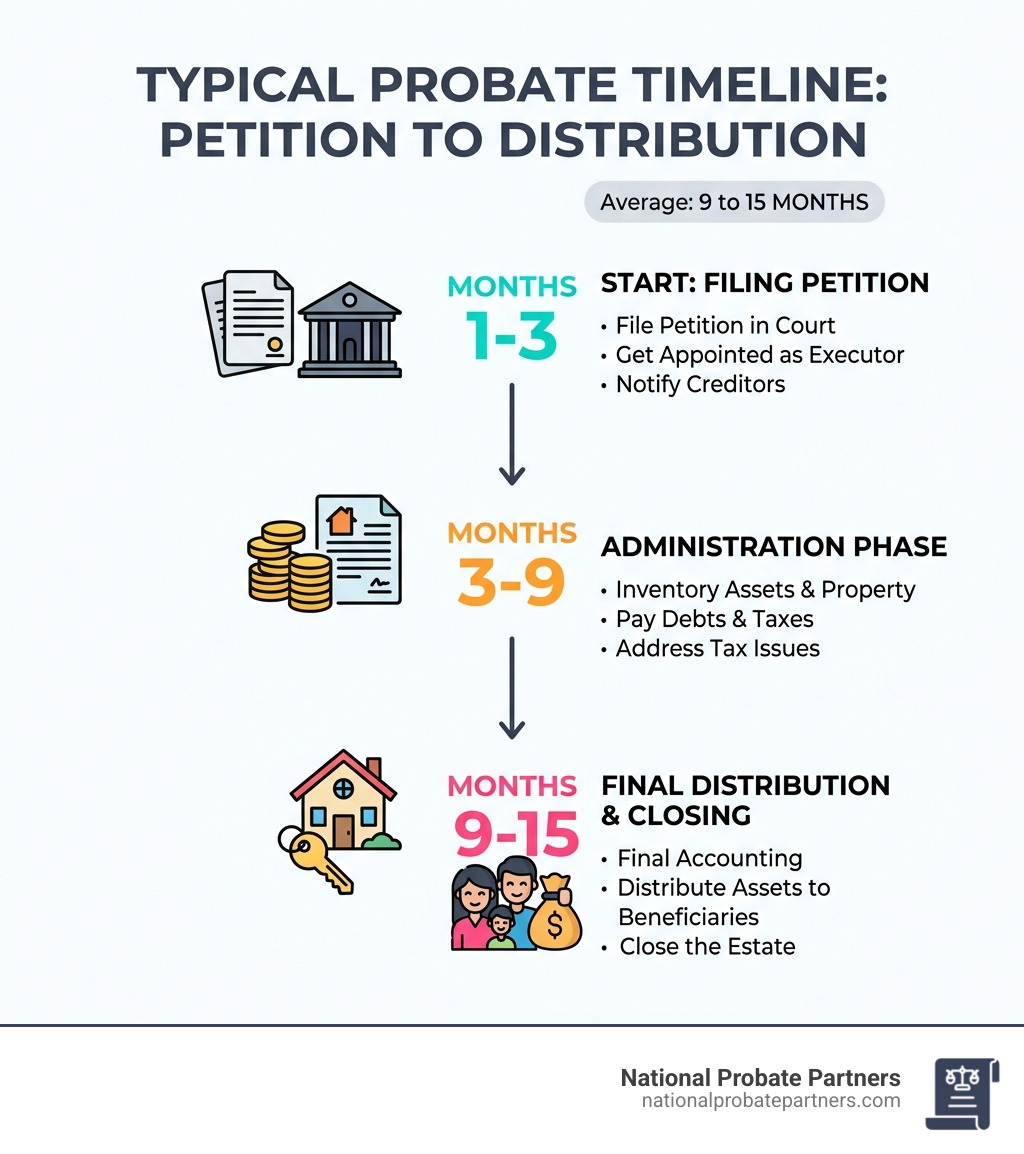
How long does the domiciliary probate process take?
The average is 9 to 15 months.
- Months 1-3: Filing the petition, getting appointed, and notifying creditors.
- Months 3-9: Inventorying assets, paying debts, and dealing with any tax issues.
- Months 9-15: Final accounting, distribution of assets, and closing the estate.
Simple estates with no debt and a clear will can sometimes be wrapped up in under a year, while complex litigation or estates with difficult-to-sell assets (like a niche business) can take several years.
Conclusion
Navigating probate is a journey no one wants to take, but almost everyone has to eventually. Understanding what is a domiciliary executor is the first step in ensuring a loved one’s legacy is handled with the respect and legal precision it deserves.
At National Probate Partners, we specialize in taking the weight off your shoulders. Whether you are dealing with a complex multi-state estate involving Texas and Arizona or you just need help understanding your duties in Scottsdale or Corpus Christi, we provide the compassionate, expert service you need.
We don’t just help you finish probate; we help you resolve the challenges efficiently so you can focus on what matters most—honoring your loved one’s memory.
If you still have questions, our Ultimate Probate Lawyer FAQ is a great place to start. When you’re ready for personalized help, we’re here to guide you every step of the way. Reach out to us today to see how we can simplify your probate experience.