
What a Probate Lawyer Florida Actually Does (And When You Need One)
A probate lawyer Florida residents rely on helps families navigate the court-supervised process of settling a deceased person’s estate — from validating a will and notifying creditors to distributing assets and closing the estate.
Here’s a quick overview of what you need to know:
| Question | Quick Answer |
|---|---|
| When is probate required? | When assets are held solely in the deceased person’s name |
| Two main types | Formal Administration (larger estates) and Summary Administration (under $75,000 or deceased 2+ years) |
| How long does it take? | 2–3 months for Summary; 6–12 months for Formal Administration |
| Typical legal cost | $3,000–$7,000 flat fee, or up to 3% of estate value |
| Is a lawyer required? | Yes — Florida law requires legal representation for most formal probate cases |
| Does a will avoid probate? | No — a will still must go through the Florida court system |
Losing someone is hard enough. Then comes the paperwork, the court deadlines, the creditor claims — and sometimes, family conflict.
Florida’s probate system has specific rules that differ from other states, primarily governed by the Florida Probate Code. There are strict filing deadlines, complex homestead property laws, special protections for surviving spouses, and unique challenges for out-of-state heirs. Missing a step can cost an estate thousands of dollars and months of delays.
And with an estimated $30 trillion in wealth currently transferring from Baby Boomers to the next generation, the stakes have never been higher — and probate disputes have never been more common.
This guide explains everything you need to know about Florida probate, step by step.
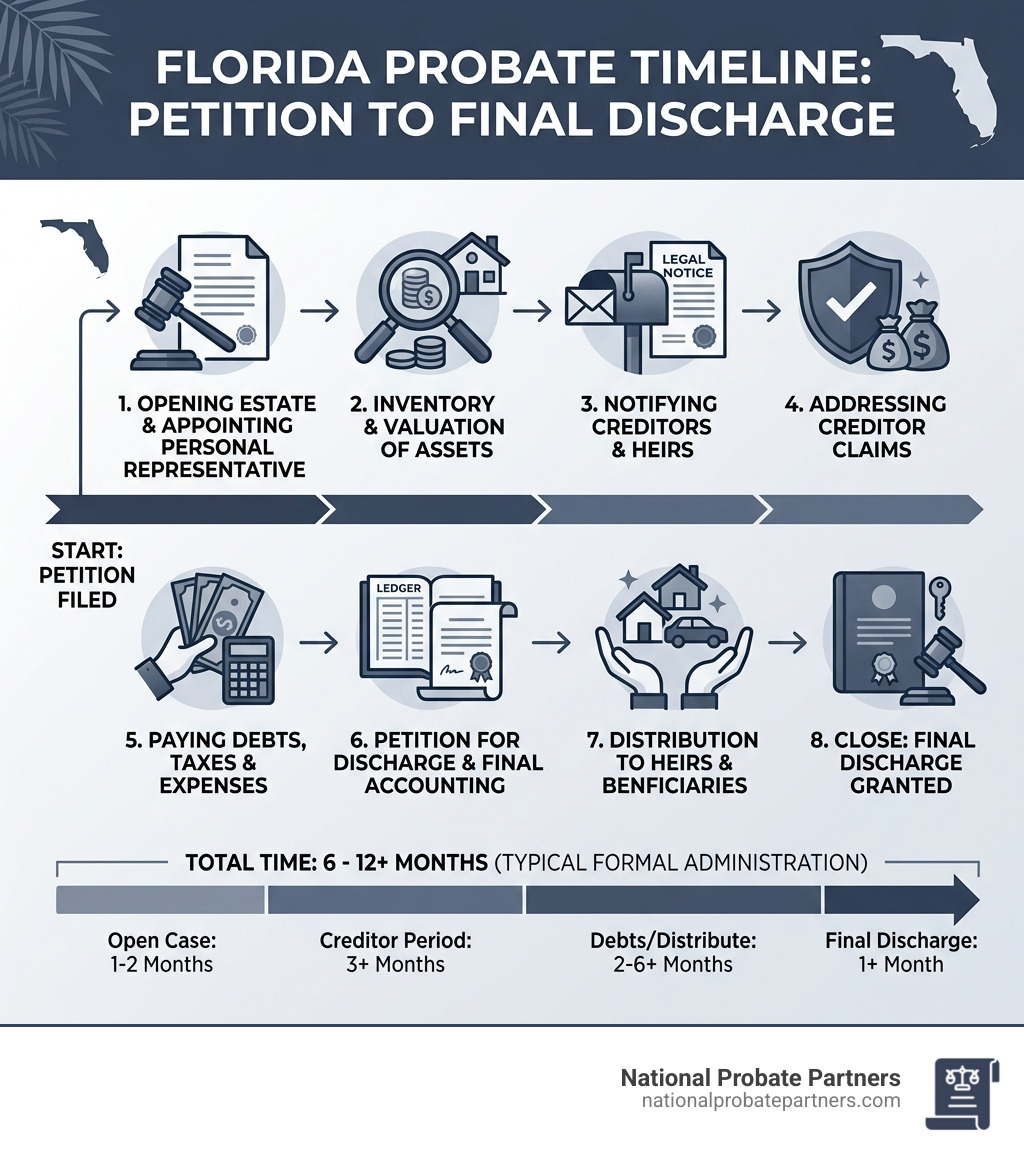
Important probate lawyer florida terms:
Understanding Florida Probate and Administration Types
In May 2026, as we look at the current legal landscape, Florida probate remains a court-monitored process necessary to transfer assets from a deceased person (the “decedent”) to their rightful heirs or beneficiaries. It is required whenever a person dies owning assets in their sole name.
Florida law offers different “paths” for probate, depending on the size of the estate and how long ago the person passed away. Choosing the wrong path can lead to unnecessary expenses and wasted time.
Comparing Administration Types
| Feature | Formal Administration | Summary Administration |
|---|---|---|
| Estate Value | Over $75,000 | Under $75,000 (non-exempt) |
| Time Since Death | Any | Under 2 years (if <$75k) OR Over 2 years (any value) |
| Personal Representative | Required | Not Required |
| Typical Duration | 6–12 Months | 2–3 Months |
| Court Appearances | Rare (usually remote) | Rare |
If you are staring at a stack of bank statements and a house deed, you might be wondering, How do I know if I need a probate lawyer? Generally, if the assets were not in a trust and don’t have a “Payable on Death” (POD) beneficiary, you will likely need to head to court.
Intestate Succession If your loved one died without a will, they died “intestate.” In these cases, Florida’s intestacy laws act as a default “will,” dictating exactly who gets what. Usually, this starts with the surviving spouse and children, but it can get complicated quickly if there are step-children or no immediate family.
The $75,000 Threshold and the Two-Year Rule Summary Administration is the “shortcut” of Florida probate. You can use it if the “probate assets” (assets not including the primary home) are worth less than $75,000. However, there is a secret weapon: if the person has been deceased for more than two years, the estate qualifies for Summary Administration regardless of how much it is worth. This is because the three-month creditor period expires after two years, making the process much safer and faster.
Ancillary Probate and Out-of-State Property Florida is a land of “snowbirds.” Often, someone dies in another state (like Arizona or Texas) but owns a vacation condo in Miami or a home in Orlando. Because Florida courts have exclusive jurisdiction over Florida land, you must open an “ancillary probate” case here to move that property, even if probate is already happening in the decedent’s home state.
Simplified Options for Small Estates
For very small estates, there are even simpler options than Summary Administration.
- Disposition Without Administration: This is only available if the estate is so small that the assets just cover the cost of the funeral and final medical bills. It’s essentially a way to get reimbursed for those final expenses.
- Small Estate Affidavits: While some states allow simple affidavits for bank accounts, Florida is much stricter. Most banks will still require a court order (either Summary or Formal) before they release funds.
The Role of a Probate Lawyer Florida in the Legal Process
When you hire a probate lawyer florida families trust, you aren’t just hiring someone to fill out forms. You are hiring a guide to navigate the 20 different judicial circuits in Florida, each of which has its own local quirks and “judges’ requirements.”
The Personal Representative
In Formal Administration, the court appoints a “Personal Representative” (known in other states as an executor). This person has a fiduciary duty, which is the highest legal duty of care. They are responsible for:
- Identifying and gathering assets.
- Publishing a “Notice to Creditors” in a local newspaper.
- Paying valid debts and taxes.
- Distributing the remaining wealth to beneficiaries.
Hiring a Probate Lawyer in 2026: What You Need to Know is crucial because the Personal Representative can be held personally liable if they mishandle estate funds. A lawyer protects the representative from these “traps for the unwary.”
Why You Need a Probate Lawyer Florida for Formal Administration
In Florida, the law actually requires most Personal Representatives to be represented by an attorney. This is because the process is too technical for a layperson to handle “pro se” (without a lawyer).
From filing the initial Petition for Administration to obtaining the “Letters of Administration” (the golden ticket that allows you to talk to banks), every step requires specific legal language. Your attorney ensures that the asset inventory is filed correctly and that the judge is satisfied with the accounting before the estate is closed.
Challenging a Will with a Probate Lawyer Florida
Not every probate case is smooth sailing. Sometimes, a “ne’er-do-well” child appears out of nowhere, or a caregiver suddenly becomes the sole beneficiary of a new will signed just days before death.
Probate Disputes: What You Need to Know from a Probate Lawyer often center on three main issues:
- Undue Influence: This is more than just “nagging.” It is over-persuasion or coercion that destroys the free will of the person making the will.
- Lack of Testamentary Capacity: If the decedent suffered from advanced dementia or was not of “sound mind” when the will was signed, the document can be tossed out.
- Breach of Fiduciary Duty: If the person in charge is stealing from the estate or playing favorites, a litigation lawyer can step in to remove them and seek damages.
Costs, Timelines, and Florida-Specific Protections
One of the first questions we hear is, “How much does a probate lawyer cost?“
In Florida, there are two common ways lawyers bill:
- Statutory Fee: Florida statutes suggest that a fee of 3% of the estate’s value is “presumptively reasonable.” For a $1 million estate, that’s a $30,000 fee.
- Flat-Fee or Hourly Billing: Many modern firms, including those we work with, prefer flat fees for uncontested cases. This provides cost certainty, often ranging from $3,000 to $7,000, keeping more money in the pockets of the heirs.
The Timeline Summary administration usually wraps up in 2 to 3 months. Formal administration typically takes 6 to 12 months. Delays often happen if there is a house that needs to be sold, a dispute with a creditor, or if the IRS gets involved with a complex tax return.
Protecting the Surviving Spouse and Home
Florida has some of the most robust “debtor protections” in the country, specifically regarding the family home.
- The Homestead Exemption: In Florida, your primary residence is generally “exempt” from the claims of most creditors. This means that even if the decedent died with $50,000 in credit card debt, the creditors usually cannot force the sale of the house to get paid.
- The Elective Share: You cannot easily disinherit a spouse in Florida. A surviving spouse is entitled to an “elective share” of 30 percent of the decedent’s elective estate, regardless of what the will says.
- Family Allowance: While the estate is being settled, a spouse or children can petition the court for a “family allowance” of up to $18,000 to cover living expenses.
Avoiding the Maze: Estate Planning and Trust Administration
The best way to handle a probate lawyer florida case is to avoid it entirely. As we move through 2026, more families are using “probate avoidance” strategies to bypass the court system.
Revocable Living Trusts A trust is like a suitcase. You put your assets inside it while you are alive, and when you pass away, your “Successor Trustee” simply hands the suitcase to your beneficiaries. No judge, no public record, and no 12-month wait.
Ladybird Deeds Also known as an Enhanced Life Estate Deed, this allows a Florida property owner to keep control of their home during their life but have it transfer automatically to their heirs upon death. It’s a “poor man’s trust” that works wonders for real estate.
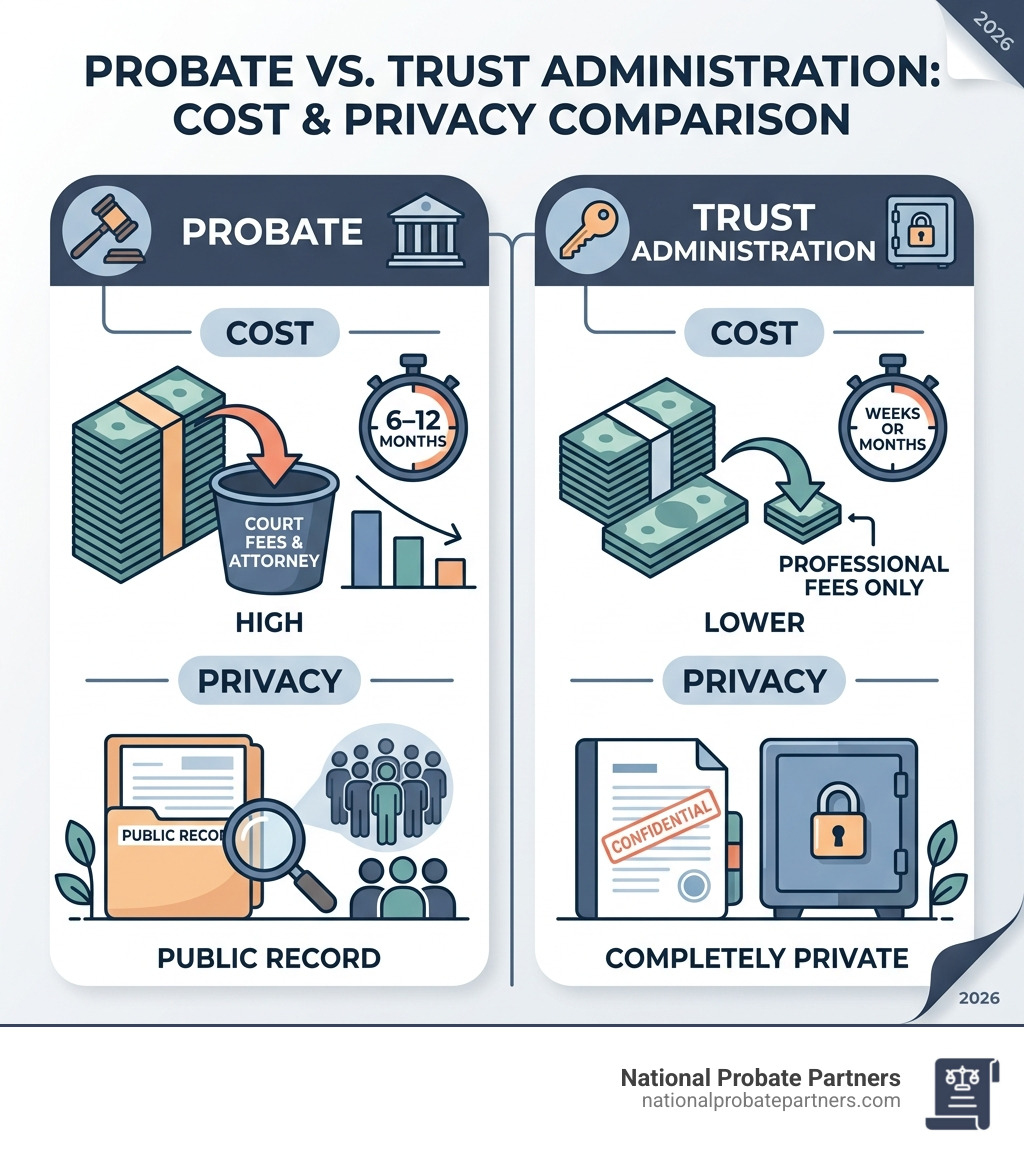
The Difference Between Probate and Trust Administration
| Feature | Probate | Trust Administration |
|---|---|---|
| Supervision | Court-Supervised | Private |
| Privacy | Public Record | Completely Private |
| Speed | 6–12 Months | Weeks or Months |
| Cost | High (Court fees + Attorney) | Lower (Professional fees only) |
While a trust avoids the probate court, it still requires “administration.” A trustee must still notify beneficiaries, pay final debts, and follow the trust’s instructions. However, it is almost always faster and cheaper than the alternative.
Frequently Asked Questions about Florida Probate
How long does the probate process typically take in Florida?
For a Summary Administration, you are looking at 2 to 3 months. For Formal Administration, the standard is 6 to 12 months. The biggest “wait” in Formal Administration is the mandatory 90-day window where creditors are allowed to file claims against the estate.
Who can serve as a personal representative in Florida?
Not just anyone can run a Florida estate. To qualify, you must be:
- A Florida resident OR
- A close blood relative (spouse, sibling, parent, child, etc.).
- You must be at least 18 years old.
- You cannot have a felony conviction on your record.
Is a lawyer legally required for probate in Florida?
Technically, for Summary Administration, you can sometimes go it alone (though it is risky). However, for Formal Administration, Florida Probate Rule 5.030 mandates that every Personal Representative must be represented by an attorney admitted to the Florida Bar. The court will simply refuse to move your case forward without one.
Conclusion
Navigating the Florida “estate maze” doesn’t have to be a nightmare. Whether you are dealing with a small estate under $75,000 or a complex multi-million dollar litigation case involving undue influence, the right legal partner makes all the difference.
At National Probate Partners, we understand that behind every case file is a family grieving a loss. Our goal is to provide the compassionate, expert guidance needed to resolve these challenges efficiently. From the initial petition to the final distribution of assets, we help you honor your loved one’s legacy without getting lost in the paperwork.
If you are ready to move forward, don’t wait for the deadlines to pile up. Schedule a Case Review today and let us help you find the clearest path through the Florida probate process.

Disclaimer: This guide is for informational purposes only and does not constitute legal advice. Laws regarding probate and estate planning are subject to change. Always consult with a qualified attorney regarding your specific situation.