
What Is a Trust Administration Guide — and Why You Need One Now
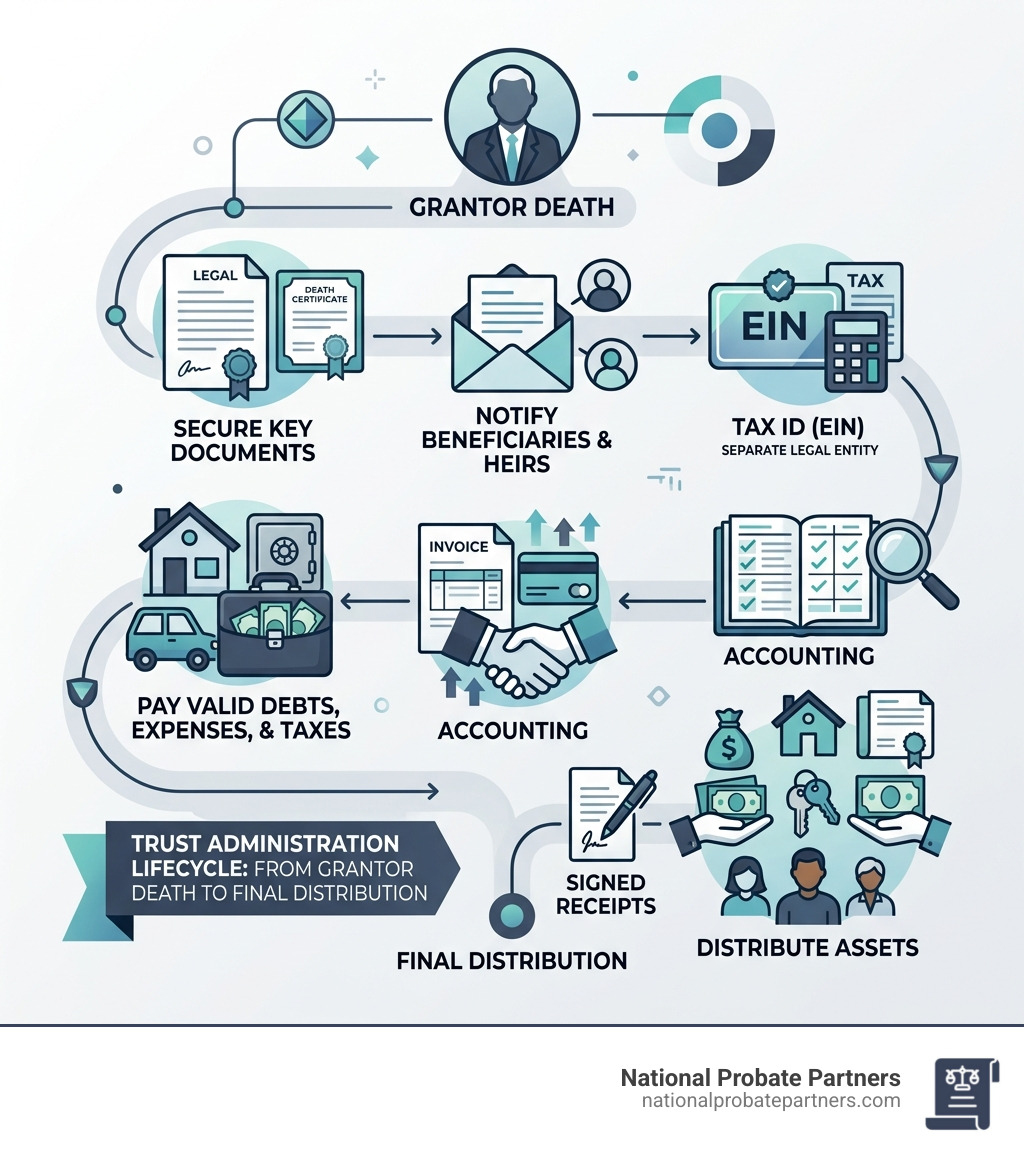
A trust administration guide is a step-by-step roadmap for successor trustees who must manage and distribute a trust’s assets after the grantor passes away. If you’ve just been named a successor trustee, here’s a quick overview of what the process involves:
- Secure key documents — Obtain death certificates and locate the original trust
- Notify beneficiaries and heirs — Required within 60 days in California
- Get a Tax ID (EIN) — The trust becomes a separate legal entity at death
- Inventory and value assets — Establish date-of-death values for every asset
- Pay valid debts, expenses, and taxes — Before any distributions are made
- Provide a formal accounting — Give beneficiaries a full record of trust activity
- Distribute assets — Follow the trust’s instructions and collect signed receipts
When a loved one dies, grief doesn’t wait for paperwork. But as a successor trustee, the legal and financial responsibilities start immediately — whether you feel ready or not.
Trust administration is the private, court-free process of carrying out a trust’s instructions after the grantor’s death. Unlike probate, it happens outside the public record. But that doesn’t mean it’s simple. Trustees take on serious fiduciary duties — meaning the law holds them personally accountable for how they manage assets, communicate with beneficiaries, and follow the trust’s terms.
For many first-time trustees, the hardest part isn’t the paperwork. It’s not knowing what comes first, what deadlines matter, and what mistakes could expose them to personal liability.
This guide breaks the entire process down into clear, manageable steps — so you can fulfill your role with confidence, protect yourself legally, and honor your loved one’s wishes.
Understanding Trust Administration and the Fiduciary Role
To navigate this journey, we first need to speak the language of trusts. At its core, trust administration involves four key players. The Grantor (or Settlor) is the person who created the trust and put their assets into it. The Trustee is the person managing those assets. While the Grantor is alive and healthy, they usually serve as their own trustee.
However, once the Grantor passes away or becomes incapacitated, the Successor Trustee steps in. That is likely you. Your job is to manage the trust for the Beneficiaries—the people or organizations destined to receive the assets.
Stepping into this role means you are now a fiduciary. This isn’t just a fancy title; it is the highest standard of care recognized by the law. As a fiduciary, you must adhere to several core duties:
- Duty of Loyalty: You must act solely in the interest of the beneficiaries. No “self-dealing” allowed—you cannot use trust assets for your own benefit or favor your own interests over those of the heirs.
- Duty of Impartiality: If there are multiple beneficiaries, you cannot play favorites. You must treat them all fairly according to the trust’s instructions.
- Prudent Investor Rule: You must manage the trust’s investments as a “prudent person” would, seeking to preserve capital while generating reasonable income. You can’t bet the trust fund on the latest “meme stock” or a risky business venture.
It is also vital to understand the type of trust you are handling. Most people start with a Revocable Trust, which can be changed at any time by the Grantor. However, the moment the Grantor passes away, that trust typically becomes Irrevocable. This means the “rules” are now set in stone, and the trust becomes its own legal and tax entity. For a deeper dive into these responsibilities, you can explore A Guide to Trust Administration – Wealth Counsel.
Failure to uphold these standards can lead to serious legal consequences. Understanding the risks is the first step toward avoiding them, as detailed in our resource on Understanding Breach of Trust and How to Protect Your Assets.
Defining the Successor Trustee’s Legal Obligations
Your legal authority as a successor trustee comes directly from the trust document and state law. You don’t usually need a judge to “appoint” you (unlike an executor in probate), but you do need to prove your authority to banks and institutions using a “Certification of Trust.”
Your primary obligations include:
- Asset Protection: You must keep trust property safe. This might mean changing the locks on a house, ensuring insurance policies are active, or moving funds into secure, trust-titled accounts.
- Record-keeping: You must track every penny. Every expense paid, every dividend received, and every distribution made must be documented.
- Disclosure Requirements: Beneficiaries have a right to know what is happening. You are legally required to keep them “reasonably informed.”
For those serving in the military or managing assets for service members, there are often additional layers of complexity regarding residence and federal protections. Resources like Estate Planning Information for the Military provide specialized context for these unique situations.
The Step-by-Step Trust Administration Guide for Successor Trustees
In California and many other states, trust administration follows a structured legal timeline. While the process is designed to be faster than probate, it is governed by strict codes—specifically the California Probate Code—that dictate when and how you must act.

Initial Steps in Your Trust Administration Guide
The first 60 days are a whirlwind. Here is how we recommend you handle the immediate aftermath:
- Order Death Certificates: You will need more than you think. We suggest ordering at least 10 to 15 certified copies. Banks, life insurance companies, and the County Recorder will all want originals.
- The 60-Day Notice: Under California Probate Code Section 16061.7, you must formally notify all beneficiaries and “heirs-at-law” (even those not mentioned in the trust) that the trust has become irrevocable and that you are the trustee. This notice starts a 120-day clock for anyone wishing to contest the trust.
- Acquire an EIN: Since the trust is now its own legal entity, it can no longer use the decedent’s Social Security number. You must apply for a Federal Tax ID number (Employer Identification Number) from the IRS.
- Open Trust Bank Accounts: Never, ever put trust money into your personal bank account. Open new accounts titled in the name of the trust using your new EIN.
- Marshaling and Securing Assets: This is the “treasure hunt” phase. You need to identify everything the trust owns.
- Real Property: Secure the home. If it’s vacant, make sure the utilities stay on and the yard is maintained to prevent it from looking abandoned.
- Valuation: You must establish the “Date-of-Death Value” for every asset. This is critical for the Stepped-up Basis. Essentially, when beneficiaries eventually sell an asset (like a house), their capital gains tax is calculated based on the value on the day the Grantor died, not what the Grantor originally paid for it. This can save the family thousands in taxes!
For a detailed look at how to track these values and manage the books, refer to The Essential Trust Administration Accounting Handbook for Modern Fiduciaries.

Managing Taxes and Creditor Claims
Before the beneficiaries get their checks, Uncle Sam and the creditors get theirs. As trustee, you are responsible for filing the decedent’s final income tax return (Form 1040) for the year they passed away.
Additionally, if the trust earns more than $600 in income after the death (from interest, dividends, or rental income), you must file a Form 1041 (Fiduciary Income Tax Return). For very large estates—those exceeding $13.61 million in 2024/2025—you may also need to file a Federal Estate Tax Return (Form 706).
Regarding creditors, while trusts don’t have the same formal “creditor claim” period as probate, you still have a duty to pay valid debts. We often recommend setting aside a “tax reserve”—a chunk of money held back from distribution until you receive the final “closing letter” from the IRS or state tax board.
Finalizing the Process: A Trust Administration Guide to Distributions
Once debts are paid and assets are liquidated (or prepared for transfer), it’s time for the final act. But don’t just hand out the jewelry and cash yet!
You must provide a Trust Accounting to the beneficiaries. This report shows the starting balance, all income, all expenses, and the final amount to be distributed. To protect yourself, you should ask each beneficiary to sign a Receipt and Release. This document confirms they received their share and “releases” you from further liability.
Administration Timelines
| Estate Complexity | Typical Duration | Major Milestones |
|---|---|---|
| Simple Estate | 6–9 Months | Notice, Inventory, Final Tax Return, Distribution |
| Standard Estate | 9–18 Months | Real Estate Sale, Creditor Negotiations, Accounting |
| Complex Estate | 18+ Months | Estate Tax Filings (Form 706), Business Valuation, Disputes |
Avoiding Common Pitfalls and Legal Disputes
Even with the best intentions, trustees can stumble. Here are the most common “landmines” we see:
- Commingling Funds: Mixing trust money with your own is the fastest way to get sued. Keep everything separate.
- Communication Gaps: Silence breeds suspicion. If beneficiaries don’t hear from you for three months, they assume you’re spending the money in Vegas. Send regular updates.
- Missing the “Heggstad” Opportunity: Sometimes a Grantor forgets to put a house or account into the trust. In California, a “Heggstad Petition” (Probate Code 850) might allow you to get that asset into the trust without a full probate, provided there is written intent.
- Skipping Appraisals: Don’t guess what the house is worth. Hire a professional appraiser. If you sell the house to your cousin for a “good deal,” other beneficiaries can sue you for the difference in market value.
If tensions rise, consider mediation before heading to court. It’s cheaper, faster, and keeps the family drama out of the public record. For more on the legal nuances of these challenges, see Beyond Probate: The Role of a Trust Administration Lawyer.
Trust Administration vs. Probate: Key Differences in California
We are often asked why people bother with trusts at all. The answer usually comes down to three things: privacy, speed, and cost.
- Privacy: Probate is a public court proceeding. Anyone can look up what you inherited and what debts the estate had. Trust administration is private.
- Court Intervention: In probate, the judge must approve almost every major move. In trust administration, you (the trustee) have the power to act independently, provided you follow the trust document.
- Distribution Speed: While probate often drags on for 12 to 24 months due to court backlogs, a simple trust can often be settled in under a year.
To see a side-by-side comparison of these two paths, check out Trust vs. Probate: What’s the Difference and Why It Matters.
Frequently Asked Questions about Trust Administration
How long does the trust administration process typically take in California?
For a straightforward estate with a single home and a few bank accounts, you’re looking at 6 to 12 months. The mandatory 120-day “contest period” following the initial notice accounts for a large portion of that time. If you have to sell real estate, resolve complex tax issues, or deal with a litigious sibling, it can easily stretch to 18 months or longer.
When should a trustee hire a trust administration attorney?
We recommend consulting an attorney immediately upon the Grantor’s death. Even if you don’t hire them for the full process, a “consultation” ensures you don’t miss the 60-day notice deadline. You definitely need an attorney if:
- The trust owns a business or multiple real estate properties.
- A beneficiary has threatened to sue.
- The trust document is poorly written or ambiguous.
- You are worried about your own personal liability.
Reasonable attorney fees are generally paid out of the trust assets, not your own pocket.
Can a trustee be personally liable for mistakes made during administration?
Yes. If you breach your fiduciary duty—whether through “self-dealing,” gross negligence, or simple mismanagement—beneficiaries can file a surcharge action. This is a lawsuit asking the court to make you pay for the losses out of your own personal funds. This is why following a trust administration guide and keeping meticulous records is so vital.
Conclusion
Stepping into the role of a successor trustee is a profound act of service. It requires a steady hand, a sharp eye for detail, and a compassionate heart. While the legal requirements can feel like a mountain of red tape, you are the bridge between a loved one’s legacy and their family’s future.
At National Probate Partners, we specialize in making this complex journey simple. Whether you are navigating the California Probate Code or managing an estate in Texas, we offer the personalized and compassionate guidance you need to resolve challenges efficiently. You don’t have to do this alone.
If you’re feeling overwhelmed by your duties or just want to ensure you’re checking every box, we invite you to learn more about how we can support you by reading Beyond Probate: The Role of a Trust Administration Lawyer. Let us help you protect the legacy you’ve been entrusted to manage.