
When a loved one passes away, the legal process of settling their estate is usually handled in the state where they lived. This is called the “domiciliary probate.” However, state laws are like bubbles—they only cover what is inside their own borders. A judge in Arizona or New York has no legal power to sign a deed for a house in Corpus Christi. This is where ancillary probate in Texas comes into play.
What is ancillary probate in Texas?
In simple terms, ancillary probate in Texas is a secondary court proceeding used to “domesticate” a foreign will. If a person lived and died in another state (the nonresident decedent) and their will was already proven valid there, the Texas court recognizes that foreign proceeding. Think of it as a legal “handshake” between two states. The Texas court accepts the findings of the home-state court and gives the executor the local authority needed to transfer or sell Texas-based assets.
When ancillary probate in Texas is required
You generally need to open an ancillary proceeding if the deceased person was not a Texas resident but owned property here that meets these three criteria:
- The property is “situs” to Texas: This means the asset is physically or legally located in Texas (like land or mineral rights).
- The property was owned solely in their name: If there is no “right of survivorship” or trust involved, the title is stuck.
- A transfer of title is necessary: To sell the property, clear a cloud on the title, or distribute it to heirs, a Texas court order is required to update the deed records.
Domiciliary probate vs. ancillary probate
It helps to think of domiciliary probate as the “home base” and ancillary probate as the “satellite office.” The home state handles the bulk of the work—identifying heirs, paying federal taxes, and managing bank accounts. The Texas ancillary court focuses strictly on the assets located within Texas.
| Feature | Domiciliary Probate | Ancillary Probate (Texas) |
|---|---|---|
| Location | Where the decedent lived | Where the Texas property is located |
| Purpose | Settle the entire estate | Transfer title to Texas assets |
| Will Status | Original will is filed and proven | Authenticated copies of the foreign will are filed |
| Authority | Broad power over personal property | Specific power over Texas real estate/minerals |
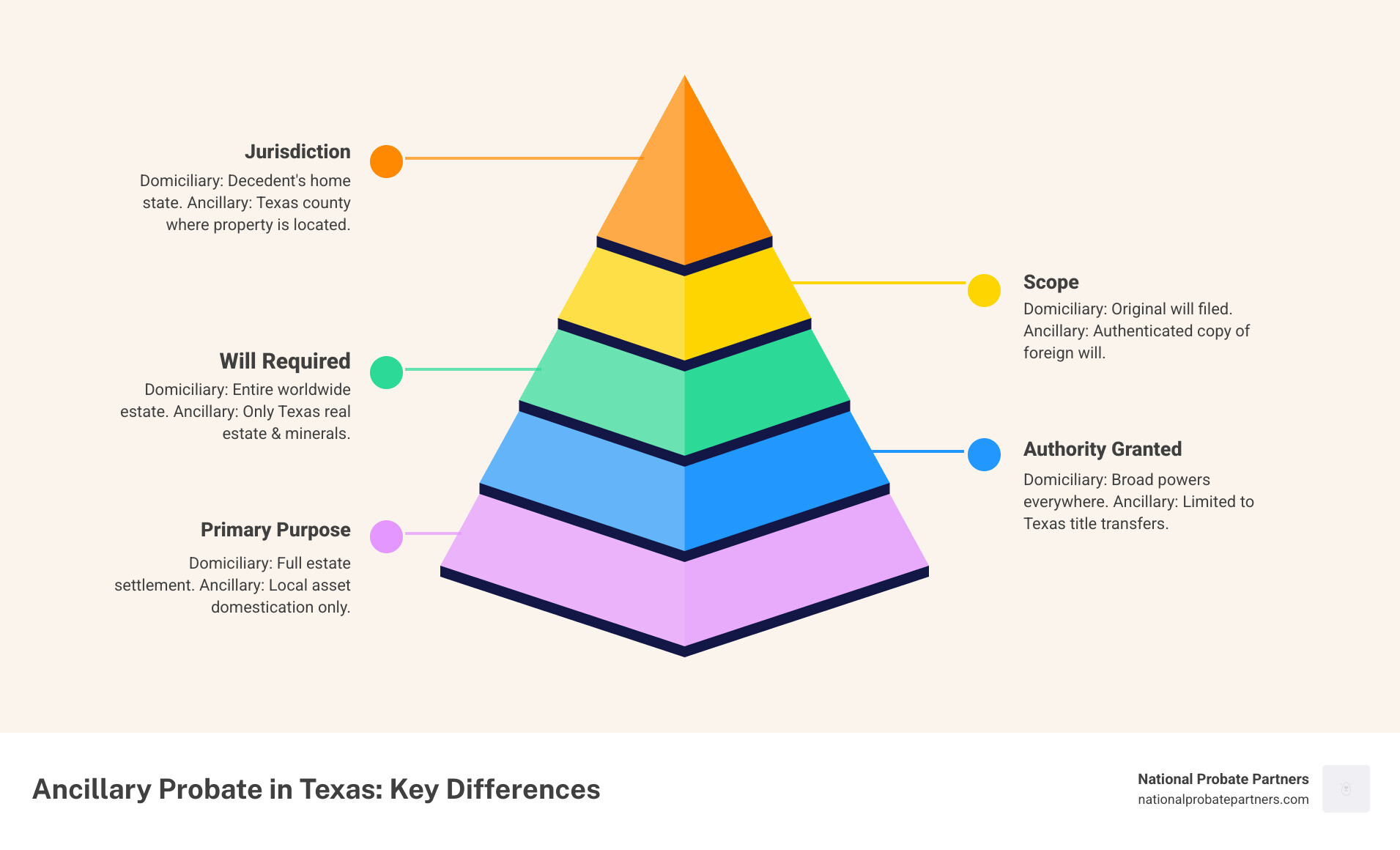
Which Texas Assets Trigger Ancillary Probate—and Which Do Not
Not everything a person owns in Texas requires a trip to the probate court. Texas law distinguishes between “tangible” property (like land) and “intangible” property (like a bank account).
Assets that usually trigger ancillary probate in Texas
The most common “triggers” we see at National Probate Partners involve real property. These include:
- Real Estate: Homes, condominiums in Galveston, vacation rentals, or hunting land.
- Mineral Rights: This is a big one in Texas. Oil and gas royalties, leasehold interests, and working interests are considered real property. Oil companies often refuse to pay out royalties to heirs until a Texas court order is recorded.
- Business Interests: If the decedent owned a physical business or a partnership interest in a Texas-registered entity that doesn’t have a buy-sell agreement or survivorship clause.
- Titled Vehicles: Boats, cars, or trailers titled in Texas without a designated beneficiary.
Assets that usually do not require ancillary probate
Generally, “movable” or intangible assets follow the person. If a Nevada resident had a bank account at a national bank with a branch in Dallas, the Nevada probate order is usually enough for the bank to release the funds. Other assets that typically bypass the Texas court include:
- Trust Assets: Property held in a Revocable Living Trust.
- Accounts with Beneficiaries: Life insurance or IRAs with named beneficiaries.
- POD/TOD Accounts: “Payable on Death” or “Transfer on Death” bank and brokerage accounts.
Title details that change the answer
How the deed is written matters immensely. If the deed says “Joint Tenancy with Right of Survivorship” (JTWROS) or “Community Property with Right of Survivorship,” the property may pass automatically to the survivor without any probate. However, if the property was held as “Tenants in Common,” the deceased person’s share must go through probate.
In some cases, an Affidavit of Heirship might be a cheaper alternative if the family is not planning to sell the property for at least two years, as most title companies require a two-year “waiting period” before they will insure a title based solely on an affidavit.

The Two Main Ways to Handle a Foreign Will in Texas
Texas is actually quite “friendly” toward foreign wills. Under the Texas Estates Code, there are two primary pathways to handle a will that has already been probated in another state.
Full ancillary administration: when active management is needed
This is a formal proceeding where the Texas court appoints an “ancillary representative” (usually the same person serving as executor back home). This is necessary if:
- There are unpaid debts in Texas that need to be settled.
- There is a need to recover property or “collect” assets from third parties.
- The estate is involved in a Texas-based lawsuit.
- The executor needs to actively manage a Texas business or mineral lease.
In this scenario, the court issues Ancillary Letters Testamentary, which give the executor the same powers in Texas that they have in their home state. You can learn everything you need to know about ancillary probate and how it differs from standard administration in our deeper guides.
Muniment of title: when a simpler route may work
If the only reason you are in a Texas court is to transfer the title of a house or mineral rights to the beneficiaries named in the will, and the estate has no unpaid debts (other than a mortgage), you may qualify for a Muniment of Title.
This is a streamlined process unique to Texas. Instead of appointing an executor and requiring a formal inventory, the court simply signs an order admitting the foreign will to probate as a “muniment” (evidence) of title. Once that order is recorded in the county deed records, the chain of title is officially linked to the new owners. It is faster, cheaper, and much less “paperwork-heavy.”
What documents are needed to file for ancillary probate in Texas?
To get started, you cannot just use a photocopy of the will. Per Texas Estates Code § 501.002, you must provide authenticated copies (often called “exemplified” or “triple-certified” copies). This requires:
- A copy of the will and the order admitting it to probate in the home state.
- An attestation by the court clerk.
- A certificate from the judge stating the clerk’s attestation is in proper form.
- A certificate from the clerk stating the judge is indeed the judge.
- The court’s official seal.
Step-by-Step Process for Filing Ancillary Probate in Texas
Navigating the Texas court system requires following a specific sequence. Missing a step can lead to “title gaps” that haunt the family years later when they try to sell the property.
Where to file and which court handles the case
You must file the application in the county where the Texas property is located. If the decedent owned property in multiple counties (for example, a house in Travis County and mineral rights in McLennan County), you generally file in one county, and then record certified copies of the final order in the deed records of the other counties.
Step-by-step ancillary probate in Texas process
- Hire a Texas Attorney: While it’s technically possible to file on your own, Texas courts almost always require an attorney to represent an executor.
- Gather Authenticated Records: Request the “triple-certified” packet from the home-state probate court.
- File the Application: Your attorney files the application for ancillary probate in the correct Texas county.
- Notice Posting: A notice is posted at the courthouse for about 10 days to allow anyone to contest the filing.
- The Hearing: In many uncontested ancillary cases, the judge can sign the order without a formal “live” hearing, or the hearing can be handled via Zoom.
- Issuance of Order/Letters: The court signs the order admitting the will. If it’s a full administration, the executor takes an oath and receives Letters Testamentary.
- Recording: The most critical step! The court order and the will must be recorded in the Official Public Records (Deed Records) of every county where the decedent owned land.
- Distribution: The property is officially transferred to the beneficiaries.
For more details on managing property in different jurisdictions, see the multi-state guide to probating property across state lines.
How long ancillary probate in Texas takes and what affects timing
In May 2026, the typical timeline for an uncontested ancillary probate is 4 to 6 months. Factors that can speed this up or slow it down include:
- Court Backlogs: Urban counties like Harris or Dallas may have longer wait times for hearing dates than smaller rural counties.
- Document Errors: If the “triple-certification” from the home state is missing a seal or a signature, the Texas court will reject it, forcing you to start the document request over.
- Creditor Claims: If a creditor files a claim against the Texas property, the case can stretch past the year mark.
Estimated costs in 2026
Budgeting is essential for executors. Based on current 2026 rates, here is what you can expect:
- Court Filing Fees: These vary by county. For example, Travis County is approximately $360, while McLennan County is closer to $435. Expect to pay between $360 and $550.
- Attorney’s Fees: Most firms, including National Probate Partners, offer flat fees for uncontested ancillary probate, typically ranging from $2,500 to $7,500 depending on the complexity.
- Representative Commissions: If a formal administration is required, the ancillary representative is entitled to a fee of up to 5% of assets collected and 5% of assets paid out (though this is often waived by family members).
No Will, Common Mistakes, and Ways to Avoid Ancillary Probate
What happens if there is no will at all? Or what if the family makes a mistake during the filing?
What happens if there is no will for a non-resident with Texas property?
If a nonresident dies “intestate” (without a will), the process is more complex. Texas courts use in rem jurisdiction to determine who the heirs are based on Texas intestacy laws—even if those laws are different from the home state. This requires a formal Proceeding to Determine Heirship, which involves appointing an independent attorney (an Attorney Ad Litem) to investigate the family tree. This is significantly more expensive and time-consuming than probating a foreign will.
Common mistakes to avoid in ancillary probate proceedings
- Filing in the wrong county: Filing where the decedent used to live rather than where the land is located.
- Failing to record the order: Thinking the court case is the end. If the order isn’t recorded in the deed records, the title isn’t clean.
- Ignoring Mineral Rights: Families often forget that a tiny royalty check from an oil company means there is real property that needs probating.
- Poor Coordination: Not ensuring the home-state executor and the Texas attorney are on the same page regarding tax filings and creditor notices.
How to avoid ancillary probate in the future
The best way to handle ancillary probate in texas is to make sure your heirs never have to deal with it. We recommend several tools to our clients:
- Revocable Living Trust: Title the Texas property in the name of a trust. Since the trust doesn’t “die,” no probate is needed.
- Transfer on Death Deed (TODD): Texas allows you to file a deed now that names a beneficiary who will automatically own the property the moment you pass away.
- LLC Ownership: For investment properties or mineral rights, holding them in an LLC can sometimes convert the asset into “intangible” personal property, which may be handled by the home-state probate.
Do you need a Texas attorney, and why?
Yes. Texas probate courts are specialized, and the rules of civil procedure are strict. A local attorney ensures that the “foreign” documents meet Texas standards and that the final orders are recorded correctly to protect the property’s value. Coordinating between two different legal systems is a challenge—our team at National Probate Partners specializes in this “bridge-building” to make the process as painless as possible. For more guidance, check out our Texas probate advice lawyer guide.
Frequently Asked Questions About Ancillary Probate in Texas
Can you sell Texas property before ancillary probate is completed?
Technically, you can sign a sales contract, but you cannot “close” and transfer the deed. A title company will not issue title insurance until they see a Texas court order. Most buyers will not wait 4 to 6 months for probate to finish, so it is best to start the ancillary process as soon as possible.
Is ancillary probate required for mineral rights in Texas?
Yes, almost always. Because mineral rights are considered real property, oil companies will “suspend” royalty payments upon learning of an owner’s death. They will only release those funds and update their “division orders” once they receive a recorded copy of a Texas probate order.
Can ancillary probate be opened in Texas if no home-state probate was filed?
Yes. If the decedent owned property in Texas but the family decided not to open probate in the home state (perhaps because all home-state assets were in a trust), you can file an Original Probate in Texas. The Texas court will treat it as a primary case for the Texas assets only.
Conclusion
Finding out you have to go through a second probate in another state can feel like a bureaucratic nightmare. However, ancillary probate in texas is a well-defined process designed to protect your rights to the property. Whether you are dealing with a family home in Corpus Christi or mineral interests in the Permian Basin, the key is to act quickly to secure the title.
At National Probate Partners, we help families nationwide navigate these Texas-sized challenges with compassion and local expertise. We can help you determine if you qualify for a streamlined Muniment of Title or if a full administration is necessary.
Your Texas Property Checklist:
- [ ] Locate the most recent deed to the Texas property.
- [ ] Obtain “triple-certified” copies of the will and probate order from the home state.
- [ ] Identify if there are any outstanding debts in Texas.
- [ ] Contact a Texas probate attorney to determine the best filing pathway.
If you are ready to clear the title to your Texas property and move forward, we are here to help. Reach out to us for a consultation, and let’s get this resolved efficiently. For more information on the process, read our guide on how to master ancillary letters testamentary across state lines.