
When a Loved One Dies in Arizona: What You Need to Know Right Now
Arizona estate law governs how a person’s property is managed, transferred, and distributed after death — whether or not they left a will.
Here is a quick overview of the key things to know:
- Governing statute: Arizona Revised Statutes (ARS) Title 14 covers all trusts, estates, and protective proceedings
- Probate types: Informal (uncontested) or formal (disputed) — informal typically takes 6 to 9 months
- No will? Assets pass to relatives in a fixed legal order called intestate succession
- Small estates: Personal property under $200,000 or real property under $300,000 may skip full probate
- No state estate tax: Arizona has no inheritance or estate tax; federal tax applies only to estates over $15 million (2026)
- Community property state: Assets acquired during marriage are split differently than separate property
- Non-probate transfers: Life insurance, retirement accounts, and payable-on-death accounts pass outside probate entirely
Settling an estate is hard enough emotionally. Add in court deadlines, creditor claims, and family disagreements — and it can feel completely overwhelming.
Arizona is one of the busiest probate states in the country. Over 1.4 million residents are aged 65 or older. The state sees roughly 65,000 deaths per year. Maricopa County alone processes more than 10,000 probate filings annually.
That volume means the courts move on a schedule — not yours. Missing a deadline or filing the wrong form can cost you months and thousands of dollars.
This guide breaks down Arizona estate law in plain language so you know exactly where you stand and what comes next.
Important Arizona estate law terms:
Navigating Arizona Estate Law: Key Provisions of ARS Title 14
If you want to understand how the Copper State handles your “stuff” after you’re gone, you have to look at the rulebook: Arizona Revised Statutes Title 14. This massive body of law covers everything from how to write a will to how to manage a multi-million dollar trust.
Specifically, Chapter 2. INTESTATE SUCCESSION AND WILLS is the heart of the matter. It sets the ground rules for who gets what. One of the most important concepts in Title 14 is “jurisdiction.” In Arizona, the Superior Court has the power to oversee estates. If the person who passed away lived in Scottsdale, the Maricopa County Superior Court is usually where the action happens.
Title 14 also demands transparency. There are strict notice requirements. You can’t just settle an estate in secret; you have to let heirs, devisees, and creditors know what’s going on. This is where fiduciary representation comes in. A “fiduciary” is someone (like a Personal Representative or Trustee) who has a legal duty to act in the best interest of the estate.
Understanding these rules is the first step in Understanding the Estate: What It Means for Your Legacy. Without a clear grasp of Title 14, it’s easy to get lost in the legal weeds.
The Probate Process: Informal vs. Formal Proceedings
In Arizona, probate isn’t a one-size-fits-all experience. Depending on how much the family gets along and whether there is a valid will, you’ll likely head down one of two paths.
Informal Probate is the “express lane.” It’s designed for estates where there is an original, valid will that no one is fighting over. There’s no need for a judge to sit through hearings; instead, a court registrar handles the paperwork. This is the most common route and usually the most affordable.
Formal Probate, on the other hand, is the “courtroom lane.” This happens if there’s a dispute—maybe someone thinks the will is a fake, or there’s a massive argument over who should be in charge. A judge or commissioner must make formal rulings to resolve these conflicts.
Then there is Supervised Administration. This is like “probate on a leash.” The court stays involved in every single step, and the Personal Representative can’t distribute a dime without the court’s explicit permission.
One of the biggest questions we hear is: How Much Does a Probate Lawyer Cost?. In Arizona, fees are generally “reasonable,” but formal, contested cases can get expensive quickly due to the extra court time and legal filings required.
Comparing Arizona Probate Proceedings
| Feature | Informal Probate | Formal Probate |
|---|---|---|
| When to Use | No disputes; valid original will | Contested will; missing heirs |
| Court Involvement | Minimal; handled by registrar | High; requires judge’s orders |
| Speed | Faster (6–9 months typical) | Slower (can take 12+ months) |
| Cost | Lower | Higher due to litigation |
| Creditors | 4-month notice period applies | 4-month notice period applies |
Small Estate Affidavits and Simplified Procedures
Not every death requires a trip to probate court. Arizona is actually quite generous with its “small estate” thresholds. If the estate is below a certain value, you can use an affidavit—a sworn legal document—to collect and distribute assets without a full court case.
As of May 2026, the thresholds are:
- Personal Property: If the total value is $200,000 or less, you can use an affidavit. You must wait at least 30 days after the death to file.
- Real Property (Real Estate): If the assessed value of Arizona real estate is $300,000 or less, you can use a small estate affidavit. However, you must wait at least 6 months after the death before filing.
These simplified procedures are a lifesaver for families trying to transfer a modest bank account or a small family home without spending thousands on legal fees.
Intestate Succession: Distribution Without a Will
What happens if you die without a will? In Arizona, the state has a “default will” for you. This is called Intestate Succession in Arizona. It’s a rigid formula that doesn’t care about your personal relationships—it only cares about legal bloodlines.
Arizona is a community property state. This means that generally, anything you and your spouse earned or bought during the marriage belongs to both of you 50/50. Separate property is what you owned before the marriage or received as a specific gift or inheritance.
Here is the breakdown of who gets what under Arizona estate law if there is no will:
- Spouse and Children from the same marriage: The spouse gets everything.
- Spouse and Children from a prior relationship: This is where it gets messy. The spouse keeps their half of the community property, but the decedent’s half of the community property and half of their separate property go to the children. The spouse only gets the remaining half of the separate property.
- No Spouse or Children: The estate goes to parents, then siblings, then more distant relatives.
Arizona also follows the 120-hour rule. To inherit, an heir must survive the decedent by at least five days. If they don’t, the law treats them as if they died first.
If the state searches and finds absolutely no living relatives, the property “escheats” to the state. Basically, the government gets it. This is rare, but it’s a great reason to make sure you have a plan in place.
Estate Planning Essentials: Wills, Trusts, and Nonprobate Transfers

The best way to keep your family out of the courtroom is to use tools that bypass probate entirely. These are called nonprobate transfers.
Common examples include:
- Beneficiary Designations: Naming a person on your life insurance policy.
- POD/TOD Accounts: “Payable on Death” for bank accounts or “Transfer on Death” for stocks.
- Joint Tenancy: If you own a house with a spouse as “Joint Tenants with Right of Survivorship,” the house passes to them automatically.
- Living Trusts: A trust is a separate legal entity that holds your assets. Because the trust doesn’t “die,” the assets inside it don’t go through probate.
When comparing a Trust vs. Probate: What’s the Difference and Why It Matters, probate is public and court-supervised, while a trust is private and usually much faster.
Requirements for a Valid Will Under Arizona Estate Law
If you decide to write a Last Will and Testament, you must follow specific rules for it to be legal in Arizona:
- Signature: The “testator” (the person making the will) must sign it.
- Witnesses: At least two people must witness the signing and sign the will themselves.
- Holographic Wills: Arizona recognizes handwritten wills! As long as the “material provisions” and the signature are in your own handwriting, it can be valid even without witnesses. (Though we usually recommend a formal version to avoid disputes).
- Self-Proved Wills: If you and your witnesses sign in front of a notary, the will becomes “self-proved.” This means the court doesn’t have to track down the witnesses years later to prove the will is real.
Trust Administration and Arizona Estate Law
If you use a trust, you’ll be following the Arizona Trust Code. This sets the duties for the Trustee—the person you put in charge. Trustees have a “fiduciary duty,” meaning they must be honest, loyal, and careful with the money.

Arizona also allows for directed trusts. This is a modern legal setup where you can split up the responsibilities. For example, you might have one person in charge of making investment decisions and another person in charge of handing out the money to the kids. However, under ARS §14-10808(B), the person following those directions is generally only liable if they act with “bad faith” or “reckless indifference.”
Protection of Digital Assets and RUFADAA
In 2026, our lives are more digital than ever. What happens to your Bitcoin, your social media accounts, or your 20 years of family photos stored in the cloud?
Arizona has adopted the Revised Uniform Fiduciary Access to Digital Assets Act (RUFADAA). This law allows you to give your Personal Representative or Trustee the legal authority to manage your digital world. Without this specific permission in your will or trust, tech companies (custodians) often refuse to grant access due to privacy laws. You can also use “online tools” provided by companies like Google or Apple to set your preferences in advance.
Protective Proceedings and Ancillary Administration
Sometimes, estate law isn’t about someone who has died—it’s about someone who is still here but needs help.
- Guardianships: Established for minors or incapacitated adults to handle their physical care and medical decisions.
- Conservatorships: Established to manage the finances and property of someone who cannot do it themselves.
Arizona follows the Uniform Adult Guardianship and Protective Proceedings Jurisdiction Act (UAGPPJA), which helps when a person moves between states.
Finally, there is ancillary administration. Imagine someone lived in Texas (where National Probate Partners is based) but owned a vacation condo in Scottsdale. Since a Texas court can’t give orders to Arizona real estate, a secondary, “ancillary” probate case must be opened in Arizona just to handle that condo. This involves appointing a “foreign personal representative” to manage the local assets.
Frequently Asked Questions about Arizona Estate Law
What happens to my house if I die without a will in Arizona?
If the house is only in your name, it will go through probate. If you have a spouse and all your children are from that marriage, the spouse usually gets the house. If you have children from a prior marriage, they may end up owning a portion of the house along with your spouse, which can lead to forced sales or complicated buyouts.
Can an unmarried partner inherit under Arizona intestacy laws?
No. Arizona law does not recognize “common law marriage” or provide inheritance rights to partners unless they are legally married. If you want your partner to inherit, you must have a will, trust, or beneficiary designation.
How long does the probate process typically take in Maricopa County?
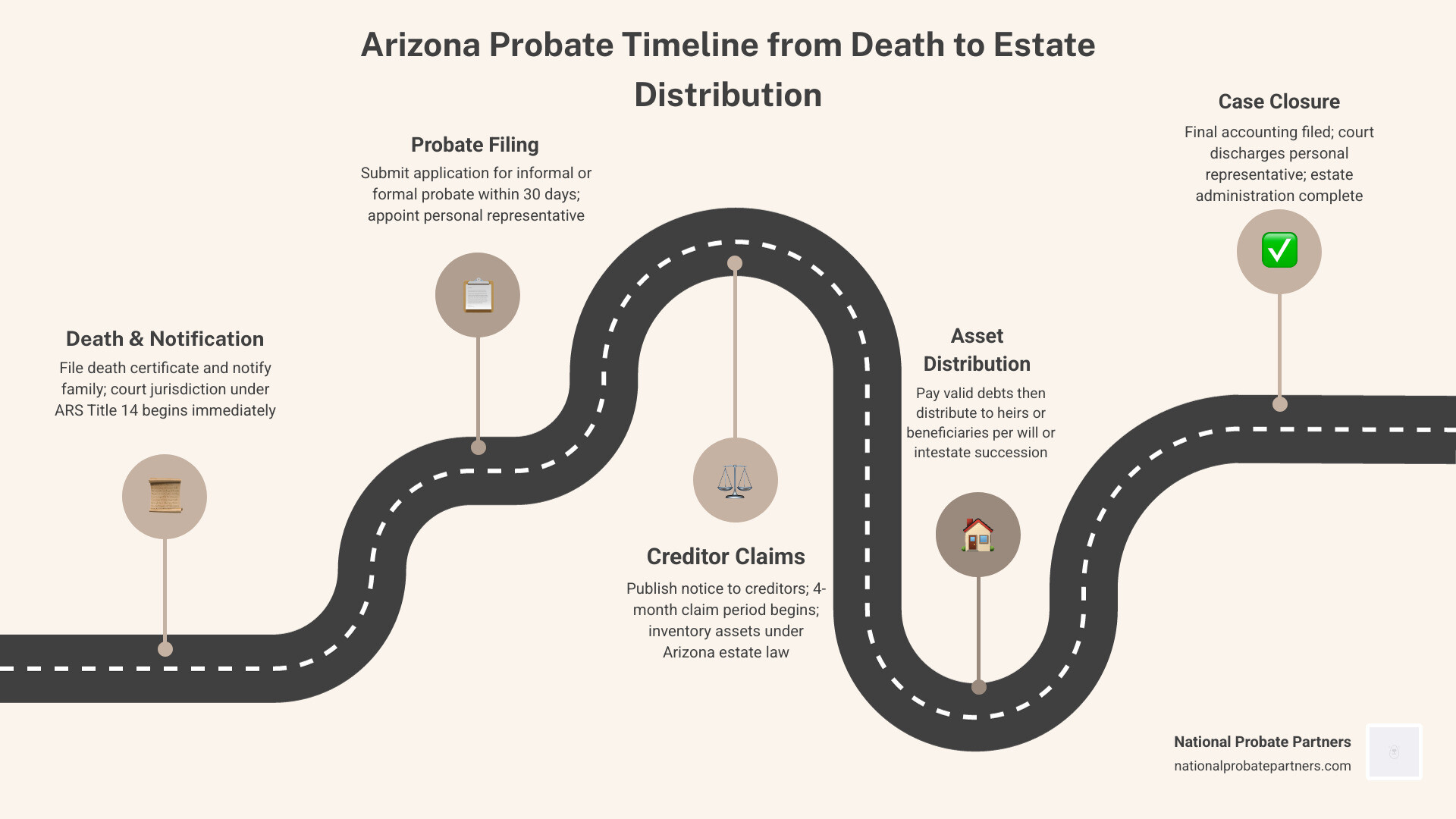
For a standard, uncontested informal probate, expect 6 to 9 months. This timeline is largely driven by the mandatory four-month creditor notice period, during which the estate must remain open to allow bill collectors to make claims. Formal or contested cases can easily last a year or longer.
Conclusion
Navigating Arizona estate law can feel like wandering through the desert without a map. Whether you are dealing with the loss of a loved one in Scottsdale or trying to protect your own legacy for the future, the rules are complex and the stakes are high.
At National Probate Partners, we specialize in taking the weight off your shoulders. From handling complex probate filings in Maricopa County to helping families avoid the court process altogether through smart estate planning, we offer the compassionate, personalized service you need.
If you’re feeling stuck, check out The Ultimate Probate Lawyer FAQ 2025 Edition for more answers to your burning questions. Ready to get started? We are here to help you resolve your probate challenges efficiently.