
When Do You Actually Need an Estate Litigation Attorney?
An estate litigation attorney is a lawyer who handles legal disputes that arise during the settlement of a deceased person’s estate. If you’re dealing with a contested will, a trustee who isn’t doing their job, or family members fighting over an inheritance, this is the type of attorney you need.
Here’s a quick summary of what an estate litigation attorney does:
- Represents executors, trustees, beneficiaries, or creditors in estate-related disputes
- Challenges or defends wills and trusts on grounds like undue influence or lack of mental capacity
- Pursues or defends breach of fiduciary duty claims against trustees or personal representatives
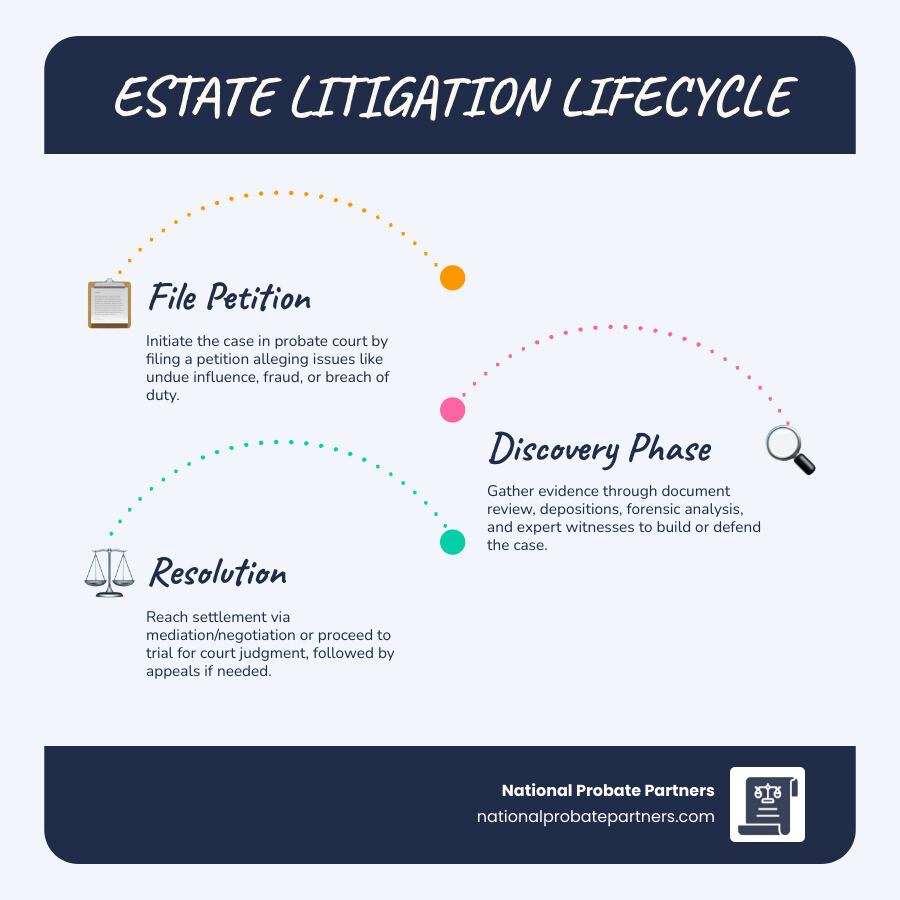
- Negotiates settlements, leads mediation, or takes cases to trial in probate court
- Protects vulnerable adults from financial exploitation by caregivers or family members
When a loved one passes away, the last thing most families expect is a legal battle. But disputes over estates are far more common than people realize — and far more damaging. They don’t just drain money. They destroy relationships.
The emotional weight of grief, combined with disagreements over property, missing assets, or a suspicious last-minute will change, can push even close families into court. As one legal insight from the research puts it plainly: problems in estate litigation are typically tied more to emotions than to business.
Estate disputes can range from a simple disagreement between siblings to a multi-million dollar challenge involving a 104-year-old woman’s fortune — a real case that was ultimately settled consistent with her wishes after a hard-fought legal defense.
Whether you’re an executor trying to carry out a loved one’s final wishes, a beneficiary who believes something isn’t right, or a trustee facing accusations of mismanagement — understanding what an estate litigation attorney does, and when you need one, is critical.
Estate litigation attorney further reading:
Why You Need an Estate Litigation Attorney for Complex Disputes

When we talk about estate litigation, we aren’t just talking about reading a will. We are talking about high-stakes advocacy. An estate litigation attorney serves as a vital shield for executors and trustees who are being unfairly sued, and a sword for beneficiaries who have been wrongfully disinherited.
In May 2026, the complexity of family structures—blended families, sibling rivalries, and second marriages—has made the role of a specialized litigator more important than ever. Unlike a general practitioner, a litigation specialist understands how to navigate the specific procedural rules of probate courts in places like Scottsdale, Arizona, or Corpus Christi, Texas.
These attorneys handle several critical roles:
- Executor/Trustee Representation: If you are an executor, you have a “fiduciary duty.” This means you must act in the best interest of the beneficiaries. If a beneficiary accuses you of “self-dealing” or mismanagement, an attorney defends your actions and protects you from personal liability.
- Beneficiary Rights: If you’ve been cut out of a will or if the person in charge isn’t giving you information, an attorney can file a petition to compel an accounting or even remove the person in charge.
- Third-Party Claims: Sometimes, the dispute isn’t between family members. It might involve a creditor claiming the estate owes them money or a business partner disputing the transfer of company shares.
For more insights into choosing the right professional, you can explore our Detailed Reviews of the Top 10 Probate Litigation Attorneys Near Me. Understanding the nuances of this role is the first step in protecting your inheritance.
Grounds for Challenging a Will with an Estate Litigation Attorney
Not every “unfair” will is illegal. To successfully challenge a will, you need specific legal grounds. In our experience, the most common reasons include:
- Undue Influence: This occurs when someone (often a caregiver or a “favored” child) exerts so much pressure on the testator that the will no longer reflects the testator’s true wishes. It often involves isolation and threats.
- Lack of Testamentary Capacity: The person making the will must be of “sound mind.” If they suffered from advanced dementia or were under the influence of heavy medication when they signed, the document may be invalid.
- Fraud or Forgery: This involves tricking someone into signing a document or simply faking their signature.
- Improper Execution: Every state has strict rules. For example, in Arizona and Texas, a will usually requires two competent witnesses. If these formalities aren’t met, the will might not hold up in court.
To dig deeper into these specific legal hurdles, read our guide: Is That Will Valid? Exploring the Grounds for a Contest.
When to Consult an Estate Litigation Attorney for Trust Breaches
Trusts are often used to avoid probate, but they aren’t immune to conflict. In fact, fiduciary litigation is a rapidly growing field. Because trusts are often managed privately for years, mismanagement can go unnoticed until it’s too late.
You should consult an estate litigation attorney if you suspect:
- Asset Mismanagement: The trustee is making risky investments or letting real estate fall into disrepair.
- Breach of Trust: The trustee is using trust money for their own expenses (self-dealing).
- Failure to Inform: The trustee refuses to provide a formal accounting or answer basic questions about the trust’s value.
We often see cases where a trustee believes they have a “right to privacy,” but the law is clear: beneficiaries have a right to know what is happening with their assets. For a full breakdown of your protections, see Understanding Breach of Trust and How to Protect Your Assets.
Alternatives to Trial: Mediation and Negotiation Strategies
While we are always ready for a “bench trial” (a trial where a judge, not a jury, makes the final ruling), we often find that the best outcomes happen outside the courtroom. Litigation is expensive and slow. Mediation is often the smarter path.
| Feature | Mediation | Bench Trial |
|---|---|---|
| Control | Parties decide the outcome | Judge decides the outcome |
| Privacy | Private and confidential | Public record |
| Speed | Can be resolved in a day | Can take 1-3 years |
| Cost | Relatively low | Very high (legal fees, experts) |
| Relationships | Aims to preserve family ties | Often destroys family ties |
Using “emotional intelligence” is a key strategy for any modern estate litigation attorney. Sometimes, a private family meeting or a structured settlement negotiation can resolve a grudge that has lasted for decades. If you’re curious about how these disputes are handled, check out Probate Disputes: What You Need to Know from a Probate Lawyer.
The Role of Neutral Mediators in May 2026
In May 2026, virtual mediation has become a standard tool for families spread across the country. A neutral mediator doesn’t take sides. Their job is to find the “middle ground” that everyone can live with. This is non-binding, meaning you don’t have to agree to the mediator’s suggestions, but it provides a safe space to vent frustrations and find financial solutions without the “winner-takes-all” aggression of a trial.
Leveraging Forensic Experts in Discovery
When a case does get serious, we don’t just rely on “he said, she said” testimony. We use meticulous discovery processes. This might include:
- Forensic Document Examiners: To determine if a signature on a holographic (handwritten) will is authentic.
- Medical Professionals: To review hospice records or doctor’s notes from the exact day a will was signed to determine mental capacity.
- Financial Auditors: To track “converted funds”—money that was moved out of a bank account just before someone passed away.
Navigating Probate Administration and Intestate Succession

Probate is the legal process of wrapping up someone’s life. If there is a will, the court validates it. If there is no will, the person has died “intestate.”
In intestate succession, the state decides who gets what. Generally, this prioritizes:
- Spouses
- Children
- Parents
- Siblings
If you are a member of the military or stationed overseas, navigating these state-specific laws in Arizona or Texas can be even more daunting. Resources like Military Legal Assistance & Services can provide initial guidance, but you will still need a local attorney to handle the specific probate filings.
Differences Between Administration and Litigation
It is important to understand that probate administration and probate litigation are two different things.
- Administration is the “paperwork” phase—filing the will, notifying creditors, and paying taxes.
- Litigation happens when someone objects to that paperwork.
Many people start in administration and suddenly find themselves in litigation when a “long-lost” relative appears or a sibling challenges the executor’s fees. For more on how to survive this transition, read The Chances of Successfully Contesting a Trust Without Losing Your Mind.
Handling Multi-State Estate Challenges
We live in a mobile society. It is common for someone to live in Scottsdale, Arizona, but own a ranch in Texas. This creates “ancillary probate,” where you have to open legal proceedings in two different states. A firm with national coordination capabilities can manage these hurdles so you don’t have to hire three different law firms.
Costs, Timelines, and Prevention Strategies
How much does it cost? How long does it take? These are the questions everyone asks.
Timelines: A simple, uncontested probate can take 6 to 9 months. However, once an estate litigation attorney gets involved in a contest, you are looking at 1 to 3 years. Costs: Litigation is usually billed hourly, and costs can escalate quickly during the “discovery” phase where depositions are taken.
Real-World Outcomes and Case Studies
The statistics from recent years show the scale of what is at stake:
- Tax Victories: One estate recently won an unprecedented federal gift tax case, avoiding $20 million in penalties.
- Fiduciary Accountability: A court awarded an estate $1 million after a respondent was found to have converted (stolen) the decedent’s funds.
- Investment Disputes: Trustees were successfully defended in a $20 million suit claiming they failed to diversify stock in a trust.
These cases prove that whether the estate is worth $50,000 or $50 million, having the right strategy matters.
Proactive Planning to Avoid Future Litigation
The best way to “win” a lawsuit is to never have one in the first place. This is called “defensive estate planning.”
- No-Contest Clauses: You can include a provision that says if a beneficiary challenges the will and loses, they get nothing.
- Clear Intent: Don’t just leave a house to “my kids.” Specify who gets the furniture, the jewelry, and the family dog.
- Regular Updates: If you get divorced or have a falling out with a child, update your documents immediately.
Frequently Asked Questions about Estate Disputes
How long does estate litigation typically take in 2026?
In 2026, while technology has sped up some filings, the court backlogs in major areas like Texas and Arizona mean that a contested case usually takes 18 to 36 months to reach a final judgment or settlement.
What are the most common triggers for a trust challenge?
The most common triggers are lack of transparency from the trustee and unequal distributions among siblings. When one child receives more than others without a clear explanation in the trust document, litigation is almost inevitable.
Can an executor be held personally liable for mistakes?
Yes. If an executor or trustee commits “malfeasance”—such as stealing funds, failing to pay estate taxes, or ignoring the terms of the will—the court can “surcharge” them. This means they have to pay the estate back out of their own pocket.
Get Legal Help from National Probate Partners
At National Probate Partners, we know that behind every case file is a family looking for closure. Whether you are in Scottsdale, Corpus Christi, or serving in the Armed Forces Pacific, we provide the personalized and compassionate service needed to resolve even the most complex inheritance disputes.
Estate litigation doesn’t have to be a never-ending battle. With the right estate litigation attorney, you can protect your loved one’s legacy and your own future. For more information on how we can help you navigate these challenges, visit our probate lawyer services page today.