
The Fastest Way to Settle a Small Estate Without Going to Court
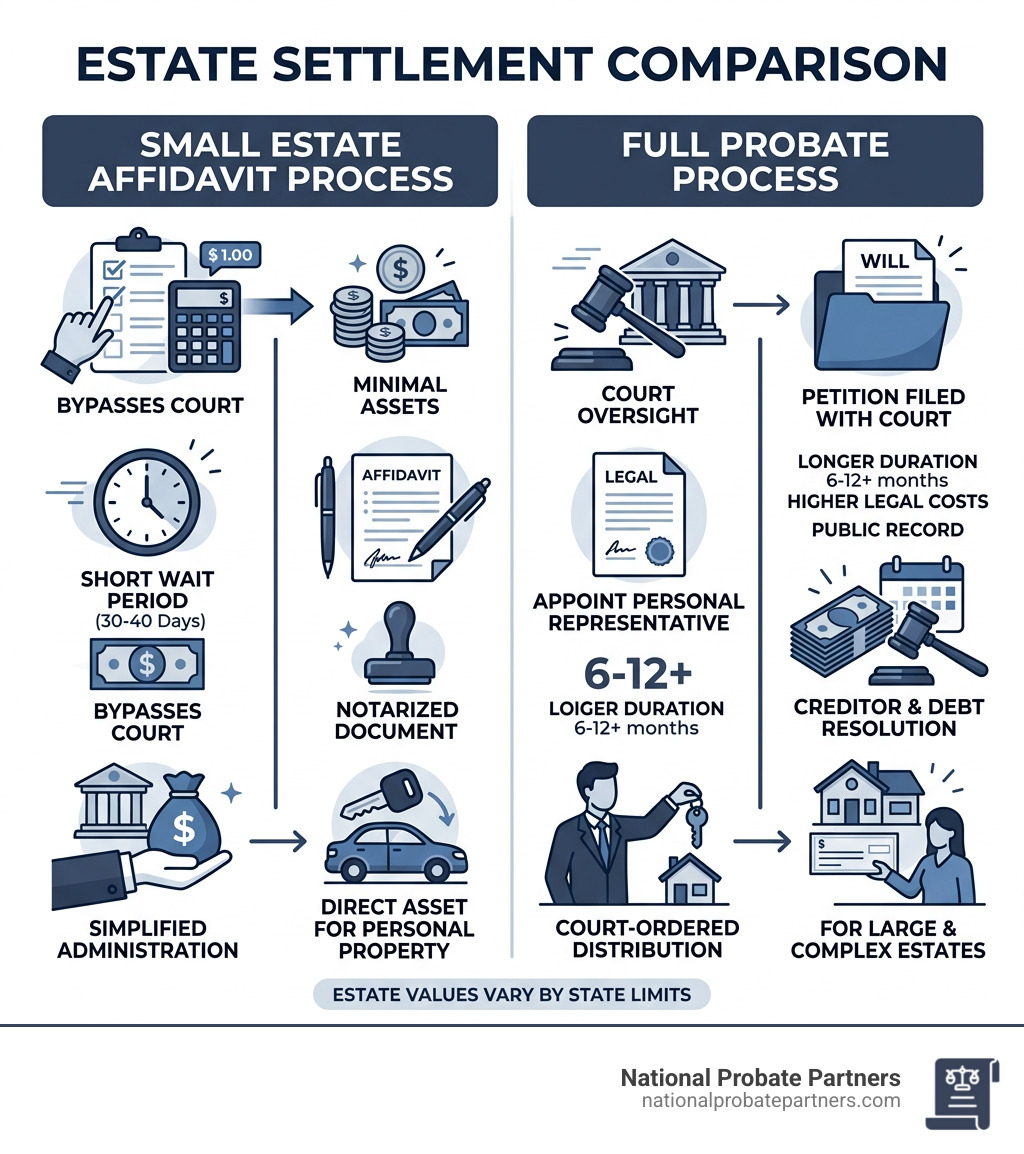
A printable small estate affidavit is a legal form that lets heirs claim a deceased person’s assets — without going through the full probate process.
Here’s how it works at a glance:
- Confirm eligibility — The estate must fall below your state’s value limit (typically $50,000–$150,000)
- Wait the required period — Usually 30–40 days after the date of death
- Download and complete the form — Fill in the decedent’s assets, debts, and heir information
- Get it notarized — Most states require a notary signature
- Present it to the asset holder — Banks, DMVs, or transfer agents release the assets directly to you
No court hearings. No probate attorney required (in most cases). Just a completed, notarized form.
Losing a loved one is hard enough. The last thing you need is months of court dates and legal fees just to transfer a bank account or a used car.
That’s exactly why the small estate affidavit exists — it’s one of the most practical shortcuts in all of estate law. Most states offer it, and millions of families use it every year to skip formal probate entirely.
But there’s a catch. Each state has its own rules. The form looks different. The dollar limits vary. Some states exclude real estate. Others require witnesses. Get it wrong, and you could face personal liability for the decedent’s unpaid debts.
This guide walks you through everything you need to know — from finding the right form to filling it out correctly and avoiding the mistakes that cause delays.
Understanding the Benefits of a Small Estate Affidavit
When we talk about settling an estate, most people immediately think of a judge in a robe and expensive legal battles. However, for many families, a printable small estate affidavit acts as a “legal fast-pass.” It is designed for simplified administration, allowing you to bypass the traditional probate court system entirely.
The primary benefit is speed. Traditional probate can take six months to two years. With a small estate affidavit, you are often looking at a matter of weeks. This is especially helpful when dealing with personal property, such as bank accounts, stocks, or the contents of a storage unit. According to the Small estate affidavit to transfer personal property | California Courts | Self Help Guide, this process is specifically designed for estates that don’t involve complex real estate holdings or massive wealth.

Another major advantage is cost. By avoiding court filings and the need for a court-appointed executor, you save thousands in administrative fees. However, you might still wonder, Do you really need a probate lawyer? Contact us for a free consultation! While the affidavit is DIY-friendly, legal heirship and intestate succession (who gets what when there is no will) can get complicated if the family doesn’t agree.
Comparison of State Limits and Waiting Periods
Every state has a threshold. If the estate is worth one dollar over that limit, you’re back in the traditional probate line.
| State | Monetary Limit | Waiting Period |
|---|---|---|
| Texas | $75,000 | 30 Days |
| Arizona | $75,000 (Personal) / $100,000 (Real Estate) | 30 Days |
| Illinois | $150,000 | No specific day-count (but must be “small”) |
| Washington | $100,000 | 40 Days |
Step-by-Step Guide to Completing Your printable small estate affidavit
Filling out the form is a bit like doing your taxes—it requires precision and a lot of gathering of paperwork. You cannot simply sign and go; you must be recognized as a “successor,” which usually means you are the surviving spouse, a child, or a named beneficiary.
First, you must respect the waiting period. Most jurisdictions require you to wait at least 30 to 40 days after the date of death before you can even file the document. This gives creditors a chance to come forward and ensures no one else has started a formal probate case.
Next, you’ll need to identify all heirs. This is where things can get sticky. If there is a will, it dictates the heirs. If there isn’t, state law decides. If you find yourself confused about who qualifies, you might ask, How do I know if I need a probate lawyer? to ensure you aren’t leaving anyone out.
Calculating the Total Value of the Decedent’s Estate
This is the most critical step. To use a printable small estate affidavit, the “fair market value” of the assets must be under the state limit.
- What to include: Bank accounts, vehicles, jewelry, and unpaid wages.
- What to exclude: Property that passes automatically to a survivor (like a joint bank account or a life insurance policy with a named beneficiary).
- Liens and Debts: In many states, you calculate the value based on the gross value, not the value minus the mortgage.
- Exempt Property: Items like a family homestead or a primary vehicle are often excluded from the total “probate value” in states like Texas.
Gathering Required Documents for Your printable small estate affidavit
Don’t head to the notary until you have your “evidence” folder ready. You will need:
- An original Death Certificate: Usually the “long form” showing the cause of death.
- Property Titles: Such as car titles or mobile home registrations.
- Vehicle Identification Numbers (VINs): Required for transferring titles at the DMV.
- Account Numbers: For any bank accounts or investment funds you are claiming.
For those looking for structured programs to help, the Small Estate Affidavit Program provided by some court systems offers a “DIY” computer program to help generate these forms, though we always recommend checking your local county clerk’s requirements first.
State-Specific Requirements and Monetary Limits
The rules of the road change depending on where the decedent lived. Jurisdiction and “venue” (the specific county where the paperwork is filed) are paramount. If the person lived in Corpus Christi, you file in Texas; if they lived in Scottsdale, you follow Arizona law.
Before you file, read through a Probate lawyer FAQ: What you need to know when hiring a probate lawyer to understand local court rules. Some counties require a filing fee, while others allow you to simply present the affidavit to a bank without filing it in court at all.
Filing a printable small estate affidavit in Texas vs. New York
In Texas, where National Probate Partners has a strong presence, the limit for a Small Estate Affidavit (SEA) is $75,000. Texas is unique because it allows the SEA to transfer the title of a homestead, but only if the homestead is the only real property in the estate and it is being transferred to a surviving spouse or minor child.
Texas also requires the signature of two “disinterested witnesses”—people who know the family but won’t inherit anything. You also have to account for Medicaid Estate Recovery Program (MERP) claims. You can find the specific form here: [PDF] Small Estate Affidavit | Texas Law Help.
In contrast, New York has a lower limit of $50,000. The process there is often referred to as a “Voluntary Administration.”
Understanding Illinois and Washington Thresholds
If you are dealing with an estate in Illinois, you have a much higher ceiling of $150,000. Illinois allows the affidavit to be used for both personal property and real estate in certain limited circumstances, though it is primarily used for bank accounts and vehicles.
Washington state sits in the middle with a $100,000 limit. Washington law requires a “ten-day rule” where you must provide written notice to all other heirs before you can claim the assets. They also have specific motor vehicle exclusions that can make the process smoother if a car is the only asset involved.
Common Pitfalls and When to Avoid the Affidavit Process
While we love the efficiency of a printable small estate affidavit, it isn’t a magic wand. There are several scenarios where using one is a bad idea—or legally impossible.
- Real Estate Exclusions: In most states (Arizona being a notable exception with its specific real property affidavit), you cannot use a small estate affidavit to transfer a house. If the decedent owned a home in their name alone, you’re likely headed to formal probate.
- Family Disputes: If siblings are fighting over who gets Mom’s jewelry, an affidavit is a recipe for a lawsuit. The person who signs the affidavit takes on personal liability. If you distribute assets incorrectly, the other heirs can sue you.
- Creditor Claims: If the decedent had $40,000 in the bank but $60,000 in credit card debt, the creditors are technically first in line. Using an affidavit to take the money and run can lead to creditors coming after your personal assets.
- Pending Probate: You cannot use an affidavit if someone has already applied for formal letters of testamentary in court.
If you find yourself in these “gray areas,” you should research How much does a probate lawyer cost? and Do you need a probate attorney? Unpacking their role. Sometimes, a little professional help upfront saves a mountain of legal trouble later.
Frequently Asked Questions about Small Estate Affidavits
How long is the required waiting period after death?
In Texas and Arizona, the 30-day rule is standard. You must wait 30 days from the date of death before the affidavit is valid. Washington requires 40 days. This “cooling off” period ensures that no one else has filed for formal probate and that the family has had time to locate a will if one exists.
Who is eligible to file as a successor?
The hierarchy usually starts with the surviving spouse. If there is no spouse, the adult children are next. In some cases, a “funeral creditor” (the person who paid for the burial) can file to be reimbursed, but this varies significantly by state. You must state under oath that you are entitled to the asset.
What happens after the affidavit is filed?
Once the affidavit is notarized (and filed with the court, if your state requires it), you take the document to the “asset holder.” This could be a bank manager, the DMV, or a stock transfer agent. By law, they are required to release the asset to you. The affidavit provides them with a “discharge of liability,” meaning the bank can’t be sued for giving you the money—the responsibility stays with you to distribute it correctly to other heirs.
Conclusion
Navigating the loss of a loved one is a heavy burden, and the legalities shouldn’t make it heavier. A printable small estate affidavit is a powerful tool for families in Texas, Arizona, and beyond to resolve estate matters quickly and with dignity. By understanding the limits, gathering your documents, and following state-specific rules, you can achieve a final distribution of assets without the stress of a courtroom.
At National Probate Partners, we specialize in helping families navigate these complex waters efficiently. Whether you are in Corpus Christi, Scottsdale, or serving abroad in the Armed Forces, we provide the compassionate, expert service needed to resolve probate challenges and help you avoid them in the future through smart estate planning.
If you’re feeling overwhelmed by the paperwork or aren’t sure if your loved one’s estate qualifies for this shortcut, reach out to us. We’re here to provide the peace of mind you deserve.
For more information or to start your process, visit National Probate Partners.