
What Is Probate Litigation — and Why It’s on the Rise
Probate litigation refers to any formal legal dispute that arises during the administration of a deceased person’s estate. These conflicts play out in probate court and can involve:
- Will contests — challenging whether a will is valid
- Trust disputes — questioning how a trust is being managed
- Fiduciary misconduct — holding executors or trustees accountable for mismanagement
- Beneficiary conflicts — resolving disagreements over asset distribution
- Contested guardianships and conservatorships — disputing who should manage a vulnerable person’s affairs
If you’re dealing with one of these issues right now, the short answer is this: you likely need to act fast, because strict deadlines apply in almost every state.
These disputes are becoming more common. Estate planning attorneys and probate judges across the country — including in states like Maine — have noticed a marked increase in probate litigation over the past decade. The reasons aren’t surprising. Blended families, second marriages, aging parents, and complex financial arrangements all create fertile ground for conflict when someone passes away.
The stakes are high on every level. Probate fights can drain an estate’s assets, fracture family relationships, and drag on for years. As one experienced probate litigator put it plainly: probate fights are nasty, exhausting, and expensive.
This guide walks you through everything you need to know — from the most common triggers and legal grounds, to the court process, your rights, and how to protect yourself.
Easy probate litigation word list:
Understanding the Grounds for Probate Litigation
When we talk about probate litigation, we aren’t just talking about a family disagreement over who gets the antique tea set. We are talking about a formal legal challenge to the validity of estate documents or the actions of the people in charge. To succeed in court, you cannot simply be “unhappy” with the outcome; you must have specific legal grounds.
Common grounds for a will or trust contest include:
- Lack of Capacity: Arguing the deceased (the testator) did not understand the nature of their assets or who their family members were at the time of signing.
- Undue Influence: Claiming someone used excessive persuasion to overcome the deceased’s free will.
- Fraud or Forgery: Proving the document was signed based on lies or that the signature isn’t authentic.
- Improper Execution: Showing the document wasn’t signed or witnessed according to specific state laws (like having two witnesses in Texas or Arizona).
- Duress: Proving the deceased was threatened into signing the document.
Common Triggers for Estate Contests
Why does probate litigation happen in some families and not others? Research shows that high-risk factors often involve complex family dynamics. Sibling rivalry is a classic trigger, especially when one child feels they did more “heavy lifting” as a caregiver.
Second marriages are another major flashpoint. If an individual marries multiple times without a prenuptial agreement, it often incites litigation between the new spouse and children from a previous marriage. Furthermore, “non-standard” estate plans—such as those that omit a child, treat children differently, or leave significant gifts to non-family members like mistresses or new caregivers—are far more likely to be challenged in court.
Proving Undue Influence and Capacity
Proving these cases in April 2026 requires more than just a “gut feeling.” For undue influence, courts look for four factors: the vulnerability of the victim (often due to age or illness), the influencer’s apparent authority, the tactics used (like isolating the senior from family), and an inequitable result.
In states like Arizona and Texas, medical records are gold. To prove a lack of capacity, we often look for evidence of cognitive decline, such as a diagnosis of dementia or Alzheimer’s, or medications that might have impaired judgment. It is important to note that in a will contest, the attorney-client privilege regarding the deceased’s intent is waived as a matter of law, meaning the drafting attorney’s notes can be used as evidence.
[TABLE] Comparing Will vs. Trust Contests
| Feature | Will Contest | Trust Contest |
|---|---|---|
| Primary Document | Last Will and Testament | Trust Agreement / Amendment |
| Court Venue | Probate Court | Probate or Civil Court |
| Common Deadlines | Often 120 days to 6 months after notice | Often 120 days after notice (e.g., CA/AZ) |
| Key Issue | Validity of the entire document | Interpretation or Trustee actions |
| Publicity | Public record through probate | Generally private unless litigated |
The Procedural Roadmap: Navigating the Court System
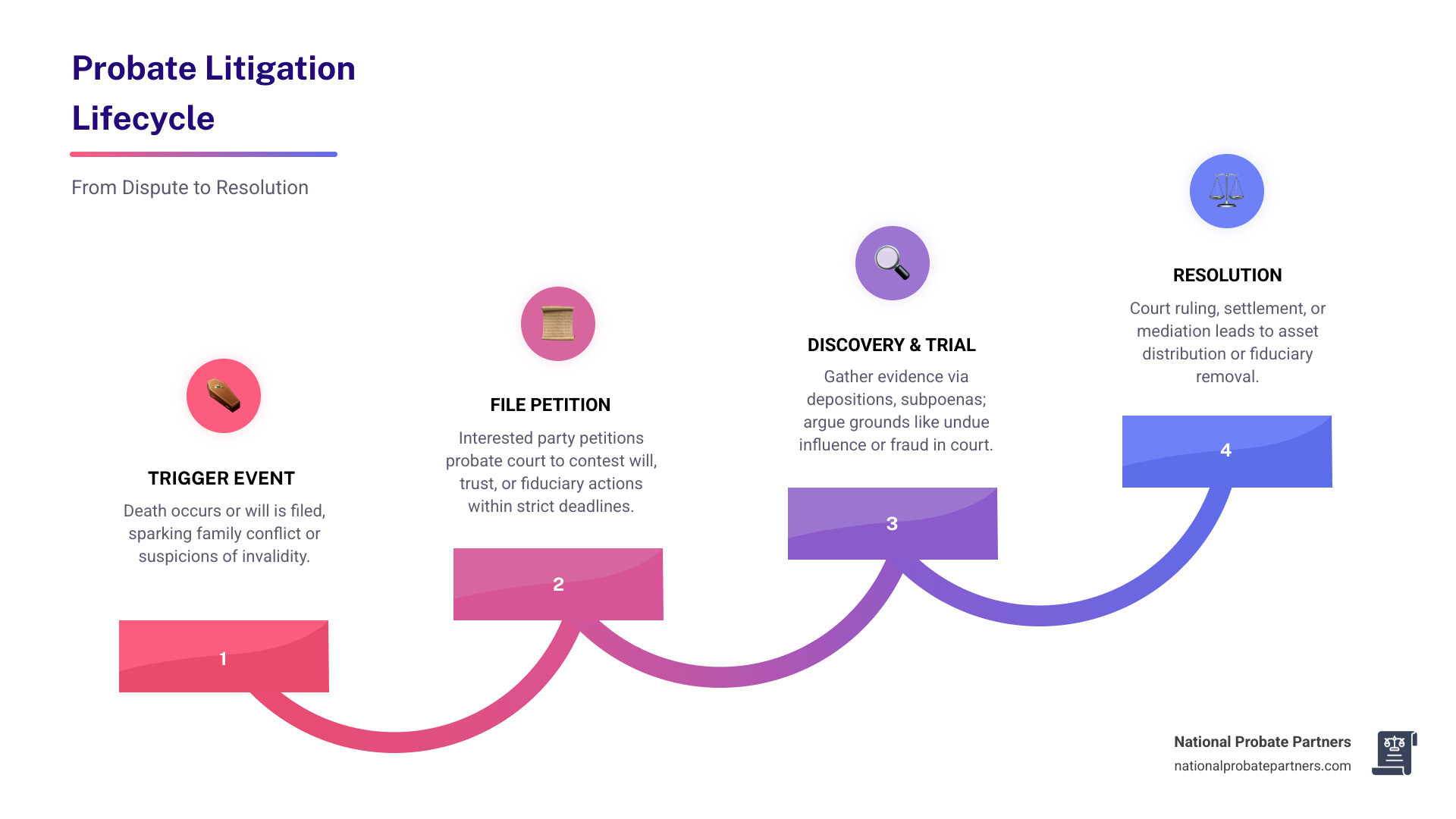
Once a dispute is identified, the probate litigation process moves into the formal court system. It isn’t a quick sprint; it’s more of a marathon with very specific hurdles.
- Initiation: The process begins by filing a petition or a formal objection in the appropriate court.
- Service: All “interested parties” must be legally notified.
- Answer: The opposing side (usually the executor or trustee) files a response.
- Discovery: This is the “fact-finding” phase.
- Dispositive Motions: Sometimes, a judge can decide a case early if the facts aren’t in dispute.
- Trial: If no settlement is reached, the case goes before a judge (or sometimes a jury) for a final ruling.
For more details on these steps, check out our guide on what you need to know from a probate lawyer.
Key Stages of Probate Litigation
The first hurdle is “standing.” Not just anyone can sue an estate. You must be an “interested person,” which typically means an heir (someone who would inherit if there were no will), a named beneficiary, or a creditor with a valid claim against the estate.
Deadlines and Statutes of Limitations
Time is your greatest enemy in probate litigation. Statutes of limitations are strict and vary by state:
- Texas & Arizona: Often, you have a limited window (sometimes as short as 120 days or 6 months) after a will is admitted to probate to file a contest.
- Trusts: Many states provide a 120-day window to challenge a trust after receiving a formal notice of its existence. If you miss these deadlines, you may be barred forever from bringing your claim, regardless of how strong your evidence is.
The Role of Discovery and Evidence
Discovery is where the “heavy lifting” happens. We use subpoenas to get bank records, medical files, and emails. We also conduct depositions—sworn out-of-court testimony—to lock in what witnesses remember.
A unique aspect of probate litigation is the handling of attorney-client privilege. While the privilege generally survives death, in many jurisdictions (like Michigan), it is held by the personal representative. However, when the deceased’s “testamentary intent” is at issue, courts often allow the drafting attorney to testify about what the client actually wanted.
Fiduciary Misconduct and Legal Remedies
Sometimes the will is fine, but the person in charge is not. Executors and trustees have a “fiduciary duty,” which is the highest legal standard of care. They must act with total loyalty and honesty toward the beneficiaries.
Breach of trust occurs when a fiduciary:
- Self-Deals: Sells estate property to themselves or a relative at a discount.
- Mimanages Assets: Leaves a house vacant and uninsured, or makes risky investments.
- Conflicts of Interest: Favors one child over another because of a personal relationship.
- Fails to Account: Refuses to show beneficiaries where the money is going.
Common Remedies in Probate Litigation
If we prove misconduct, the court has several “tools” to fix the situation:
- Fiduciary Removal: The court kicks the executor or trustee out and appoints a replacement.
- Surcharge Petitions: The court orders the fiduciary to pay money back into the estate out of their own pocket to make up for losses.
- Preliminary Injunctions: A judge can “freeze” assets so the executor can’t spend them while the lawsuit is pending.
- Trust Reformation: The court changes the terms of a trust to fix a mistake or clarify an ambiguity.
Mediation and Alternative Dispute Resolution
Most probate litigation cases actually settle before trial. Why? Because trials are expensive and public. Mediation—where a neutral third party helps the family reach a compromise—is often required by courts in places like Texas and Arizona. ADR (Alternative Dispute Resolution) is a powerful way to preserve what’s left of family harmony and keep the estate from being entirely consumed by legal fees.
Prevention Strategies: How to Avoid Future Disputes
The best way to win a probate fight is to never have one. Effective estate planning is about more than just a piece of paper; it’s about “litigation-proofing” your legacy.
Effective Estate Planning Tools
If you have a complex family—say, a blended family or a child with special needs—standard “off-the-shelf” forms won’t cut it.
- Prenuptial and Nuptial Agreements: These are the #1 way to prevent disputes between a second spouse and children from a first marriage.
- Life Insurance Trusts: These can provide immediate cash to a spouse while leaving the bulk of the estate to children, reducing the “tug-of-war” over assets.
- Clear Drafting: Ambiguity is the mother of all lawsuits. Using professional drafting ensures that “who gets what” is crystal clear.
Managing High-Risk Family Dynamics
If you know your children don’t get along, don’t name them as co-executors. This is a recipe for a deadlock that leads straight to court. Instead, choose a neutral professional fiduciary or a bank.
Also, consider “equalization.” If you give one child a house, give the other an equivalent amount in cash or life insurance. If you must disinherit someone, discuss it with an attorney about using a “no-contest clause,” which stipulates that if a beneficiary challenges the will and loses, they get nothing at all. For more on these tough choices, read our guide on who gets the kids and the cash.
Frequently Asked Questions
Who has standing to initiate probate litigation?
Only “interested parties” have legal standing. This includes legal heirs (people who would inherit by law if there were no will), beneficiaries named in the current or a previous version of the will, and creditors who are owed money by the deceased.
How long does the probate litigation process typically take?
A simple petition to remove an executor might take 3 to 6 months. However, a full-blown will contest involving medical experts and discovery typically takes 1 to 3 years. The timeline depends heavily on court backlogs and how much the parties are willing to fight.
What are the potential costs and risks involved?
The primary risk is estate depletion. Because legal fees for the executor are often paid out of the estate, a long fight can leave nothing for the heirs. There is also a massive emotional impact; probate litigation often ends sibling relationships permanently.
Conclusion
At National Probate Partners, we understand that behind every legal file is a family trying to navigate a difficult loss. Based in Texas and serving clients nationwide—with specific expertise in Scottsdale, Arizona and Corpus Christi, Texas—we provide the compassionate, personalized counsel needed to resolve these complex challenges.
Whether you are a beneficiary who has been unfairly cut out or an executor facing meritless accusations, we are here to help you protect your rights and your legacy.