
What Are Trust Beneficiary Rights — and Why They Matter
Trust beneficiary rights are the legal protections that entitle you to information, accountings, fair distributions, and accountability from the person managing a trust on your behalf.
Here’s a quick summary of the core rights most trust beneficiaries have:
- Right to information — You can request a copy of the trust document and receive updates on how assets are being managed
- Right to accounting — The trustee must provide regular financial reports showing income, expenses, and distributions
- Right to timely distributions — You’re entitled to receive what the trust promises, within a reasonable timeframe
- Right to impartial treatment — Trustees cannot favor one beneficiary over another
- Right to enforce trust terms — If the trustee isn’t following the trust document, you can take legal action
- Right to remove a trustee — If a trustee is mismanaging the trust, you can petition a court to have them replaced
A lot of beneficiaries don’t realize how much power they actually have. Many assume they simply have to wait — and hope — that the trustee does the right thing.
That’s not true.
We recently heard from a woman whose brother had taken over as trustee after their father died and their mother lost capacity. She had no idea whether the assets were being managed properly. She didn’t know what she was entitled to ask for, or whether she even had the right to ask.
She did. And so do you.
Whether you’re dealing with a slow trustee, missing accountings, or outright mismanagement, understanding your rights is the first step to protecting your inheritance.
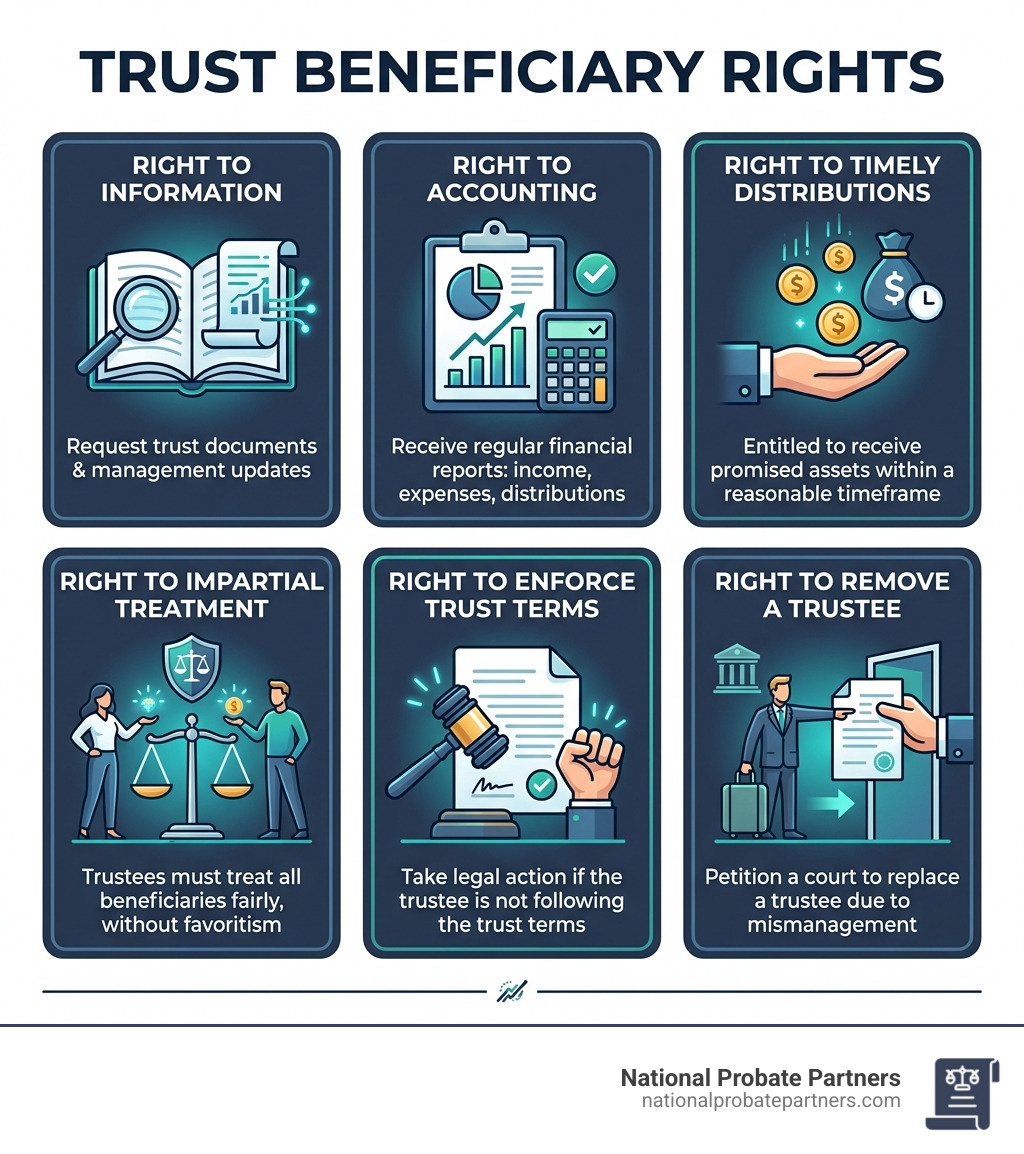
Trust beneficiary rights vocabulary:
Understanding the Different Types of Trust Beneficiaries
Not all beneficiaries are created equal in the eyes of the law—or the trust document. Depending on how the trust was written, your status determines when you get paid and what information you are entitled to receive.
Current vs. Remainder Beneficiaries
A current beneficiary (sometimes called a “primary” beneficiary) is someone currently entitled to receive income or principal from the trust. For example, if a trust says, “Pay my spouse all income for life,” the spouse is the current beneficiary.
A remainder beneficiary is the person who receives the assets after the current beneficiary’s interest ends. Using the same example, if the trust says the remaining assets go to the children after the spouse passes away, the children are remainder beneficiaries. While they don’t get money right now, they still have trust beneficiary rights to ensure the trustee isn’t blowing the inheritance on bad investments today.
Contingent Beneficiaries
These are the “backup” beneficiaries. You only become a beneficiary if a specific event happens—usually the death of a primary beneficiary. If you are a contingent beneficiary, your rights are often more limited until your interest “vests” (becomes real). However, you still have an interest in making sure the trust exists and is being managed according to the law.
Mandatory vs. Discretionary Interests
Some trusts are like a paycheck: the trustee must pay you $2,000 a month (a mandatory interest). Others are more like a request: the trustee may pay you for your “health, education, maintenance, and support” (a discretionary interest). If you have a discretionary interest, the trustee has more power, but they still must act reasonably and in good faith. You can learn more about how these roles differ from those in a will by reading The Named Beneficiary in a Will: Your Essential Guide.
The Core Trust Beneficiary Rights You Can Enforce

When we talk about enforcing your rights, we aren’t just talking about being “polite.” These are legal entitlements backed by state statutes in places like Arizona and Texas.
- The Right to Information: You cannot protect your interests if you don’t know what the trust says. In most jurisdictions, once a trust becomes irrevocable, you have a right to a copy of the trust document. This includes any amendments. If a trustee refuses to show you the “map” they are following, that is a massive red flag.
- The Right to an Accounting: You have the right to see the math. A trust accounting should show every penny that came in (income), every penny that went out (expenses and fees), and exactly what assets are left.
- The Right to Distributions: If the trust says you get a distribution at age 25, and you are 26, the trustee is late. You have the right to receive your inheritance according to the timeline set by the person who created the trust (the settlor).
- The Right to Impartiality: A trustee cannot play favorites. If there are three siblings, the trustee (who might be one of the siblings) cannot give themselves a low-interest loan from the trust while making everyone else wait for their check.
These protections are designed to keep the trustee on a tight leash. The trustee holds “legal title” to the assets, but they don’t own them—they are managing them for your benefit.
Revocable vs. Irrevocable Trusts: When Do Your Rights Begin?
Timing is everything. One of the most common questions we get at National Probate Partners is, “My dad has a trust; why won’t the trustee talk to me?”
The answer usually depends on whether the trust is revocable or irrevocable.
- Revocable Trusts: As long as the person who created the trust (the settlor) is alive and competent, they hold all the power. They can change the beneficiaries, move money out, or delete the trust entirely. During this time, the beneficiaries usually have no rights to information or accountings. The trustee’s only duty is to the settlor.
- Irrevocable Trusts: This is when trust beneficiary rights truly kick in. A trust typically becomes irrevocable when the settlor passes away or becomes mentally incapacitated. At that moment, the “beneficiaries-in-waiting” become “actual beneficiaries” with enforceable legal rights.
Understanding this transition is vital. If you are curious about how these structures differ from the standard court-supervised process, check out Trust vs Probate: What’s the Difference and Why It Matters. You can also find more general details on What Rights Does a Trust Beneficiary Have?.
Trustee Obligations: Notifications, Accountings, and Deadlines
Trustees have a lot of homework to do, and the law gives them strict deadlines. If they miss these, they could be held personally liable for a “breach of fiduciary duty.”
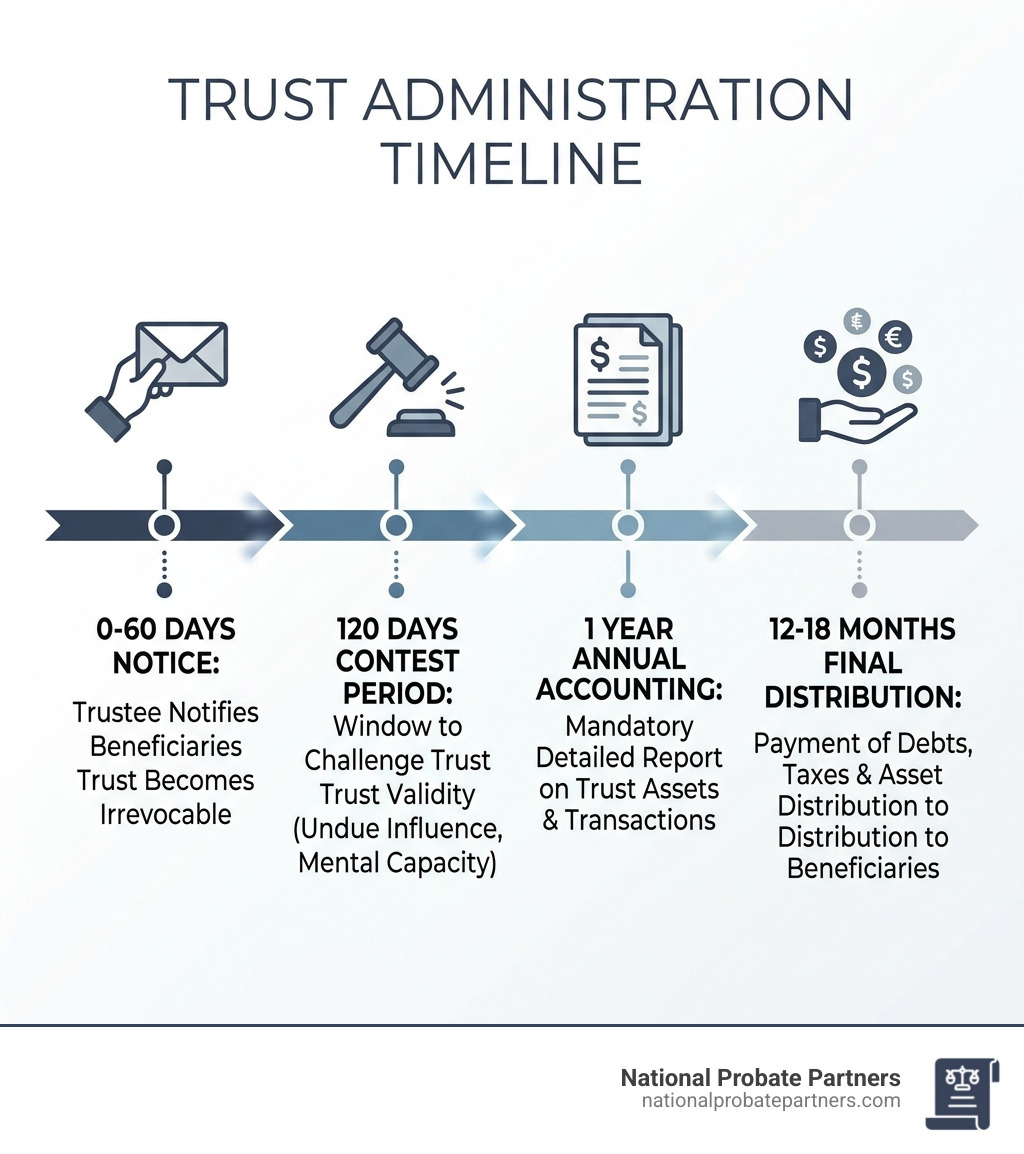
The 60-Day Notice
In many states, including Arizona and Texas, a trustee must notify the beneficiaries that the trust has become irrevocable within a specific timeframe—often 60 days (though this varies by state; for example, Michigan uses a 63-day window). This notice must include the trustee’s contact information and a statement that you have the right to request a copy of the trust.
The 120-Day Contest Period
Once you receive that formal notice, the clock starts ticking. In many jurisdictions, you have 120 days to contest the validity of the trust. If you think the settlor was under “undue influence” or lacked the mental capacity to sign the document, you must act within this window. If you wait, you may lose your right to challenge the trust forever.
Annual Accountings
Unless the trust document specifically waives it (and sometimes even if it does), trustees are generally required to provide an accounting at least once a year. This report must be detailed. We recommend reviewing The Essential Trust Administration Accounting Handbook for Modern Fiduciaries to see exactly what a “good” accounting looks like.
The 12-18 Month Timeline
While every trust is different, a typical trust administration takes between 12 to 18 months. This gives the trustee time to value assets, pay off any of the settlor’s debts, file tax returns, and handle the final distribution. If it’s been two years and you haven’t heard a peep, it’s time to start asking questions.
How to Handle Trustee Misconduct and Breach of Fiduciary Duty
A trustee is a “fiduciary,” which is a fancy legal way of saying they are held to the highest standard of honesty and care. Unfortunately, not every trustee is a saint. Common signs of misconduct include:
- Self-Dealing: The trustee buys trust property for themselves at a “discount” price.
- Commingling: The trustee mixes trust money with their own personal bank account.
- Improper Investments: The trustee puts the entire inheritance into a friend’s risky startup or a volatile cryptocurrency.
- Favoritism: The trustee pays for their own kids’ college out of the trust but denies your request for a medical emergency.
If you suspect this is happening, you have several remedies. You can ask for a surcharge, which forces the trustee to pay back the trust out of their own pocket for any losses they caused. You can also petition the court for trustee removal. To understand the gravity of these breaches, read Understanding Breach of Trust and How to Protect Your Assets. Sometimes, you need the help of a professional to step in; you can learn more at Beyond Probate: The Role of a Trust Administration Lawyer.
Enforcing Trust Beneficiary Rights Against a Non-Compliant Trustee
If a trustee is ignoring you, don’t just keep calling their cell phone. You need to create a paper trail.
- Written Request: Send a formal letter (certified mail is best) requesting the specific information or accounting you are owed. Cite the trust terms or state law.
- Formal Demand Letter: If the first letter is ignored, have an attorney send a demand letter. This often signals to the trustee that you are serious.
- Court Petition: If all else fails, you can petition the probate court to compel the trustee to act. The court can order them to provide an accounting, stop a specific sale, or even remove them from the role entirely.
- Forensic Accounting: If the numbers in the accounting don’t add up, you might need a forensic accountant to trace where the money actually went.
State-Specific Variations in Trust Beneficiary Rights
While many trust principles are universal, the specific “rules of the road” vary by state. Since National Probate Partners serves clients across the United States with a focus on Texas and Arizona, it’s important to know the local flavors of the law.
| Feature | Arizona | Texas |
|---|---|---|
| Notification Deadline | 60 days after accepting trusteeship | Reasonable time (often 60 days) |
| Accounting Requirement | Annual (unless waived) | Upon demand (at least every 12 months) |
| Contest Period | Generally 120 days after notice | Generally 2 years (statute of limitations) |
| Trustee Removal | Possible for breach or lack of cooperation | Possible for breach or “other cause” |
State-Level Variations in Trust Beneficiary Rights
In Arizona, the Trust Code provides very specific protections for “qualified beneficiaries.” Trustees must keep you “reasonably informed” about the administration. If they don’t, the court can be quite strict.
In Texas, the Trust Code is the primary authority. Texas is known for allowing “independent” administrations, which means less court oversight—but that actually makes your trust beneficiary rights more important, because you are the only one watching the trustee.
For our military families stationed at bases in Texas or Arizona, there are additional considerations. Military life involves frequent moves and unique asset structures like the SGLI.
Frequently Asked Questions about Trust Beneficiary Rights
Can a beneficiary sue a trustee for mismanagement?
Yes. If a trustee has breached their fiduciary duty—through negligence, theft, or even just extreme incompetence—you can sue them in probate court. You can seek to have them removed, have the court “surcharge” them (make them pay for losses), or even ask for “punitive damages” in extreme cases of fraud.
How long does a trustee have to distribute assets in April 2026?
There is no “one size fits all” answer, but the standard for 2026 remains “a reasonable time.” For a simple trust, this might be 6 to 12 months. For a complex estate with taxes and debt, 12 to 18 months is standard. If the trustee is holding onto money for years without a valid reason (like a pending tax audit), they may be in breach of their duties.
What should I do if the trustee refuses to provide a copy of the trust?
This is a major red flag. Under the laws of Arizona and Texas, once a trust is irrevocable, you are entitled to the portions of the trust that pertain to your interest. You should immediately send a written demand via certified mail. If they still refuse, you should contact a trust administration lawyer to file a petition with the court to compel production of the document.
Conclusion
Being a trust beneficiary shouldn’t feel like being a passenger in a car with a blindfolded driver. You have the right to see the map, check the speedometer, and—if the driver is reckless—take the wheel.
At National Probate Partners, we specialize in helping families navigate these complex waters. Whether you are in Scottsdale, Arizona, or Corpus Christi, Texas, our team provides the compassionate and experienced guidance you need to ensure your loved one’s final wishes are actually carried out. We handle everything from straightforward estate administrations to complex disputes involving trustee misconduct.
Don’t let your inheritance disappear due to a trustee’s silence or mismanagement. You have rights—let us help you enforce them. Contact us.